

Pakistan’s finance minister criticizes IMF’s treatment of his country, calls it ‘totally unfair’

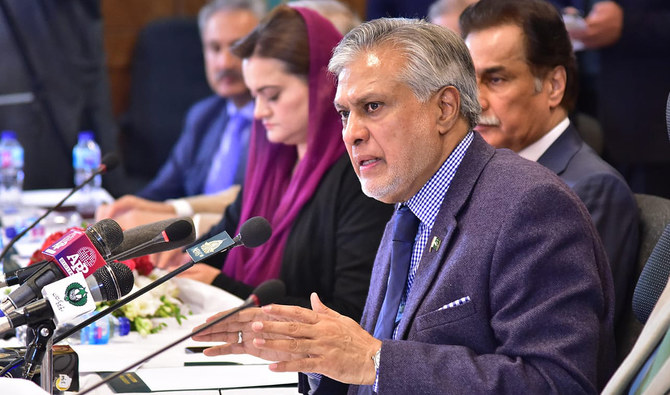
Pakistan finance minister Ishaq Dar gestures during a press briefing in Islamabad on January 4, 2023. (Photo courtesy: @FinMinistryPak/Twitter)
Short Url
Updated 09 June 2023
Follow

Pakistan’s finance minister criticizes IMF’s treatment of his country, calls it ‘totally unfair’

  • Ishaq Dar mentions geopolitics, asks global institutions like the IMF ‘not to corner Pakistan’
  • Finance minister says IMF was one of the main contributors to Pakistan’s economic turmoil

ISLAMABAD: Pakistan’s finance minister Ishaq Dar on Friday said the International Monetary Fund’s decision to delay the bailout program for the country was “totally unfair,” adding the global lender had also contributed to the economic turmoil in his country.

Dar presented the federal budget for the next fiscal year earlier in the day with a total outlay of Rs14.46 trillion ($50.4 billion). Prior to that, the government was holding negotiations with the IMF to unlock a stalled loan program which it desperately needed to shore up foreign currency reserves.

As the finance minister unveiled the country’s fiscal plan, analysts widely said the government’s tax collection targets were “unrealistic” while expressing fear that the international lending agency would not accept the budget.

Speaking to a local news channel, however, Dar said the IMF had no reason to object to the new budget since the numbers presented on Friday were “better than what the government had sent it during this week.” He added the “undue delay” by the IMF in signing the staff-level agreement with Pakistan had pushed the country toward economic turmoil.

“The IMF is one of the main contributors to the economic turmoil in Pakistan along with political instability,” he told Geo News. “This is geopolitics. I can’t say much on camera, but the ninth review [of the $6.5 billion loan program] should have been completed by February. Its delay was totally unfair treatment toward Pakistan.”

The minister maintained global institutions like the IMF should “not corner Pakistan.”

Asked if the lender was not releasing the funds due to trust issues it had developed with the country, he said that he blamed the policies of the previous, Imran Khan-led, government for sabotaging the deal with the IMF.

“The trust eroded because of the previous government’s antics,” he continued. “The previous regime made a sovereign commitment in 2019-20, but it failed to implement it. Whatever little [decisions] they implemented were also reversed. That’s what led the IMF to deal with us in this way.”

Prime Minister Shehbaz Sharif said earlier today Pakistan had not only accepted all conditions laid forth by the global lender but also implemented the prior actions that it required from the country.

“Still, the staff-level agreement has not been signed,” he said in a speech made before the cabinet ahead of the budget announcement. “Now, the matter will go to the IMF board for review.”

“We must hope that, as we have fulfilled all the conditions, the IMF ninth review will be completed this month after seeking approval from the lender’s board.”

Sharif added he had recently spoken to the managing director of the international lending agency over the phone and had asked her for “verbal” assurances related to the release of the next tranche.

“I suggested to her that if she provided me with a verbal commitment [regarding the signing of the agreement], we would take a few more steps the lender had asked for. Once we received the verbal commitment from her, we took those steps too, so now, no other [requirements] are left that could turn out to be an impediment in signing this deal.”


Pakistan weighs Trump Gaza board amid expert calls for Muslim allies’ consultations

Updated 39 min 29 sec ago
Follow

Pakistan weighs Trump Gaza board amid expert calls for Muslim allies’ consultations

  • Former diplomats warn board could sideline UN, legitimize US unilateral plans
  • Analysts say Pakistan should assert independent positions if it joins the body

ISLAMABAD: Pakistan is weighing an invitation from US President Donald Trump to join a proposed international “Board of Peace” on Gaza, a move that has sparked debate among former diplomats and foreign policy experts who warned Tuesday it could sideline the United Nations and urge Islamabad to consult close Muslim allies.

The White House announced on Friday some members of the board, which is expected to supervise the temporary governance of Gaza under a fragile ceasefire in place since October and continue beyond that transitional phase.

These names included US Secretary of State Marco Rubio, Trump’s special Middle East envoy Steve Witkoff, former British prime minister Tony Blair and Trump’s son-in-law Jared Kushner. Trump himself would chair the board, according to a plan unveiled by the White House in October.

Pakistan’s foreign office confirmed on Sunday that Prime Minister Shehbaz Sharif had also received an invitation to join the proposed body, stressing that “the country will remain engaged with international efforts for peace and security in Gaza, leading to a lasting solution to the Palestine issue in accordance with United Nations resolutions.”

“Since the Trump ‘Board of Peace’ is more like an international NGO now, which would include [Indian Prime Minister Narendra] Modi and [Israel’s Benjamin] Netanyahu, Pakistan should carefully take a decision in consultation with its close Muslim allies like Turkiye, Saudi Arabia, Qatar, Jordan, Egypt and Indonesia, and it should be a joint decision of these countries together,” Former federal minister and analyst Mushahid Hussain told Arab News.

“Otherwise, there is no point in being in the queue just to please Trump,” he added.

Israel and the Palestinian group Hamas have agreed that a Palestinian technocratic administration would operate under the oversight of an international board during a transitional period.

Hussain said that if Pakistan did decide to join the board, it should use the platform to clearly articulate its long-held positions.

“Pakistan should play the role of boldly promoting the right of self-determination of the peoples of Palestine and Kashmir, both occupied territories, and oppose any aggression against Iran, as peace and occupation or aggression cannot coexist,” he said.

International affairs analyst and author Nasim Zehra said Pakistan’s participation could still be justified if it allowed Islamabad to assert independent positions on global conflicts.

“Donald Trump has invited 60 heads of states and prime ministers to become part of the peace board, which is more like an alternative to the United Nations,” she said, referring to media reports about the board’s mandate. “If Pakistan is invited among 60 countries, it is acceptable for Pakistan to participate, and with a seat at the table, Pakistan can share its own view of how global issues can be resolved.”

Zehra added that Pakistan’s past diplomatic conduct showed it could maintain principled positions while engaging internationally.

Former ambassador to the United States Maleeh Lodhi took a stronger view, warning that the initiative appeared designed to bypass established international mechanisms.

“Pakistan should not join the Board for many reasons,” she said. “Its aim is for President Trump to get international support and legitimacy for his unilateral plans not just in Gaza but beyond, without member states having any real power.”

“It is being set up to supplant the UN in its primary role of maintaining international peace and security, with Trump effectively calling all the shots,” she added.

When contacted, Pakistan’s Defense Minister Khawaja Asif declined to comment and referred queries to the foreign office.

However, the foreign ministry spokesman Tahir Andrabi did not respond to Arab News requests for comment by the time of filing.

Pakistan has consistently supported Palestinian statehood under United Nations resolutions and has publicly criticized Israeli military operations in Gaza, while also opposing broader regional escalations, including attacks on Iran.