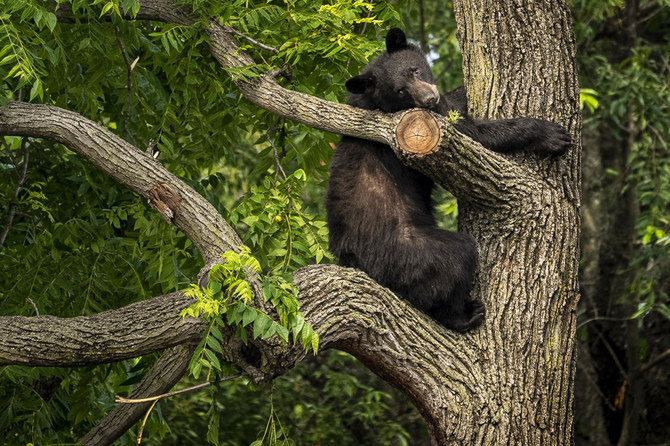
WASHINGTON: A young black bear gave residents of a quiet northeast Washington neighborhood a start Friday morning when they woke to find a furry interloper wandering backyards and sniffing around garbage cans.
Pictures of the bear and its capture touched off a frenzy on social media. It also spurred a healthy online debate as to whether to name it Franklin, for the street where he was captured, or Smokey — for both the iconic cartoon bear and as a testament to this particularly smoky week in Washington weather.
The bear was discovered roaming the Brookland neighborhood, less than 5 miles from the Capitol and White House. It prompted formation of a sort of ursine emergency task force including the Metropolitan Police Department, the local Humane Rescue Alliance, the Maryland Department of Natural Resources and the National Zoo.
Authorities formed a perimeter near the 1300 block of Franklin Street NE to keep curious onlookers away. When the young male bear climbed a tree, police used their sirens to discourage him from climbing down until capture crews were ready.
Undeterred by the noise, the bear came down around 10 a.m. and started wandering area yards. Humane Rescue Alliance staffers were able to tranquilize the approximately 200- pound animal and load it into a huge metal crate. The young male will now receive a medical check and be released back into the wild, “somewhere in Maryland,” said Chris Schindler, vice president of field services for the Humane Rescue Alliance.
Wildlife authorities had actually been tracking this particular bear for several weeks, spotting him most recently around nearby Hyattsville, Maryland. But the last bear-related mobilization like this in D.C. was at least five years ago.
“At this age, it’s natural for them to explore other areas,” said Schindler, who estimated the animal was a little more than a year old, “especially as wildlife continues to be pushed out of their natural areas by human construction.”
The bear would mostly likely not have been aggressive unless it was startled by humans or challenged by an particularly brave dog.
“Bears often do not want to engage with people,” Schindler said. “As long as people keep their distance and give them their space, it will be fine.”


Young black bear wanders Washington D.C. neighborhood, sparking a frenzy before being captured
https://arab.news/j8kuc
Young black bear wanders Washington D.C. neighborhood, sparking a frenzy before being captured

- Pictures of the bear and its capture touched off a frenzy on social media
- The bear was discovered roaming the Brookland neighborhood, less than 5 miles from the Capitol and White House


These shy, scaly anteaters are the most trafficked mammals in the world
CAPE TOWN, South Africa: They are hunted for their unique scales, and the demand makes them the most trafficked mammal in the world.
Wildlife conservationists are again raising the plight of pangolins, the shy, scaly anteaters found in parts of Africa and Asia, on World Pangolin Day on Saturday.
Pangolins or pangolin products outstrip any other mammal when it comes to wildlife smuggling, with more than half a million pangolins seized in anti-trafficking operations between 2016 and 2024, according to a report last year by CITES, the global authority on the trading of endangered plant and animal species.
The World Wildlife Fund estimates that over a million pangolins were taken from the wild over the last decade, including those that were never intercepted.
Pangolins meat is a delicacy in places, but the driving force behind the illegal trade is their scales, which are made of keratin, the protein also found in human hair and fingernails. The scales are in high demand in China and other parts of Asia due to the unproven belief that they cure a range of ailments when made into traditional medicine.
There are eight pangolin species, four in Africa and four in Asia. All of them face a high, very high or extremely high risk of extinction.
While they’re sometimes known as scaly anteaters, pangolins are not related in any way to anteaters or armadillos.
They are unique in that they are the only mammals covered completely in keratin scales, which overlap and have sharp edges. They are the perfect defense mechanism, allowing a pangolin to roll up into an armored ball that even lions struggle to get to grip with, leaving the nocturnal ant and termite eaters with few natural predators.
But they have no real defense against human hunters. And in conservation terms, they don’t resonate in the way that elephants, rhinos or tigers do despite their fascinating intricacies — like their sticky insect-nabbing tongues being almost as long as their bodies.
While some reports indicate a downward trend in pangolin trafficking since the COVID-19 pandemic, they are still being poached at an alarming rate across parts of Africa, according to conservationists.
Nigeria is one of the global hot spots. There, Dr. Mark Ofua, a wildlife veterinarian and the West Africa representative for the Wild Africa conservation group, has rescued pangolins for more than a decade, which started with him scouring bushmeat markets for animals he could buy and save. He runs an animal rescue center and a pangolin orphanage in Lagos.
His mission is to raise awareness of pangolins in Nigeria through a wildlife show for kids and a tactic of convincing entertainers, musicians and other celebrities with millions of social media followers to be involved in conservation campaigns — or just be seen with a pangolin.
Nigeria is home to three of the four African pangolin species, but they are not well known among the country’s 240 million people.
Ofua’s drive for pangolin publicity stems from an encounter with a group of well-dressed young men while he was once transporting pangolins he had rescued in a cage. The men pointed at them and asked him what they were, Ofua said.
“Oh, those are baby dragons,” he joked. But it got him thinking.
“There is a dark side to that admission,” Ofua said. “If people do not even know what a pangolin looks like, how do you protect them?”


