Saudi Arabia ‘poised for major global media role,’ says Telfaz11 CEO Alaa Fadan

1 / 2
As the streaming environment becomes more cluttered, audiences are looking for local, quality content making it ever more important for the Middle east to foster local talent, says the CEO. (Supplied)
2 / 2
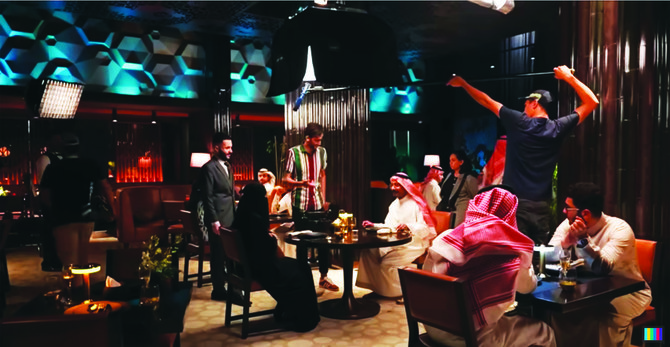
Saudi studio Telfaz11 and the Kingdom’s media production hub NEOM signed a deal this month to cooperate on at least nine TV and film productions over the next three years. (Supplied)
Short Url
Updated 10 June 2023
Follow

Saudi Arabia ‘poised for major global media role,’ says Telfaz11 CEO Alaa Fadan

  • Studio’s partnership with NEOM to see 9 nine TV and film productions in next 3 years

DUBAI: Saudi studio Telfaz11 and the Kingdom’s media production hub NEOM signed a deal this month to cooperate on at least nine TV and film productions over the next three years.

“We are thrilled to embark on this partnership with NEOM and to be part of their mission to create a new world-class media hub in Saudi Arabia,” Telfaz11’s CEO Alaa Fadan told Arab News recently.

The partnership “reemphasizes Telfaz11’s core vision and DNA of investing in the creative culture” and provides the company with “new opportunities for growth and innovation,” he added.

Two feature films and one TV series are already in development, and a few other projects have been identified as well, he said.

Telfaz11 has “a rich slate of projects mapped out for the next three years” and will work with NEOM to select which projects would be rolled out as part of the deal, Fadan said.

HIGHLIGHTS

Last year, the Saudi Film Commission announced the Daw funding program dedicated to supporting local productions and talent.

This year Saudi Arabia’s Cultural Development Fund launched a $234-million Film Sector Financing Program as well as a $100-million film sector fund to foster the growth of domestic media.

The Kingdom has made remarkable strides in recent years, driven by visionary initiatives focusing on developing the media and entertainment sectors, says the CEO.

In 2021, Saudi Arabia drew $238 million in box-office revenue compared to only $112 million in 2019, according to research firm Omdia.

Beyond production, the company would also be setting up an office in NEOM by the end of the year, which is “part of a strategic move that will facilitate our vision for expansion in the Kingdom,” he said.

Telfaz11’s physical presence in NEOM will allow it to “increase collaboration with other industry partners, enhance knowledge sharing, and access state-of-the-art facilities,” he added.


Telfaz11’s CEO Alaa Fadan

Lastly, the two entities will work on “multi-disciplinary talent development programs” as part of the partnership, “creating a vibrant talent pool across the value chain and strong career opportunities for graduates,” Fadan said.

They will work with national and international experts to devise programs across different areas of film production including scriptwriting, on-set production training and more.

As the streaming environment becomes more cluttered, audiences are looking for local, quality content making it ever more important for the Middle East, and Saudi Arabia in particular, to foster local talent, he said.

“We are at the epicenter of a massive investment in streaming, driving MENA’s explosive entertainment growth and we see this driving an increase in investment in local content,” said Fadan.

“As the demand for quality content rises, it reinforces the importance of our work and motivates us to continually raise the bar in terms of creativity and production value,” he added.

Telfaz11 has witnessed the streaming boom firsthand. It was among the first local companies to sign a deal with Netflix. In 2020, the streaming giant inked a pact to produce eight films by Telfaz11 after a successful partnership on the studio’s short-film collection “Six Windows in the Desert.”

For Fadan, the partnership with Netflix “presents a significant milestone in promoting local storytelling and elevating the visibility of Saudi and Middle Eastern content worldwide.”

It is, however, not restricting itself to only Netflix and taking a “versatile approach to content creation and distribution” that includes partnering with various platforms, to cater to a wider set of audiences with a diverse content mix, he explained.

YouTube and other social media platforms are important to the company, which has nearly 3.5 million subscribers on the video-sharing channel as well as a partnership with MBC’s streaming platform Shahid for digital content.

“Our collaborations with these platforms exemplify our commitment to reaching audiences through various channels,” Fadan said.

Since its inception in 2011, he added, Telfaz11 has been on “a mission to cultivate the voice of Saudi and empower local creative talent in the region.”

The studio has been working to “unlock the potential of Saudi Arabia’s creative economy, and generate new opportunities for actors, filmmakers, screenwriters, and content creators,” he added.

The Kingdom’s creative economy is poised for success with major investments in the media, film and entertainment industries.

“This development has sparked a surge in the demand for quality content, creating opportunities for production companies like ours, Telfaz11, to contribute to the burgeoning film industry in the Kingdom,” Fadan said.

More than 30 productions have been shot in NEOM alone over the past 18 months, including “Desert Warrior,” “Dunki” and “Rise of the Witches.”

Last year, the Saudi Film Commission announced the Daw funding program dedicated to supporting local productions and talent. And this year Saudi Arabia’s Cultural Development Fund launched a $234-million Film Sector Financing Program as well as a $100-million film sector fund to foster the growth of domestic media.

These are just a few of the initiatives announced by the Kingdom, and as a result, “Saudi Arabia is poised to play a significant role in the global media landscape, both in content creation and production,” Fadan said.

“The country has made remarkable strides in recent years, driven by visionary initiatives focusing on developing the media and entertainment sectors,” he added.

In 2021, Saudi drew $238 million in box-office revenue compared to only $112 million in 2019, according to research firm Omdia.

Moreover, box-office revenues in the Kingdom are forecast to surpass $1 billion by 2020 making it one of the world’s top-20 cinema markets, according to another report.

“The combination of diverse storytelling, technological advancements, and increased international collaborations positions Saudi Arabia as an emerging force within the global media landscape,” said Fadan.


A look back at how Arab News marked its 50th anniversary

Updated 31 December 2025
Follow

A look back at how Arab News marked its 50th anniversary

  • In a year crowded with news, the paper still managed to innovate and leverage AI to become available in 50 languages
  • Golden Jubilee Gala, held at the Diplomatic Quarter in Riyadh, now available to watch on YouTube

RIYADH: In 2025, the global news agenda was crowded with headlines concerning wars, elections and rapid technological change.

Inside the newsroom of Arab News, the year carried additional weight: Saudi Arabia’s first English-language daily marked its 50th anniversary.

And with an industry going through turmoil worldwide, the challenge inside the newsroom was how to turn a midlife crisis into a midlife opportunity. 

For the newspaper’s team members, the milestone was less about nostalgia than about ensuring the publication could thrive in a rapidly changing and evolving media landscape.

“We did not want just to celebrate our past,” said Faisal J. Abbas, editor-in-chief of Arab News. “But more importantly, we were constantly thinking of how we can keep Arab News relevant for the next five decades.”

Faisal J. Abbas, editor-in-chief of Arab News. (Supplied)

The solution, he added, came down to two words: “Artificial intelligence.”

For the Arab News newsroom, AI was not a replacement for journalism but as a tool to extend it.

“It was like having three eyes at once: one on the past, one on the present, and one on the future,” said Noor Nugali, the newspaper’s deputy editor-in-chief.

Noor Nugali, deputy editor-in-chief of Arab News. (Supplied)

One of the first initiatives was the 50th anniversary commemorative edition, designed as a compact historical record of the region told through Arab News’ own reporting.

“It was meant to be like a mini history book, telling the history of the region using Arab News’ archive with a story from each year,” said Siraj Wahab, acting executive editor of the newspaper.

The issue, he added, traced events ranging from the outbreak of the Lebanese civil war in 1975 to the swearing-in of Donald Trump, while also paying homage to former editors-in-chief who shaped the newspaper’s direction over five decades.

The anniversary edition, however, was only one part of a broader strategy to signal Arab News’ focus on the future.

To that end, the paper partnered with Google to launch the region’s first AI-produced podcast using NotebookLM, an experimental tool that synthesizes reporting and archival material into audio storytelling.

The project marked a regional first in newsroom-led AI audio production.

The podcast was unveiled during a special 50th anniversary ceremony in mid-November, held on the sidelines of the Arab Media Forum, hosted by the Dubai Future Foundation. The event in the UAE’s commercial hub drew regional media leaders and officials.

Remarks at the event highlighted the project as an example of innovation in legacy media, positioning Arab News as a case study in digital reinvention rather than preservation alone.

“This is a great initiative, and I’m happy that it came from Arab News as a leading media platform, and I hope to see more such initiatives in the Arab world especially,” said Mona Al-Marri, director-general of the Government of Dubai Media Office, on the sidelines of the event.

“AI is the future, and no one should deny this. It will take over so many sectors. We have to be ready for it and be part of it and be ahead of anyone else in this interesting field.”

Behind the scenes, another long-form project was taking shape: a documentary chronicling Arab News’ origins and its transformation into a global, digital-first newsroom.

“While all this was happening, we were also working in-house on a documentary telling the origin story of Arab News and how it transformed under the current editor into a more global, more digital operation,” said Nugali.

The result was “Rewriting Arab News,” a documentary examining the paper’s digital transformation and its navigation of Saudi Arabia’s reforms between 2016 and 2018. The film charted editorial shifts, newsroom restructuring and the challenges of reporting during a period of rapid national change.

The documentary was screened at the Frontline Club in London, the European Union Embassy, Westminster University, and the World Media Congress in Bahrain. It later became available on the streaming platform Shahid and onboard Saudi Arabian Airlines.

The grand slam of the anniversary year was the Golden Jubilee of Arab News gala, held in late September in Riyadh’s Diplomatic Quarter. (AN photo)

It was also nominated for an Association for International Broadcasting award.

In early July, a special screening of the documentary took place at the EU Embassy in Riyadh. During the event, EU Ambassador to Saudi Arabia Christophe Farnaud described the film as an “embodiment” of the “incredible changes” that the Kingdom is undergoing.

“I particularly appreciate … the historical dimension, when (Arab News) was created in 1975 — that was also a project corresponding to the new role of the Kingdom,” Farnaud said. “Now the Kingdom has entered a new phase, a spectacular phase of transformation.”

Part of the documentary is narrated by Prince Turki Al-Faisal, the former Saudi ambassador to the US, who in the film delves into the paper’s origins.

Prince Turki Al-Faisal, the former Saudi ambassador to the US. (AN photo)

The grand slam of the anniversary year was the Golden Jubilee of Arab News gala, held in late September in Riyadh’s Diplomatic Quarter.

Hosted by the Dean of Diplomatic Corps in Saudi Arabia and Ambassador of Djibouti to Riyadh Dya-Eddine Said Bamakhrama, the evening featured a keynote address by Prince Turki, who spoke about Arab News’ founding under his father, the late King Faisal, and its original mission to present the Kingdom to the English-speaking world.

The Dean of Diplomatic Corps in Saudi Arabia and Ambassador of Djibouti to Riyadh Dya-Eddine Said Bamakhrama (far left). (AN photo)

Arab News was established in Jeddah in 1975 by brothers Hisham and Mohammed Ali Hafiz under the slogan to give Arabs a voice in English while documenting the major transformations taking place across the Middle East.

The two founders were honored with a special trophy presented by Prince Turki, Assistant Media Minister Abdullah Maghlouth, Editor-in-Chief Abbas, and family member and renowned columnist Talat Hafiz on behalf of the founders. 

During the gala, Abbas announced Arab News’ most ambitious expansion yet: the launch of the publication in 50 languages, unveiled later at the World Media Congress in Madrid in cooperation with Camb.AI.

The grand slam of the anniversary year was the Golden Jubilee of Arab News gala, held in late September in Riyadh’s Diplomatic Quarter. (AN photo)

The Madrid launch in October underscored Arab News’ aim to reposition itself not simply as a regional paper, but as a global platform for Saudi and Middle Eastern perspectives.

The event was attended by Princess Haifa bint Abdulaziz Al-Mogrin, the Saudi ambassador to Spain; Arab and Spanish diplomats; and senior editors and executives.

As the anniversary year concluded, Arab News released the full video of the Golden Jubilee Gala to the public for the first time, making the event accessible beyond the room in which it was held.

For a newspaper founded in an era of typewriters and wire copy, the message of its 50th year was clear: longevity alone is not enough. Relevance, the newsroom concluded, now depends on how well journalism adapts without losing sight of its past.