


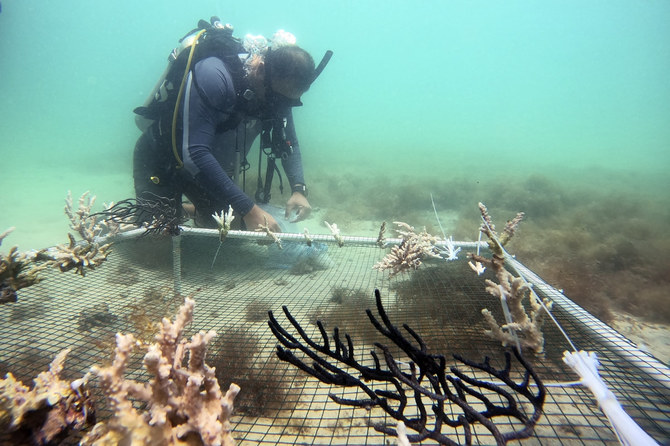
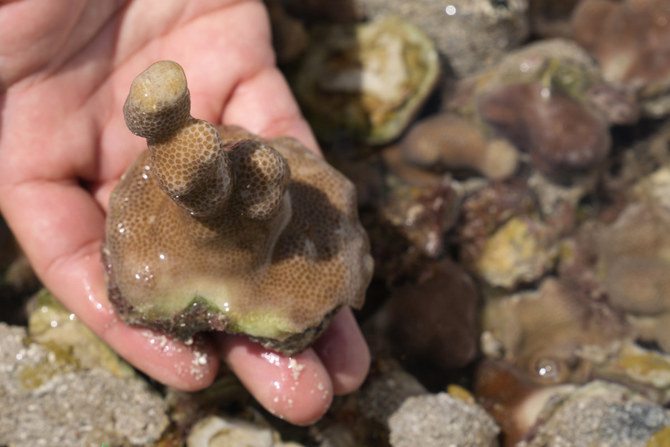

ABU DHABI: On a boat off the coast of an island near Abu Dhabi, marine scientist Hamad Al-Jailani feels the corals, picked from the reef nursery and packed in a box of seawater, and studies them carefully, making sure they haven’t lost their color.
The corals were once bleached. Now they’re big, healthy and ready to be moved back to their original reefs in the hope they’ll thrive once more.
“We try to grow them from very small fragments up to — now some of them have reached — the size of my fist,” Al-Jailani said, who’s part of the Environment Agency Abu Dhabi’s coral restoration program.
The nursery gives corals the ideal conditions to recover: clear waters with strong currents and the right amount of sunlight. Al-Jailani periodically checks the corals’ growth, removes any potentially harmful seaweed and seagrass, and even lets the fish feed off the corals to clean them, until they’re healthy enough to be relocated.
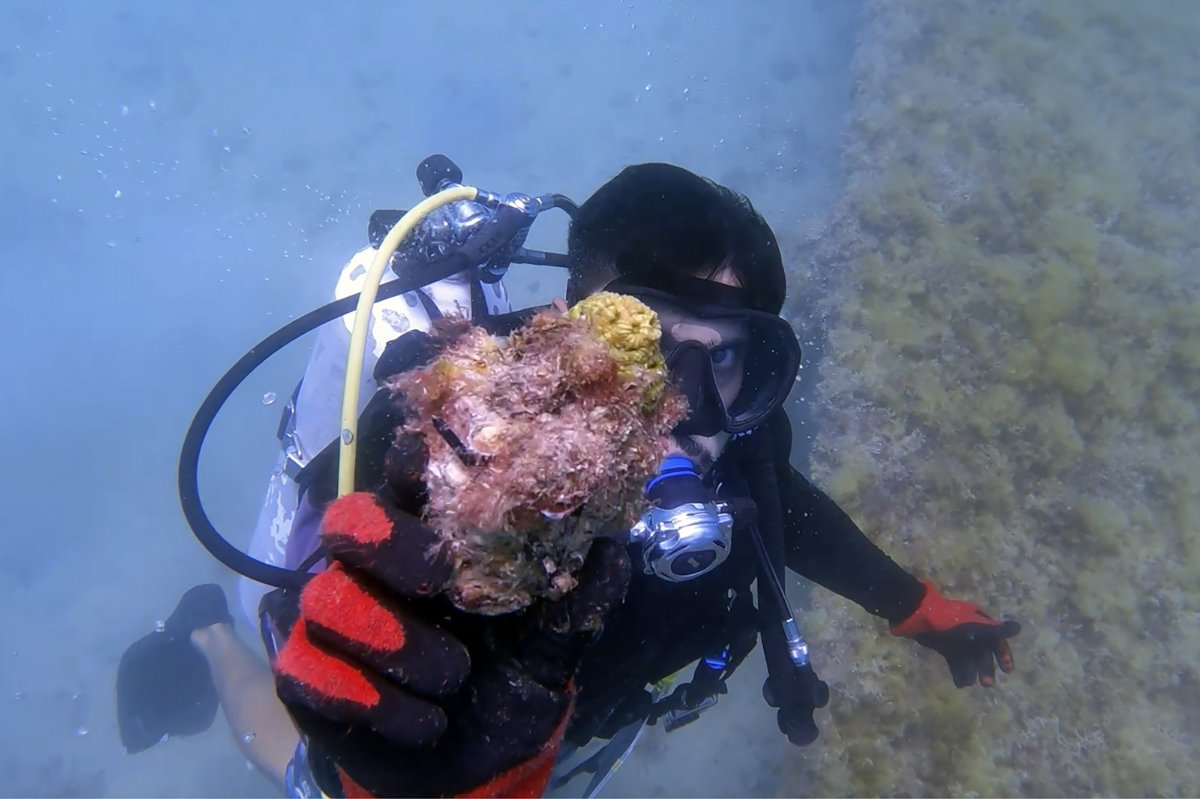
In this frame from video, Hamad al-Jailani, marine scientist at Environment Agency Abu Dhabi, shows a piece of restored coral underwater off the coast of Abu Dhabi on May 25, 2023. (AP Photo/Malak Harb)
The Environment Agency Abu Dhabi, or EAD, has been rehabilitating and restoring corals since 2021, when reefs off the United Arab Emirates’ coast faced their second bleaching event in just five years. EAD’s project is one of many initiatives — both public and private — across the country to protect the reefs and the marine life that depend on them in a nation that has come under fire for its large-scale developments and polluting industries that cause harm to underwater ecosystems. There’s been some progress, but experts remain concerned for the future of the reefs in a warming world.
Coral bleaching occurs when sea temperatures rise and sun glares flush out algae that give the corals their color, turning them white. Corals can survive bleaching events, but can’t effectively support marine life, threatening the populations that depend on them.
The UAE lost up to 70 percent of their corals, especially around Abu Dhabi, in 2017 when water temperatures reached 37 degrees Celsius (99 degrees Fahrenheit), according to EAD. But Al-Jailani said 40-50 percent of corals survived the second bleaching event in 2021.
Although the bleaching events “did wipe out a good portion of our corals,” he said, “it did also prove that the corals that we have are actually resilient ... these corals can actually withstand these kind of conditions.”
Bleaching events are happening more frequently around the world as waters warm due to human-made climate change, caused by the burning of oil, coal and gas that emits heat-trapping gases into the atmosphere. Other coral reef systems around the world have suffered mass bleaching events, most notably Australia’s Great Barrier Reef.
How to limit global warming and its effects will be discussed at length at the United Nations climate conference, which will be held in the UAE capital later this year.
The UAE is one of the world’s largest oil producers and has some of the highest per capita greenhouse gas emissions globally. The country has pledged to have net zero carbon emissions by 2050, which means all carbon dioxide emissions are either slashed or canceled out somehow, but the goal has been met with skepticism from analysts.
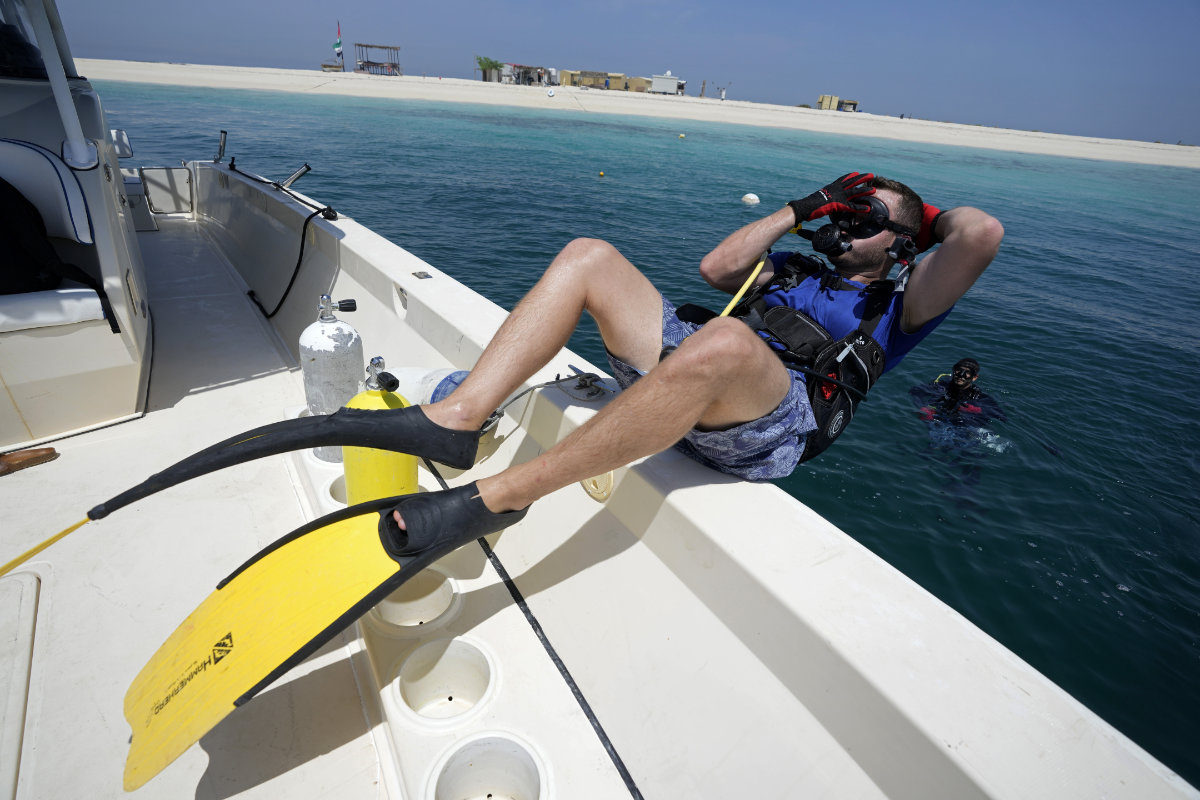
Zack Heikal, field technician of the Environmental Agency Abu Dhabi, dives into the water to visit a coral reef nursery off the coast of Abu Dhabi on May 25, 2023. (AP Photo/Kamran Jebreili)
But bleaching due to warming weather is not the only threat to coral reefs around the gulf. High oil tanker traffic, fossil-fuel related activities, offshore installations, and the exploitation of marine resources are all putting marine life under intense stress, according to the UN Environment Programme, causing them to degrade.
Environmentalists have also long criticized the UAE, and Dubai in particular, for its large-scale buildings and huge coastal developments.
The building of the Palm Jebel Ali, which began more than a decade ago and has been on hold since 2008, caused an outcry among conservationists after it reportedly destroyed about 8 square kilometers (5 square miles) of reef.
“More than 90 million cubic meters (23.8 billion gallons) of sediments were dredged and dropped, more or less on top of one of the remaining reefs near Dubai,” said John Henrik Stahl, the dean of the College of Marine Sciences at Khorfakkan University in Sharjah, UAE.
The project was meant to be similar to the Palm Jumeirah — a collection of small, artificial islands off the coast of Dubai in the shape of a palm tree.
Still, environmental projects persist across the coastline and throughout the emirates.
Development company URB has announced it wants to grow 1 billion artificial corals over a 200-square-kilometer area (124 square miles) and 100 million mangrove trees on an 80-kilometer (50-mile) strip of beaches in Dubai by 2040.
Still in the research and development phase, the project hopes to create 3D technology to print materials that can host algae, much like corals.
Members of Dubai’s diving community are also encouraging coral protection efforts.
Diving program director Amr Anwar is in the process of creating a certified coral restoration course that teaches divers how to collect and re-plant corals that have fallen after being knocked off by divers’ fins or a boat’s anchor.
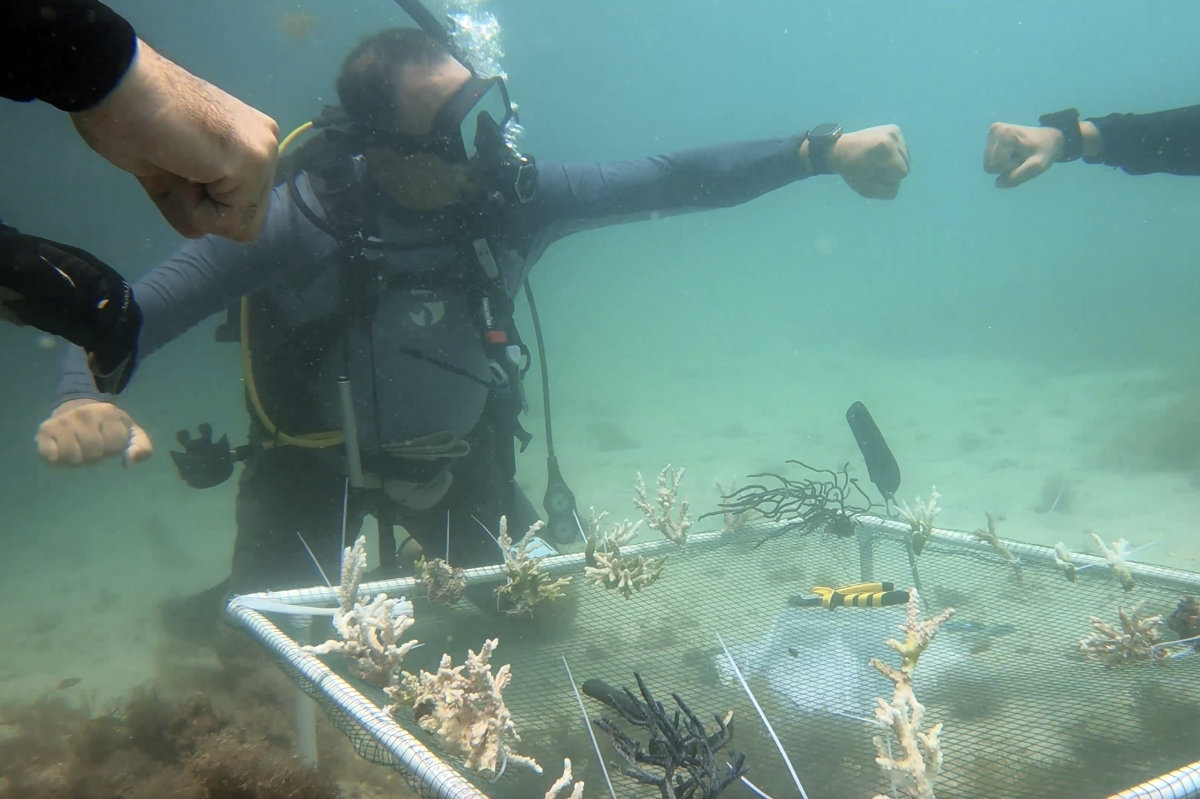
PADI Course Director Amr Anwar fist bumps divers after replanting coral in Dubai on June 4, 2023. (AP Photo/Malak Harb)
“I don’t want people to see broken corals and just leave them like that,” said Anwar. “Through the training we give people, they would be able to take these broken corals that they find and plant them elsewhere, and then see them grow and watch their progress.”
But experts say that unless the threat of overheating seas caused by climate change is addressed, coral bleaching events will continue to occur, damaging reefs worldwide.
Countries have pledged to limit the global average temperature rise to 1.5 degrees Celsius (2.7 degrees Fahrenheit) since pre-industrial times, after which scientists say the effects of warming on the planet could be much worse, and some even potentially irreversible. But analysts say most nations — including the UAE — are still way off that target.
“You have to make sure that the cause for the degradation of the coral reefs in the first place is no longer a threat,” said Stahl, the Khorfakkan University scientist. “Otherwise the restoration effort may be for nothing.”


