

Palestinian journalist seriously wounded by rubber bullet

Short Url
Updated 09 June 2023
Follow

Palestinian journalist seriously wounded by rubber bullet

RAMALLAH: Moamen Sumreen, 22, a Palestinian journalist who was covering the Israeli raid, was seriously wounded after being hit in the head by a rubber bullet, his family told AFP.

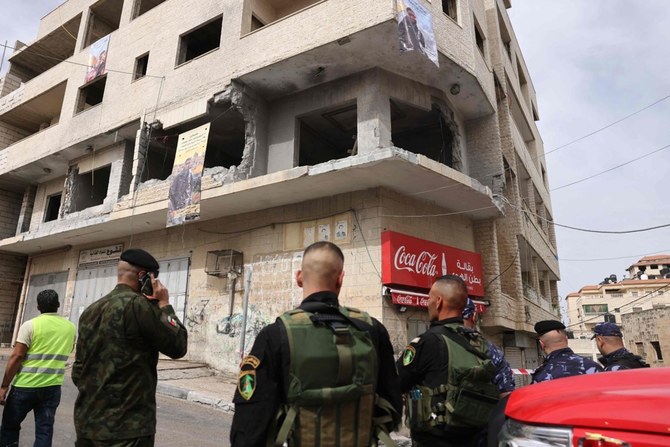
Israeli troops on Thursday demolished the West Bank home of a Palestinian accused of carrying out twin bombings in Jerusalem last November that killed two Israelis, including a teenager.
His uncle Mohammed Sumreen, also a journalist, said they had been among a group of reporters watching events unfold from the roof of a nearby building.
“Throughout the coverage, the soldiers were shining laser lights on us, targeting us with gas bombs and firing live bullets in our direction,” he said.
“Moamen wanted to change his position, he stood up and was directly hit by a bullet in the area under the ear,” he said, noting that Sumreen was wearing a jacket marked “press” when he came under fire.
The Israeli army said that the incident was “under review.”

The army used explosives to make the first floor apartment in Ramallah where Aslam Faroukh lived uninhabitable, an AFP journalist reported.
Faroukh was arrested in December and accused of carrying out the November 23 bombings at Jerusalem bus stops that killed a 15-year-old Israeli-Canadian and an Israeli in his 50s. They were the first bombings to have targeted Israeli civilians since 2016.

“The home was demolished after an appeal to the Supreme Court against the demolition was rejected,” the army said in a statement.

Originally from Israeli-annexed east Jerusalem, where he held an Israeli residency permit, Faroukh had lived in Ramallah for some years.
According to the army, he is alleged to have acted alone, “identifying with the Daesh (Daesh group) organization.”
Israel, which has occupied the West Bank since 1967, routinely demolishes the homes of individuals it blames for deadly attacks on Israelis.
Human rights activists say the policy amounts to collective punishment, as it can render non-combatants, including children, homeless.
But Israel says the practice is effective in deterring some Palestinians from carrying out attacks.
Faroukh’s mother, Um Aslam, told AFP that the demolition would only “increase their hatred and (desire for) revenge.”


Foreign media group slams Israel for refusing to lift Gaza press ban

Updated 07 January 2026
Follow

Foreign media group slams Israel for refusing to lift Gaza press ban

  • Foreign Press Association expresses 'profound disappointment' with Israeli government’s response to a Supreme Court appeal
  • Israel has barred foreign journalists from independently entering the devastated territory since the war started

JERUSALEM: An international media association on Tuesday criticized the Israeli government for maintaining its ban on unrestricted media access to Gaza, calling the move disappointing.
The government had told the Supreme Court in a submission late Sunday that the ban should remain in place, citing security risks in the Gaza Strip.
The submission was in response to a petition filed by the Foreign Press Association (FPA) — which represents hundreds of journalists in Israel and Palestinian territories — seeking immediate and unrestricted access for foreign journalists to the Gaza Strip.
“The Foreign Press Association expresses its profound disappointment with the Israeli government’s latest response to our appeal for full and free access to the Gaza Strip,” the association said on Tuesday.
“Instead of presenting a plan for allowing journalists into Gaza independently and letting us work alongside our brave Palestinian colleagues, the government has decided once again to lock us out” despite the ceasefire in the territory, it added.
Since the outbreak of the Gaza war in October 2023, triggered by an attack on Israel by the Palestinian militant group Hamas, the government has barred foreign journalists from independently entering the devastated territory.
Instead, Israel has allowed only a limited number of reporters to enter Gaza on a case-by-case basis, embedded with its military inside the blockaded Palestinian territory.
The FPA filed its petition in 2024, after which the court granted the government several extensions to submit its response.
Last month, however, the court set January 4 as a final deadline for the government to present a plan for allowing media access to Gaza.
In its submission, the government maintained that the ban should remain in place.
“This is for security reasons, based on the position of the defense establishment, which maintains that a security risk associated with such entry still exists,” the government submission said.
The government also said that the search for the remains of the last hostage held in Gaza was ongoing, suggesting that allowing journalists in at this stage could hinder the operation.
The remains of Ran Gvili, whose body was taken to Gaza after he was killed during Hamas’s 2023 attack, have still not been recovered despite the ceasefire.
The FPA said it planned to submit a “robust response” to the court, and expressed hope the “judges will put an end to this charade.”
“The FPA is confident that the court will provide justice in light of the continuous infringement of the fundamental principles of freedom of speech, the public’s right to know and free press,” the association added.
The Supreme Court is expected to issue a ruling on the matter, though it is unclear when a decision will be handed down.
An AFP journalist sits on the board of the FPA.