

Pakistan wins seat on UN Economic and Social Council

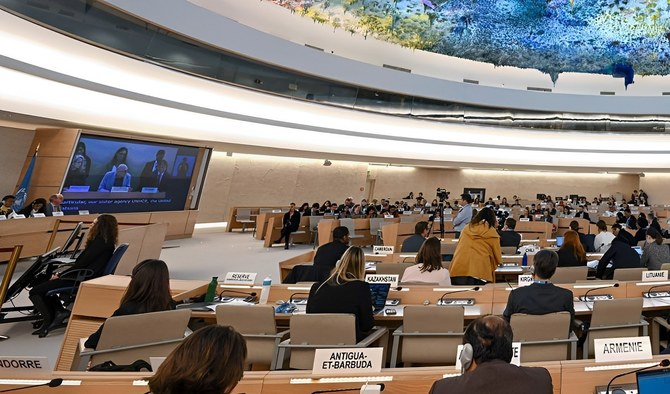
A general view of the 52nd UN Human Rights Council session in Geneva, Switzerland on March 10, 2023. (AFP/File)
Short Url
Updated 08 June 2023
Follow

Pakistan wins seat on UN Economic and Social Council

  • Pakistan has in the past served ten times on the economic and social work body
  • It has served as the body’s president in 1952, 1957, 1975, 1995, 2005 and 2020

ISLAMABAD: Pakistan was on Thursday elected to the United Nation's Economic and Social Council (ECOSOC) for a three-year term beginning January 1, 2024, state-run APP reported on Thursday.

The Economic and Social Council, under the overall authority of the UN General Assembly, coordinates the economic and social work of the UN and the UN family of organizations. The ECOSOC is responsible for promoting higher standards of living, full employment, and economic and social progress, identifying solutions to international economic, social and health problems, facilitating international cultural and educational cooperation, and encouraging universal respect for human rights and fundamental freedoms.

Ambassador Munir Akram, Pakistan’s permanent representative to the UN, said Pakistan’s election to the body was a recognition of “our positive role in international diplomacy.”

In balloting in the 193-member General Assembly, Pakistan received 129 votes. A two-third majority – 124 votes – was required for election.

“We’re very gratified at Pakistan’s success in an highly contested election. Our success is a recognition of Pakistan’s importance and its positive role in international diplomacy,” Akram said.

“We hope to play yet once again our active role in the forum of ECOSOC by fostering agreement on the structure and content of new, more dynamic and equitable structure of international economic cooperation.”

Others elected on the Asian seats are: Japan (127 votes) and Nepal (145 votes). Iraq, with 50 votes, and Tajikistan, with 120 votes, did not make it.

Pakistan has in the past served on the ECOSOC 10 times, and in the capacity as the 54-member body’s President six times in 1952, 1957, 1975, 1995, 2005 and 2020.


Pakistan urges pilgrims to complete Saudi biometrics as Hajj preparations gain pace

Updated 30 January 2026
Follow

Pakistan urges pilgrims to complete Saudi biometrics as Hajj preparations gain pace

  • Government warns pilgrims biometric verification is required for Hajj visas
  • Step follows tighter oversight after last year’s Hajj travel disruptions

ISLAMABAD: Pakistan’s government on Friday urged aspiring pilgrims to complete mandatory Saudi biometric verification for Hajj visas, as preparations for the 2026 pilgrimage gather pace following stricter oversight of the Hajj process.

The announcement comes only a day after Pakistan’s Religious Affairs Minister Sardar Muhammad Yousuf said regulations for private Hajj operators had been tightened, reducing their quota following widespread complaints last year, when tens of thousands of pilgrims were unable to travel under the private Hajj scheme.

“Saudi biometric verification is mandatory for the issuance of Hajj visas,” the Ministry of Religious Affairs said in a statement, urging pilgrims to complete the process promptly to avoid delays.

“Hajj pilgrims should complete their biometric verification at home using the ‘Saudi Visa Bio’ app as soon as possible,” it added.

The statement said the pilgrims who were unable to complete biometric verification through the mobile application should visit designated Saudi Tasheer centers before Feb. 8, adding that details of the centers were available on Pakistan’s official Hajj mobile application.

Pakistan has been steadily implementing digital and procedural requirements for pilgrims ahead of Hajj 2026, including mandatory training sessions, biometric checks and greater use of mobile applications, as part of efforts to reduce mismanagement.

Saudi Arabia has allocated Pakistan a quota of 179,210 pilgrims for Hajj 2026, with the majority of seats reserved under the government scheme and the remainder allocated to private tour operators.