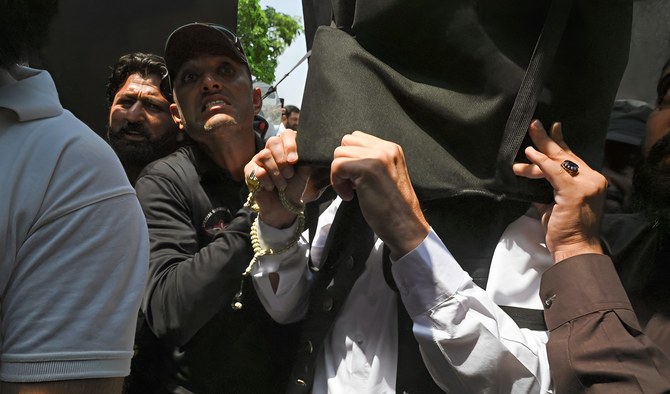
ISLAMABAD: Ousted Pakistani prime minister Imran Khan secured bail on Thursday from the Islamabad High Court over new murder charges, blocking his arrest in that case for 14 days, his lawyer said.
The ousted prime minister had been arrested on May 9 and held for three days, triggering violent protests by his followers. He is now free on bail in a range of other criminal cases.
He had traveled to the capital from his Lahore home to seek bail in the murder case and extend his bail in over a dozen other cases, to avoid a new arrest, said the lawyer, Barrister Gohar Khan.
The 70-year-old former cricket hero who become prime minister in 2018 has been embroiled in a confrontation with the powerful military since he was ousted in a no-confidence vote last year.
The military has ruled directly or overseen civilian governments throughout the history of a country in which political confrontations are often fought out in court.
Khan’s May 9 arrest on corruption charges, which he denies, sparked protests by his supporters who ransacked military facilities, raising new worries about the stability of the nuclear armed country of 220 million people as it struggles with its worst economic crisis in decades.
Since Khan was freed, new charges against him have been piling up. On Wednesday, police named him in connection with the murder of a lawyer seeking sedition proceedings against him.
Khan says he is facing nearly 150 cases and denies guilt in all of them.
Khan’s lawyer, Gohar Khan, said the former prime minister would on Thursday approach anti-terrorism courts, anti-graft courts and the High Court in Islamabad to appeal for bail in connection with more than a dozen cases.
Khan, who has been campaigning for an early election since his ouster last year, said in an online address to party workers on Wednesday that he was resigned to the possibility he could be arrested for a second time.
The military, which denies involvement in civilian politics, initially saw Khan with his conservative, nationalist agenda as a leader who shared their interests. But as prime minister, Khan took steps that angered the generals, in particular in connection with security sector appointments.
He has accused the military and intelligence agencies of trying to destroy his party, saying he has “no doubt” he will be tried in a military court and jailed as part of the army-backed crackdown on his party. The military says it does not interfere in political affairs.
The military issued a statement on Wednesday saying all planners and perpetrators of the May 9 violence had to be brought to justice.
The prime minister who replaced Khan, Shahbaz Sharif, has rejected his call for an election before one is due by late this year. Khan says the cases against him are aimed at ensuring he is excluded from the polls.
Khan has appealed for talks to end the standoff with the military. The government has rejected his calls.


![]()

Pakistan’s Imran Khan gets bail on murder charges — lawyer
Short Url
https://arab.news/462gc
Pakistan’s Imran Khan gets bail on murder charges — lawyer
- Khan says he is facing nearly 150 cases and denies guilt in all of them
- New charges against him have been piling up against Khan in recent days
Latest updates




© 2026 SAUDI RESEARCH & PUBLISHING COMPANY, All Rights Reserved And subject to Terms of Use Agreement.