

Kuwait votes in opposition-led parliament, one woman elected

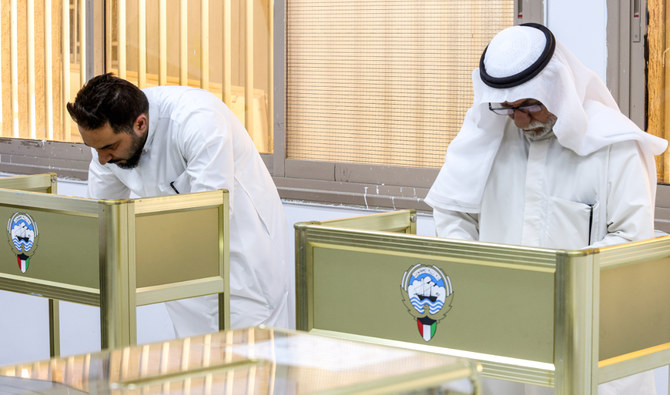
Voters tick their ballots at a polling station during parliamentary elections in Kuwait City on June 6, 2023. (AFP)
Short Url
Updated 07 June 2023
Follow

Kuwait votes in opposition-led parliament, one woman elected

  • Emir urges MPs to ‘carry responsibility of representing people, realize their aspiration for better future’

KUWAIT CITY: Opposition lawmakers won a majority in Kuwait’s parliament with only one woman elected, results showed on Wednesday, after the Gulf state’s seventh general election in just over a decade.

The opposition figures include conservatives and independent politicians not tied to the ruling family who are pushing for a raft of reforms.

The vote on Tuesday came after Kuwait’s constitutional court in March annulled the results of last year’s election — in which the opposition made significant gains — and reinstated the previous parliament elected in 2020.

Opposition lawmakers won 29 of the legislature’s 50 seats, according to results published by the official Kuwait News Agency. Only one woman was elected — opposition candidate Janan Bushehri.

The makeup of the new parliament is very similar to the one elected last year and later annulled, with all but 12 of its 50 members retaining their seats.

This has sparked concerns that the legislature may once again find itself locked in disputes with the Cabinet, further deepening a political crisis that has delayed reforms and hampered growth.

“The government has to contend with a more combative parliament than the already combative 2022 version,” said Bader Al-Saif, assistant history professor at Kuwait University. “Therefore, expect bumps in the road unless radical reforms unfold,” he said.

Longtime speaker Marzouq Al-Ghanim and Ahmed Al-Saadoun, who replaced him last year, both return to parliament. Saadoun is expected to run again for the post of speaker.

Parliament’s first session is scheduled to take place on June 20.

“We are celebrating today the (victory of the) reformist approach,” opposition lawmaker Adel Al-Damkhi told reporters after the results were announced.

“The election results are an indication of the awareness of the Kuwaiti people.”

Turnout reached 50 percent one hour before polls closed, according to the Kuwait Transparency Society, a nongovernment group. Last year’s election saw turnout of 63 percent.

Since Kuwait adopted a parliamentary system in 1962, the legislature has been dissolved around a dozen times.

Continual standoffs between the branches of government have prevented lawmakers from passing economic reforms, while repeated budget deficits and low foreign investment have added to an air of gloom.

Bushehri, the new parliament’s sole female member, said she expected it “to seek stability and move ahead on outstanding issues, whether political or economic.”

Kuwait’s Emir Sheikh Nawaf Al-Ahmad Al-Sabah congratulated the incoming deputies and called on them to “carry the responsibility of representing the people and ... realize their aspiration for a better future,” according to KUNA.

Kuwait, which borders Iraq, boasts 7 percent of global crude reserves. It has little debt and one of the strongest sovereign wealth funds in the world.


UN peacekeepers say Israeli forces fired on them in southern Lebanon

Updated 11 December 2025
Follow

UN peacekeepers say Israeli forces fired on them in southern Lebanon

  • “Yesterday, peacekeepers in vehicles patrolling the Blue Line were fired upon by IDF soldiers in a Merkava tank,” UNIFIL said
  • It said that both the peacekeepers and the Israeli tank were in Lebanese territory

BEIRUT: The United Nations Interim Force in Lebanon said Wednesday that Israeli forces fired on its peacekeepers a day earlier in the country’s south, urging Israel’s army to “cease aggressive behavior.”
It is the latest such incident reported by the peacekeepers in southern Lebanon, where UNIFIL acts as a buffer between Israel and Lebanon and has been working with Lebanon’s army to support a year-old truce between Israel and militant group Hezbollah.
“Yesterday, peacekeepers in vehicles patrolling the Blue Line were fired upon by IDF (Israeli army) soldiers in a Merkava tank,” a UNIFIL statement said, referring to the de facto border.
“One ten-round burst of machine-gun fire was fired above the convoy, and four further ten-round bursts were fired nearby,” the statement said.
It said that both the peacekeepers and the Israeli tank were in Lebanese territory at the time of the incident and that the Israeli military had been informed of the location and timing of the peacekeeping patrol in advance.
“Peacekeepers asked the IDF to stop firing through UNIFIL’s liaison channels... Fortunately, no one was injured,” it said.
Last month UNIFIL said Israeli soldiers shot at its troops in the south, while Israel’s military said it mistook blue helmets for “suspects” and fired warning shots.
In October, UNIFIL said one of its members was wounded by an Israeli grenade dropped near a UN position in the country’s south, the third incident of its kind in just over a month.
“Attacks on or near peacekeepers are serious violations of (UN) Security Council Resolution 1701,” UNIFIL said on Wednesday, referring to the 2006 resolution that formed the basis of the November 2024 truce.
“We call on the IDF to cease aggressive behavior and attacks on or near peacekeepers working to rebuild stability along the Blue Line,” the peacekeepers said.
Israel carries out regular attacks on Lebanon despite the truce, usually saying it is targeting sites and operatives belonging to Hezbollah, which it accuses of rearming.
It has also kept troops in five south Lebanon areas it deems strategic.
On Saturday, a UN Security Council delegation visiting Lebanon urged all parties to uphold the ceasefire.
It emphasized that the “safety of peacekeepers must be respected and that they must never be targeted,” after gunmen on mopeds attacked UNIFIL personnel last week.