

US humanitarian agency announces $16.4 million for flood-affected people of Sindh

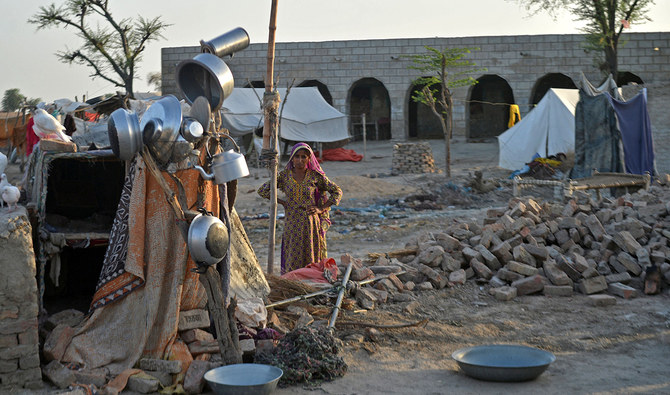
In this photograph taken on May 9, 2023, a flood-affected victim stands amid the debris of her damaged house in Dadu district of Pakistan. (AFP/File)
Short Url
Updated 07 June 2023
Follow

US humanitarian agency announces $16.4 million for flood-affected people of Sindh

  • USAID delivered nearly 630 metric tons of life-saving relief commodities to Pakistan in the aftermath of floods
  • Its new funding will reach more than 20 million people and assist with recovery, risk reduction and resilience

ISLAMABAD: The United States Agency for International Development (USAID) has announced $16.4 million in additional development and humanitarian assistance to support the flood-affected population of Pakistan’s Sindh province, an official statement from the agency confirmed on Tuesday.

Pakistan witnessed torrential rains last year which were followed by devastating floods that claimed 1,700 lives, impacted 33 million people, killed livestock, and washed away swathes of agricultural land. According to official estimates, the devastation caused losses of about $30 billion, putting the economy of the cash-strapped country under further stress.

Sindh and Balochistan were the worst-affected provinces where flood waters have still not receded from certain areas.

“Today in Sindh, Pakistan, USAID Deputy Administrator Isobel Coleman announced $16.4 million in additional development and humanitarian assistance to support the resilience of communities in Pakistan that experienced 2022’s historically severe floods,” the statement said.

It added that the new funding will reach over 20 million flood-affected individuals and assist with recovery, risk reduction, and resilience.

“The assistance will address worsening food insecurity and malnutrition and help curb the spread of disease,” the statement continued while informing the funding would also support humanitarian partners to provide nutritious food to mothers and their children, help families rebuild local infrastructure to protect them from future disasters, and increase protection services to prevent gender-based violence and support survivors.

In the aftermath of last year’s floods, USAID also deployed a disaster-assistance response team to lead the US humanitarian response and rapidly provide aid to the affected communities.

The agency worked with partners to quickly scale up vital humanitarian assistance, including through partnering with the US Department of Defense, to successfully complete an air bridge that delivered nearly 630 metric tons of life-saving relief commodities to Pakistan.

“The US is one of the largest donors to Pakistan, providing more than $200 million in humanitarian and development assistance since 2022’s catastrophic floods,” the statement added.

“The United States continues to stand with the people of Pakistan as they recover from the impacts of the historic floods.”


Pakistan, Saudi Arabia explore joint investment push in high-growth regions

Updated 29 min 10 sec ago
Follow

Pakistan, Saudi Arabia explore joint investment push in high-growth regions

  • Both sides discuss combining Pakistan’s production capacity with Saudi capital and regional market access
  • Government says Saudi side expressed interest in corporate farming in Pakistan, particularly in rice sector

KARACHI: Pakistan and Saudi Arabia are looking to jointly tap high-growth regional markets and align production and capital strengths, according to an official statement on Wednesday, following talks between Commerce Minister Jam Kamal Khan and Saudi Investment Assistant Minister Ibrahim Al-Mubarak in the Kingdom.

The two countries have long maintained close bilateral ties that have evolved into a multidimensional strategic partnership.

In October last year, the two countries launched an Economic Cooperation Framework aimed at shifting relations beyond aid toward sustainable trade, investment and development links. The framework followed the signing of a joint security agreement a month earlier, under which aggression against one would be treated as an attack on both.

“A key focus of the discussion was the joint exploration of regional markets, particularly Central Asia, Africa, and ASEAN, identified as high-growth regions offering significant opportunities for collaboration,” according to a statement circulated by Pakistan’s commerce ministry after the meeting.

“The two sides agreed that Pakistan and Saudi Arabia, by leveraging their respective strengths, can position themselves as complementary partners — combining Pakistan’s production capabilities with Saudi Arabia’s capital strength, market access, and regional connectivity,” it added.

The Saudi side expressed interest in corporate farming in Pakistan, particularly in the rice sector, with discussions covering mechanization, storage and logistics to enable consistent, long-term exports under structured arrangements.

Talks also covered broader cooperation in agriculture and food security, including rice, fodder, meat and other agri-products, with the potential involvement of Saudi financing institutions in supporting export-linked agricultural and infrastructure projects.

Corporate farming and mechanization were discussed as long-term solutions to productivity challenges in crops such as cotton, where declining yields and high manual input costs have hurt competitiveness, the statement said.

Human resource development emerged as another area of focus, with both sides noting shortages in mid-tier skills such as nurses, caregivers, technicians and hospitality staff.

The Saudi side expressed openness to replicating vocational “train-to-deploy” models in Pakistan that link training programs directly with overseas employment opportunities.

The meeting also examined opportunities in building materials, pharmaceuticals, sports goods, footwear and light manufacturing, with both sides agreeing to pursue sector-specific workshops and business-to-business engagements to translate policy alignment into tangible trade and investment flows.