

Pakistani PM says energy reforms to be part of annual budget this year

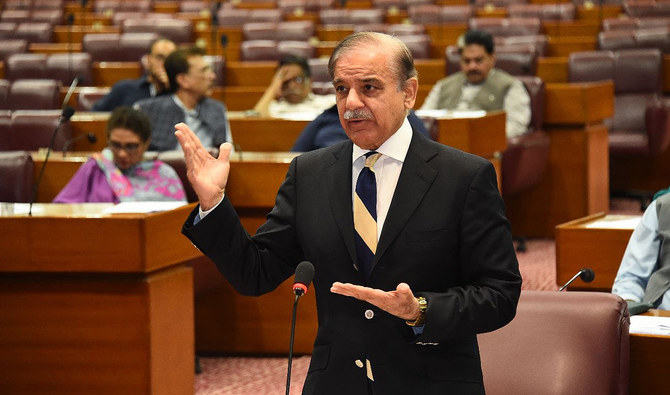
Pakistan Prime Minister Shehbaz Sharif speaks on the floor of the National Assembly in Islamabad on May 22, 2023. (Photo courtesy: Twitter/NAofPakistan)
Short Url
Updated 07 June 2023
Follow

Pakistani PM says energy reforms to be part of annual budget this year

  • South Asian nation seeking to reduce value of fuel imports, protect itself from geopolitical shocks
  • Grid failure this year plunged 220 million people into darkness for a day, disrupted commercial activity

ISLAMABAD: Pakistani Prime Minister Shehbaz Sharif said on Tuesday energy reforms would be part of the annual budget for fiscal year 2023-24, due to be presented on June 9.

The South Asian nation, which is battling a wrenching economic crisis and is in dire need of funds, is seeking to reduce the value of its fuel imports and protect itself from geopolitical shocks.

Power outages remain common in Pakistan, with a grid problem earlier this year plunging 220 million people into darkness for a whole day and disrupting commercial activity. Excess fossil fuel energy capacity also is boosting electricity costs — and raising questions about whether the country will now manage to achieve its climate change goals, with scientists saying coal needs to rapidly disappear from the world’s energy mix to prevent the worst impacts of climate change.

“The Prime Minister decided to make energy reforms part of the budget,” state-run Radio Pakistan reported after Sharif chaired a meeting on budget proposals.

“He said that renewable energy projects should be started by reducing reliance on the expensive imported fuel in a gradual manner … effective measures should be proposed in the next budget in order to control line losses and electricity theft.”

Sharif said wind and solar energy projects should be included in the upcoming budget and ongoing solarization projects in the country should be expedited.

“Emphasizing the importance of an efficient transmission system, he said power transmission projects should be completed at the earliest … transformer metering should be made part of the next budget for the elimination of line losses and the pilferage of electricity,” Radio Pakistan said.

In 2020, then Prime Minister Imran Khan promised Pakistan by 2030 would produce 60 percent of its electrical power from renewable sources.

Currently the country gets 64 percent of its electricity from fossil fuels, with another 27 percent from hydropower, 5 percent from nuclear power and just 4 percent from renewables such as solar and wind.


PM Sharif pins hopes on Trump-led peace board to help end Gaza war

Updated 5 sec ago
Follow

PM Sharif pins hopes on Trump-led peace board to help end Gaza war

  • Pakistan says new body should push ceasefire, reconstruction and two-state solution
  • Sharif thanks Kazakh president for joining peace initiative during Islamabad visit

ISLAMABAD: Prime Minister Shehbaz Sharif expressed optimism on Wednesday US President Donald Trump’s newly formed Board of Peace (BoP) would help end the conflict in Gaza and advance the implementation of a two-state solution, as he addressed a ceremony at his official residence in the capital.

The Board of Peace brings together participating states and international stakeholders seeking to support dialogue, stability and peace-related initiatives linked to the war in the Palestinian enclave.

Sharif signed the body’s charter last month alongside other world leaders on the sidelines of the World Economic Forum’s annual meeting in Davos, a move his government later described as a diplomatic success amid opposition criticism for not taking parliament into confidence.

Speaking at a ceremony to sign more than 30 memoranda of understanding with Kazakhstan, also a Board of Peace member, Sharif thanked President Kassym-Jomart Tokayev for accepting his invitation to visit Pakistan for bilateral talks.

“I would ... like to congratulate you on accepting this invitation, being a member of the Board of Peace under President Trump’s leadership,” Sharif said.

“Let us hope and pray to Allah Almighty that through our joint efforts, we will be successful in bringing long-lasting peace in Gaza, its reconstruction, and, of course, make the two-state solution a reality as soon as possible,” he added.

Pakistan told the United Nations in January that it expected the new international body to take concrete steps toward a permanent ceasefire, the reconstruction of Gaza and a lasting and just peace grounded in the Palestinian right to statehood.

It maintained that its decision to join the Board of Peace was driven by the need to address the unresolved Palestinian question, which it has described as the core source of instability in the region.

Pakistan has consistently called for the establishment of a geographically contiguous Palestinian state based on pre-1967 borders, with East Jerusalem as its capital.