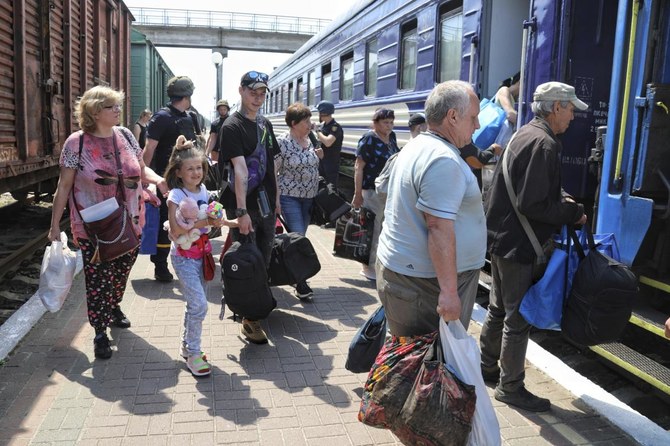
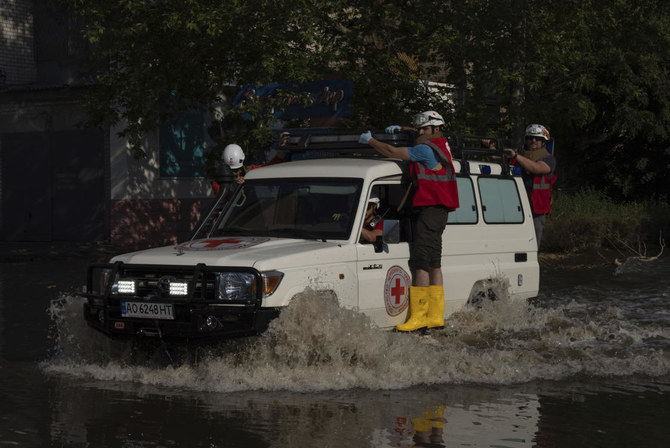
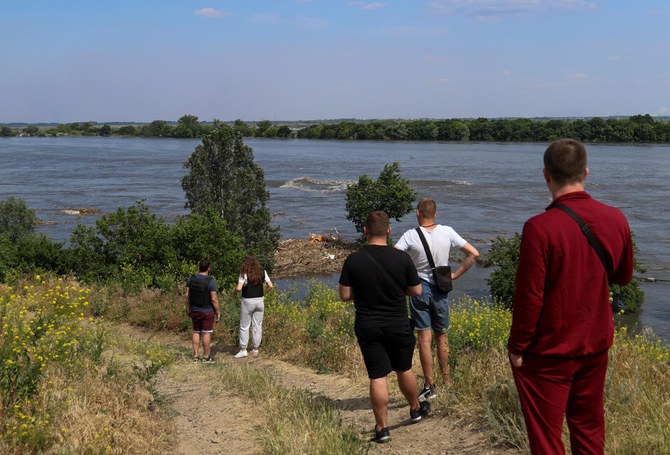
KHERSON, Ukraine: An attack on a major Russian-held dam in southern Ukraine on Tuesday unleashed a torrent of water that flooded a small city and two dozen villages and forced the evacuation of 17,000 people, sparking fears of a humanitarian disaster.
Washington warned there would be “likely many deaths” as Moscow and Kyiv traded blame for ripping a gaping hole in the Kakhovka dam, which is located on the frontline and provides cooling water for Europe’s largest nuclear plant.
Kyiv said the destruction of the dam — seized by Russia in the early hours of the war — was an attempt by Moscow to hamper its long-awaited offensive, which Ukraine’s leader stressed would not be affected.
An emergency meeting of the UN Security Council was scheduled for 2000 GMT Tuesday following requests from Russia and Ukraine, diplomatic sources said.
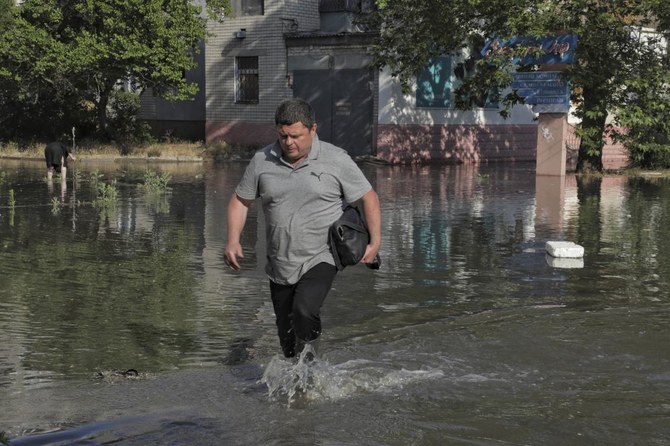
People in Kherson, the largest population center nearby, headed for higher ground as water poured into the Dnipro River.
“There is shooting, now there is flooding,” said Lyudmyla, who had loaded a washing machine onto a cart attached to an old Soviet car.
“Everything is going to die here,” added Sergiy as water from the dam poured into the city which was the scene of heavy fighting in 2022.
Ukrainian authorities said 17,000 people were being evacuated and a total of 24 villages had been flooded.
“Over 40,000 people are in danger of being flooded,” Prosecutor General Andriy Kostin said, adding that 25,000 more people should be evacuated on the Russian-occupied side of the Dnipro River.
Vladimir Leontyev, the Moscow-installed mayor of Nova Kakhovka where the dam is located, said the city was underwater and hundreds of people had been evacuated.
Ukrainian President Volodymyr Zelensky accused Russia of blowing up the dam and said authorities expected up to 80 settlements to be flooded, urging the world to “react.”
“This crime carries enormous threats and will have dire consequences for people’s lives and the environment,” Zelensky told a Vatican peace envoy, Italian cardinal Matteo Zuppi, in Kyiv, the presidency said.
He later said in a Telegram message that the explosion “did not affect Ukraine’s ability to de-occupy its own territories.”
Kyiv also called for a meeting of the UN Security Council and warned of a potential “ecocide” after 150 tons of engine oil spilled into the river.
Western powers also blamed Russia for the damage, with EU chief Charles Michel calling it a “war crime,” while NATO chief Jens Stoltenberg said the dam breach was “outrageous“
The United States “cannot say conclusively what happened at this point,” National Security Council spokesman John Kirby told reporters.
Russia however said the dam was partially destroyed by “multiple strikes” coming from Ukrainian forces and urged the world to condemn Kyiv’s “criminal acts.”
Kremlin spokesman Dmitry Peskov said the destruction was the result of “deliberate sabotage by the Ukrainian side.”
The Soviet-era dam, built in the 1950s, sits on the Dnipro River, which provides cooling water for the Russian-occupied Zaporizhzhia nuclear power plant some 150 kilometers (90 miles) away.
Moscow and Kyiv offered conflicting versions on the safety of the facility.
The Russian-installed director of the plant, Yuri Chernichuk, echoed the UN agency and said that “at the moment, there is no security threat to the Zaporizhzhia nuclear power plant.”
“The water level in the cooling pond has not changed,” he said, adding that the situation was under control.
But Ukraine, which in 1986 suffered the devastating Chernobyl nuclear disaster, sounded the alarm.
“The world once again finds itself on the brink of a nuclear disaster, because the Zaporizhzhia nuclear power plant lost its source of cooling. And this danger is now growing rapidly,” Zelensky’s aide Mykhaylo Podolyak said.
The Ukrainian nuclear operator, Energoatom, said the water level of the Kakhovka reservoir was “rapidly decreasing, which is an additional threat to the temporarily occupied Zaporizhzhia nuclear power plant.”
The UN humanitarian agency said it was concerned about “the severe humanitarian impact on hundreds of thousands of people on both sides of the front line.”
“Flooding and fast-moving water can move mines and explosive ordnance to new areas which previously had been assessed as safe, thus putting more people in danger,” it added.
News of the damage came after Russia said Ukraine had begun a long-expected counter-offensive to claw back lost territory after Moscow invaded in February, 2022.
On Tuesday, Defense Minister Sergei Shoigu announced that Moscow had halted Kyiv’s offensive but lost 71 soldiers over the past three days, an extremely rare admission of Russia’s losses.
On Monday, Zelensky praised his troops for advances claimed near the devastated city of Bakhmut.
Kyiv already accused Moscow of mining the dam as combat raged nearby in October, during the last major offensive by Ukrainian forces seeking to regain lost territory. Russia denies the claim.
The Kakhovka dam has strategic value as it pumps water into the North Crimean Canal, which starts in southern Ukraine and crosses the entire Crimean peninsula.
Experts say that any problem with the dam could cause water supply problems for Crimea, which has been under Russian control since 2014.


![]()
![]()
![]()
![]()
![]()

Ukraine evacuates thousands after key dam destroyed

Short Url
https://arab.news/475dz
Ukraine evacuates thousands after key dam destroyed
- Washington warned there would be "likely many deaths" as Moscow and Kyiv traded blame for ripping a gaping hole in the Kakhovka dam
- People in Kherson, the largest population centre nearby, headed for higher ground as water poured into the Dnipro River


Latest updates


© 2026 SAUDI RESEARCH & PUBLISHING COMPANY, All Rights Reserved And subject to Terms of Use Agreement.