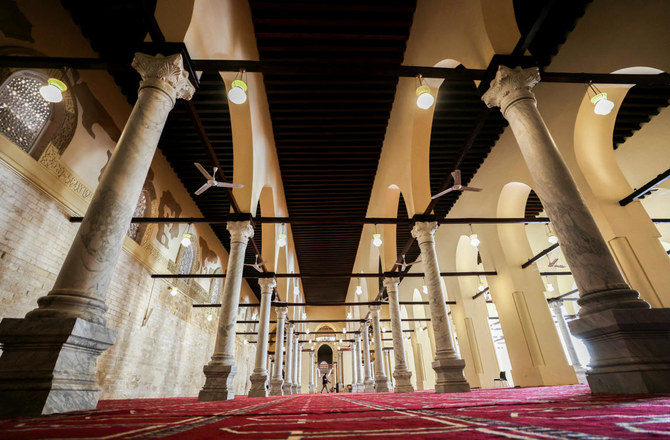
CAIRO: A 13th century mosque that fell into disrepair after being used over the years as a soap factory, a slaughterhouse and a fort reopened in Cairo on Monday after undergoing a long restoration.
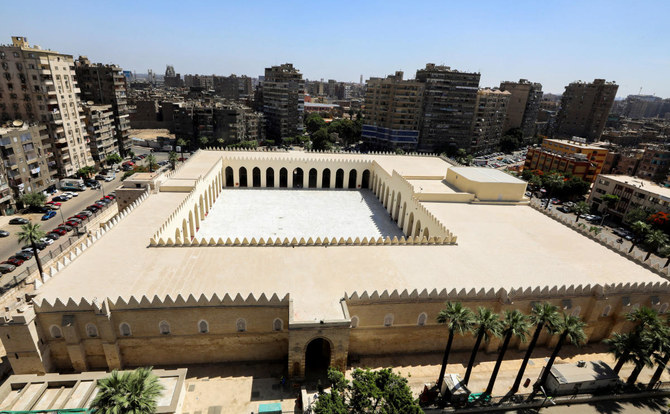
The mosque of Al-Zhahir Baybars, built under Mamluk rule in 1268, spans an area of three acres just north of central Cairo, making it Egypt’s third-largest mosque.
The mosque underwent mechanical and chemical restoration to bring it back to its original condition, said Tarek Mohamed El-Behairy, who supervised the restoration.
“Some parts were destroyed, some parts have been dismantled because they were structurally unsuitable to remain in the mosque,” he said.
“But we were very keen, even in the reconstruction process, to work according to the correct archaeological style.”
The restoration, which cost $7.68 million, was co-funded with Kazakhstan and began in 2007.
For 225 years, the mosque was either closed, abandoned or had operated for non-religious purposes that contributed to its disrepair.
During Napoleon’s campaign in Egypt it was used as a military fort, then under Ottoman rule in the 19th century as a soap factory. Later, when the British invaded Egypt in 1882, it was used as a slaughterhouse.
Al-Zahir Baybars was a prominent figure in Egypt’s history credited with cementing Mamluk rule in Egypt which spanned three centuries up to 1517.

Egypt reopens historic mosque after long restoration
https://arab.news/89csd
Egypt reopens historic mosque after long restoration
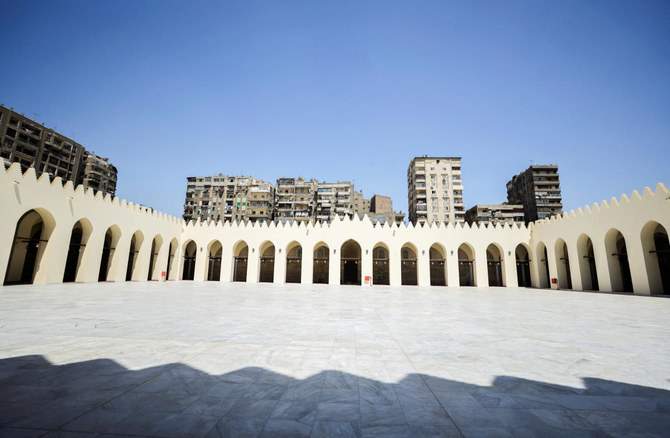
- The mosque of Al-Zhahir Baybars, built under Mamluk rule in 1268, spans an area of three acres just north of central Cairo
Japan, Qatar reaffirm commitment to ongoing bilateral cooperation across multiple sectors The ministers acknowledged increasing collaboration in energy, economy, defense and international initiatives Minister MOTEGI further expressed appreciation for Qat
- The ministers acknowledged increasing collaboration in energy, economy, defense and international initiatives
- Minister MOTEGI further expressed appreciation for Qatar’s sustained investments in Japan
TOKYO: Japanese Foreign Minister MOTEGI Toshimitsu and Sheikh Mohammed bin Abdulrahman bin Jassim Al-Thani, Prime Minister and Foreign Minister of Qatar, reaffirmed their commitment to ongoing bilateral cooperation across multiple sectors during the Third Japan-Qatar Strategic Dialogue in Doha on Tuesday.
According to the Foreign Ministry in Tokyo, the ministers acknowledged increasing collaboration in energy, the economy, defense, international initiatives, and cultural and academic exchanges.
Additionally, they expressed mutual support for their national teams’ participation in the upcoming FIFA World Cup.
During their 100-minute meeting, the ministers underscored the importance of liquefied natural gas in strengthening bilateral relations.
Minister MOTEGI conveyed appreciation for Qatar’s consistent energy supply, while Minister Mohammed reiterated Qatar’s commitment to ensuring stable energy provision to Japan.
Minister MOTEGI further expressed appreciation for Qatar’s sustained investments in Japan.
The ministers highlighted ongoing progress in defense cooperation, referencing the initiation of defense consultations in 2023, the first visit by a Japan Maritime Self-Defense Force vessel to Qatar in 12 years, and the inaugural visit by the Chief of the Joint Staff. They committed to further strengthening these exchanges.
The ministers agreed to broaden development assistance and humanitarian support by leveraging the respective strengths of both nations.
Qatar was the first country to confirm participation in the forthcoming GREEN×EXPO 2027 in Yokohama, for which Minister MOTEGI expressed gratitude. He also welcomed ongoing academic exchanges between universities and institutions.
During discussions regarding Gaza, Minister MOTEGI commended Qatar for its role in facilitating the ceasefire and the release of hostages. He stated that, following his recent visit to Israel and Palestine, Japan intends to actively contribute to peace and stability in the Middle East, including the reconstruction of Gaza.
Minister Mohammed welcomed Japan’s initiatives for regional stability and expressed a desire for continued bilateral cooperation.
The ministers also addressed the situation concerning Iran and their respective policies on North Korea, including nuclear and missile issues, abductions, and recent developments in East Asia. They agreed to maintain close cooperation on these matters, according to the Ministry, which did not provide further details.