

UN, humanitarian agencies revise budget for Afghan aid plan down to $3.2 billion

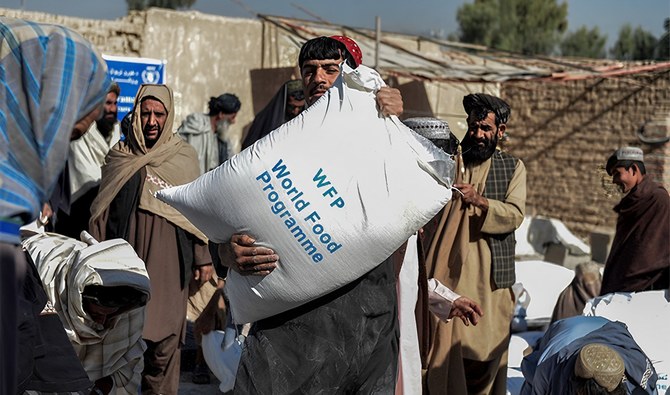
Afghan people carry sacks of food grains distributed as an aid by the World Food Programme (WFP) in Kandahar on October 19, 2021. (AFP)
Short Url
Updated 05 June 2023
Follow

UN, humanitarian agencies revise budget for Afghan aid plan down to $3.2 billion

  • Aid officials and diplomats have warned of potential decline in funding to Afghanistan due to Taliban restrictions on female workers
  • UN development agency in April predicted Afghan economy would contract, inflation would rise if there were a 30% drop in aid

The United Nations and humanitarian agencies have revised the budget for Afghanistan's aid plan for 2023 to $3.2 billion, down from $4.6 billion earlier in the year, the UN humanitarian office said on Monday.

The UN Office for the Coordination of Humanitarian Affairs said in a statement that a "changing operating context" in the wake of Taliban administration restrictions on female aid workers had contributed to the revised plan.

Taliban authorities have issued several orders barring many Afghan female NGO and United Nations employees from being able to work, which aid agencies have warned would severely hamper delivery in the religiously conservative nation.

"The recent bans on Afghan women working for... NGOs and the UN have added yet another layer of complexity to what is already an incredibly challenging protection environment, and further constrained the operational capacity of partners," the UN statement said.

Afghanistan remains one of the world's worst humanitarian crises, the statement added, with more than two-thirds of the population in need of humanitarian assistance.

Some humanitarian officials and diplomats have warned of a potential decline in funding to the war-ravaged nation due to the Taliban restrictions on female workers and donor governments assessing competing global crises and economic priorities.

It was not clear how much of the revised budget would be funded by foreign donors.

Global humanitarian appeals often fall short of the total amount requested. In 2022, the humanitarian response plan was budgeted at $4.4 billion and received around $3.2 billion. The UN says the number of people in need has grown since last year.

The United Nations' development agency in April predicted Afghanistan's economy would contract and inflation would rise if there were a 30% drop in aid.


IAEA board meets over Ukraine nuclear safety concerns

Updated 30 January 2026
Follow

IAEA board meets over Ukraine nuclear safety concerns

  • The war in Ukraine “continues to pose the world’s biggest threat to nuclear safety,” Grossi said
  • The mission will assess 10 substations “crucial to nuclear safety,” according to Grossi

VIENNA: The UN nuclear watchdog’s board of governors on Friday discussed nuclear safety in Ukraine, with several countries expressing “growing concern” following Russian attacks on the power grid.
Energy supplies to Ukraine’s nuclear plants have been affected as Russia has pounded its neighbor’s power sector since the start of its 2022 invasion, prompting fears of a nuclear disaster.
The war in Ukraine “continues to pose the world’s biggest threat to nuclear safety,” Rafael Grossi, director general of the International Atomic Energy Agency (IAEA), said when opening the board meeting.
The extraordinary meeting that lasted four hours was called after 13 countries led by the Netherlands expressed in a letter seen by AFP a “growing concern about the severity and urgency of nuclear safety risks” following a series of attacks.
Ukrainian ambassador Yurii Vitrenko told reporters before the meeting that it was “high time” for the IAEA board to discuss the situation.
A weeks-long IAEA expert mission to Ukrainian substations and power plants is under way and expected to wrap up next month, Vitrenko said.
The mission will assess 10 substations “crucial to nuclear safety,” according to Grossi.
Russian Ambassador Mikhail Ulyanov dismissed the board’s gathering as “absolutely politically motivated,” adding there was “no real need to hold such a meeting today.”
Last week, Ukraine’s Chernobyl nuclear power plant temporarily lost all off-site power.
Europe’s biggest nuclear power plant, Zaporizhzhia, occupied by Russian forces since March 2022, has also been repeatedly affected by fighting.
Earlier this month, Russia and Ukraine agreed to a localized ceasefire to allow repairs on the last remaining backup power line supplying Zaporizhzhia.
The line was damaged and disconnected as a result of military activity in early January.
The Zaporizhzhia plant’s six reactors have been shut down since the occupation. But the site still needs electricity to maintain its cooling and security systems.
Moscow and Kyiv have repeatedly accused each other of risking a nuclear catastrophe by attacking the site.