

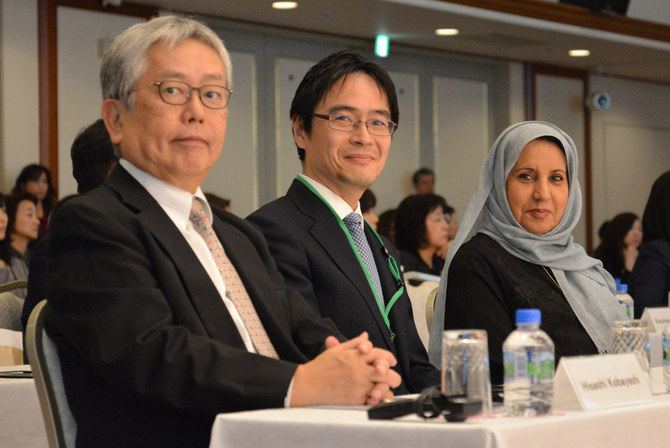
UAE-Japan Committee for Women Career Development hosts 16th forum 

Delegates from the UAE-Japan Friendship Committee for Women Career Development. (WAM)
Short Url
Updated 05 June 2023
Follow

UAE-Japan Committee for Women Career Development hosts 16th forum 

  • Forum was held under the patronage of Sheikha Fatima bint Mubarak

DUBAI: The UAE-Japan Friendship Committee for Women Career Development held its 16th forum in Abu Dhabi with the aim of empowering women in the energy industry, Emirates News Agency reported on Monday. 

The forum was held under the patronage of Sheikha Fatima bint Mubarak, chairwoman of the General Women’s Union. It was also attended by Dr. Maitha Salem Al-Shamsi, the UAE’s minister of state, executive director of Japan Cooperation Center Petroleum, Tsuyoshi Nakai, senior leaders at Abu Dhabi National Oil Co., as well as delegates from energy companies from the UAE, Japan and other Gulf countries.

During her address, Al-Shamsi reaffirmed her continuous support for forums which bolster ties between the UAE and Japan and which unlock women’s potential. 

“The oil and gas industry has made great progress towards gender diversity, but there is still a long way to go to ensure that women in this sector receive equal benefits in terms of performance and productivity,” Al-Shamsi said. 

“To achieve this, more opportunities need to be provided for women to participate and build confidence in their ability to work in the frontline and across all fields. 

“I commend ADNOC for recognising that the growth and success of the organization depends on a skilled, diverse, and committed workforce.”

As part of its 2030 Sustainability Strategy, ADNOC is striving to become a regional leader in diversity and employee development.

ADNOC Offshore CEO Tayba Al-Hashemi said: “Women are key to a more sustainable future. 

“Under the guidance of Dr. Sultan bin Ahmed Al-Jaber, minister of industry and advanced technology and ADNOC managing director and group CEO, ADNOC has made excellent progress empowering females, and we have ambitious plans to double female representation in technical positions to 25 percent by 2030.

“We need diverse thinking to deliver the maximum energy and minimum emissions the world needs, and in line with the UAE leadership’s vision, we will continue to empower women and ensure all our people can unlock their potential to help build a more sustainable future.”


GCC states ‘face reliance on Saudi Arabia for food imports’

Updated 06 March 2026
Follow

GCC states ‘face reliance on Saudi Arabia for food imports’

  • With 70 percent of food coming through Strait of Hormuz, analysts warn of inevitable shortages

DUBAI: Some Gulf states may have to rely on overland food deliveries from Saudi Arabia if the US-Israel-Iran war continues to disrupt shipping through the Strait of Hormuz and restrict regional airspace, analysts warned on Thursday.
The region is up to 90 percent dependent on food imports, and price surges and scarcity of some goods are expected.
“With over 70 percent of GCC foodstuffs being imported through the Strait of Hormuz, Gulf states face shortages if the war persists,” said Neil ​Quilliam of the Chatham House think tank. 
“While GCC countries have taken steps to diversify suppliers and ensure sufficient stores to withstand disruption, this can only last several months. At this point, price increases ​and longer lead times will start to hit the markets.”
Commodities analyst Ishan Bhanu said: “The biggest immediate effect will be due to the blockade of Jebel Ali in Dubai, serving about 50 million people. Qatar, Kuwait, Bahrain and Iraq effectively become landlocked and will depend on overland routes through Saudi Arabia.”
Bottlenecks are yet to show and the UAE has said its strategic reserves of vital goods cover four to six months of needs. It urged residents to report unjustified price increases through a dedicated hotline.
Supermarket staff ​throughout the Gulf said shelves remain largely stocked, though suppliers are taking longer to replenish certain products. Iran’s strikes on the Gulf since Saturday prompted panic buying in supermarkets, a dry run for what could come. 
“Perception of risk matters, and even if stocks are sufficient now, public runs on supermarkets can spook the public,” Quilliam said.