

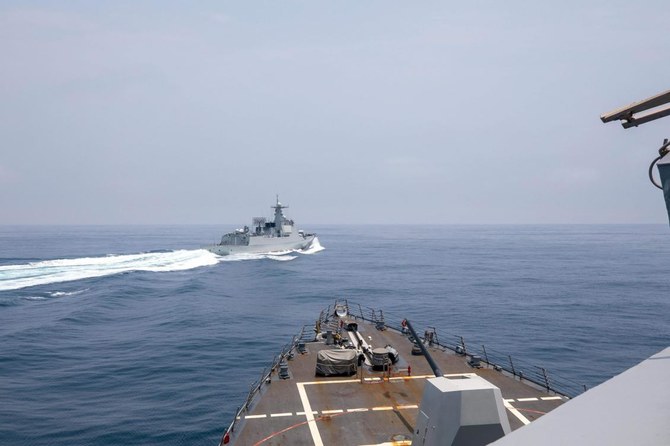

BEIJING: The maneuver of a Chinese warship in the Taiwan Strait during an encounter with a US destroyer was completely reasonable, legal, professional and “safe,” a spokesperson at China’s foreign ministry said at a press conference on Monday.
The US Navy on Sunday released a video of what it called an “unsafe interaction” in the Taiwan Strait, in which a Chinese warship crossed in front of a US destroyer in the Taiwan Strait on Saturday.
The encounter comes as both countries trade blame for not holding military talks — with disagreements between the two over everything from trade and Taiwan to Russia’s invasion of Ukraine — and raises the spectre of future face-offs that could spiral out of control.
The US military said the USS Chung-Hoon, a destroyer, and Canada’s HSMC Montreal, a frigate, were conducting a “routine” transit of the strait on Saturday when the Chinese ship cut in front of the US vessel, coming within 150 yards (137 meters).
In the video, released by the US Navy late on Sunday, a Chinese warship can clearly be seen sailing across the path of the Chung-Hoon in calm waters. The Chung-Hoon does not change course.
A voice can be heard in English, apparently sending a radio message to the Chinese ship, warning against “attempts to limit freedom of navigation,” though the exact wording is unclear because of wind noise.
’TROUBLE AND PROVOCATION’
“The measures taken by the Chinese military are completely reasonable, legitimate, and professional and safe,” said Wang Wenbin, a spokesperson at the Chinese foreign ministry.
“The US had caused trouble and provocation first, while China dealt with it in accordance with the law and regulations afterwards,” Wang told a regular press conference on Monday when asked about the video released by the US Navy.
On Saturday night, China’s military rebuked the United States and Canada for “deliberately provoking risk” with the rare joint sailing.
Chinese military commentator Song Zhongping told Reuters that this “point blank interception” was a demonstration of both the capabilities and “courage” of China’s navy.
“The more intensified the provocation from the United States, the stronger the countermeasures from China,” Song said.
It was the second such encounter in recent days.
On May 26, a Chinese fighter jet carried out an “unnecessarily aggressive” maneuver near a US military plane over the South China Sea in international airspace, according to the United States.
“It seems to me that Beijing has instructed its forces to respond more assertively against what it believes are encroaching US and allied forces,” said Derek Grossman, senior defense analyst at the RAND Corporation, a US think tank.
“By doing so, China is only increasing the chances for miscalculation — namely ships or aircraft accidentally colliding — that could then spiral into armed conflict,” he added.
In 2001, a US spy plane made an emergency landing on China’s Hainan island after a collision with a Chinese fighter jet, whose pilot died.
Taiwan’s defense ministry on Sunday called China’s actions with the US and Canadian ships “provocation” and said it was the common responsibility of free and democratic countries to maintain peace and stability in the strait.
“Any actions to increase tension and danger will not contribute to regional security,” it said in a statement.
The ministry called on China to respect the right to freedom of navigation.
China views Taiwan as its own territory, a claim the government in Taipei strongly rejects.
Beijing has been stepping up military and political pressure to try to force Taiwan to accept its sovereignty, including staging regular maneuvers near the island.


