

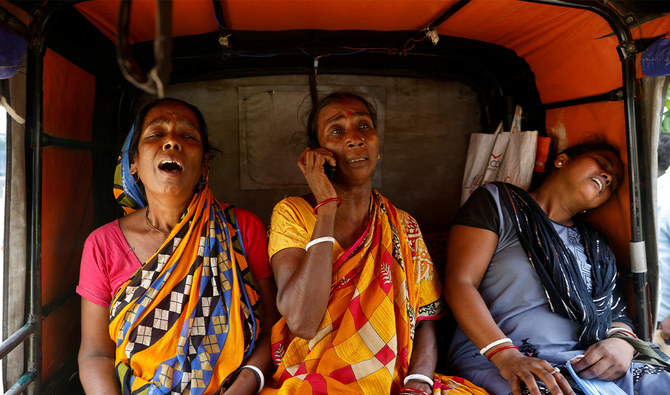

BALASORE: Gura Pallay was watching another train pass by the one he was sitting in when he heard sudden, loud screeching. Before he could make sense of what was happening, he was thrown out of the train.
Pallay, 24, landed next to the tracks along with metal wreckage of the train he’d been riding in, and instantly lost consciousness. The first thing he saw when he opened his eyes was the twisted remains of three trains on the tracks.
His train had derailed after colliding with a stopped freight train. Another passenger train, the one he had seen pass by moments earlier, had hit the derailed carriages.
“I saw it with my own eyes, but I still can’t describe what I saw. I am haunted by it,” he said Sunday at a hospital, where he lay on a stretcher with a broken leg and dark wounds on his face and arms.
Pallay is a laborer, like most of the people onboard the two passenger trains that crashed Friday in the eastern Odisha state, killing 275 people and injuring hundreds. He was traveling to Chennai city in southern India to take up a job in a paper mill factory when the Coromandel Express crashed with a goods freight train, knocking it off track, and was then hit by a second train coming from the opposite direction on a parallel track.
“I never imagined something like this could happen, but I guess it was our fate,” he said.
Investigators said Sunday that a signaling failure might have caused the three-train crash, one of the worst rail disasters in the country’s history. Authorities recommended that India’s Central Bureau of Investigations, which probes major criminal cases, open an investigation into the crash.
“We can’t bring back those we have lost, but the government is with the families in their grief. Whosoever is found guilty will be punished severely,” Prime Minister Narendra Modi said Saturday while visiting the site of the accident.
The crash occurred as Modi’s government is focusing on the modernization of India’s colonial-era railroad network.
Several survivors of the crash said they were still struggling to comprehend the disaster.
“Everything happened so quickly,” said Subhashish Patra, a student who was traveling with his family from Balasore to the state capital, Bhubaneswar, on the Coromandel Express. He was planning to take his mother to a hospital in Bhubaneswar to seek treatment for a hand injury, and then to travel to Puri, home to one of Odisha’s most important temples.
The first thing Patra could make sense of after the crash was the sound of children crying. People were screaming for help in the dark, and around him lay corpses.
“There were dead bodies all around me,” he said.
Patra said the rail carriage he was in landed with the door facing upwards. He climbed onto a pile of wreckage inside the train and managed pull himself out.
At the hospital on Sunday, Patra’s head was bandaged in gauze as he waited for an MRI scan. His head was throbbing with pain, he said, but he was grateful that he and his entire family had survived.
Others weren’t so lucky.
Alaudin, who goes by one name, traveled almost 200 kilometers (124.3 miles) Saturday from West Bengal state to the crash site, to look for his brother, who was onboard one of the trains.
He learned about the crash from television. When he tried to call his brother’s mobile phone to check on him, no one answered.
Worried, he and his sister-in-law rushed to the site of the crash afterwards and spent all of Saturday looking for him in various hospitals, hoping he would be alive. But his brother’s whereabouts remained unknown as the death toll continued to rise.
Distraught, they finally made their way to the mortuary, where Alaudin’s brother body was wrapped in a black plastic bag and placed on top of blocks of melting ice.
“I lost my brother, she lost her husband,” Alaudin said, pointing to his sister-in-law. “And his two boys have lost a father.”
His brother was 36 years old, Alaudin said.


