

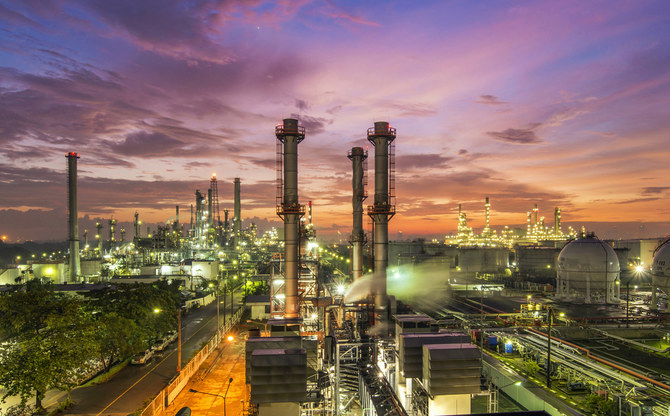
Saudi Arabia, China contemplate energy security through petrochemical JVs

Both nations discussed ways to boost ties in energy sector and help achieve the goals outlined in Saudi Vision 2030 and China’s Belt and Road Initiative. 
Short Url
Updated 04 June 2023
Follow

Saudi Arabia, China contemplate energy security through petrochemical JVs

RIYADH: Saudi Arabia and China are collaborating to ensure safe energy supplies in their markets by planning to establish petrochemical joint ventures.

Saudi Minister of Energy Abdulaziz Al-Saud held a meeting with the chairman of the National Energy Authority of the Republic of China, Zhang Jianhua, in Riyadh to discuss JVs that will transform crude oil into petrochemicals and develop innovative uses of hydrocarbons, nuclear energy and fuel. 

Both nations are working to increase collaboration in the energy sector’s supply chains. 

Al-Saud and Zhang also discussed ways to boost ties between the countries in numerous energy fields, which will help achieve the goals outlined in Saudi Vision 2030 and China’s Belt and Road Initiative. 

Further collaborations between both countries are anticipated as the Kingdom is set to host the 10th session of the Arab-Chinese Business Conference and the eighth Investment Symposium. 

Set to take place between June 11 and 12 in Riyadh, the conference is expected to be the largest Arab-Chinese gathering for business and investment. 

It will host over 2,000 participants, including high-level government representatives, senior officials, CEOs, investors and entrepreneurs.

“Collaborating for Prosperity” aims to boost cooperation in the economy, trade and investment to achieve solutions of mutual interest to Arab nations and China through strategic collaboration. 

It is organized by the Kingdom’s investment and foreign affairs ministries in partnership with the Chinese Council for the Promotion of International Trade and several government agencies. 

Saudi Investment Minister Khalid Al-Falih said that trade and cultural ties between Arab countries and China extended over 2,000 years and that the conference reflected that historical relationship. 

He added that Saudi-Chinese relations had developed, especially following King Salman’s visit to China in 2017 and the two historic visits by Crown Prince Mohammed bin Salman to Beijing in 2016 and 2019. 

Trade in 2022 between the Arab countries and China reached SR1.6 trillion ($430 billion), a 31 percent increase from the previous year. 

Saudi Arabia led the way with trade between the countries reaching around SR400 billion ($106 billion), a 30 percent increase over 2021.  


As world fractures, experts weigh in on the politics of AI at WGS

Updated 26 sec ago
Follow

As world fractures, experts weigh in on the politics of AI at WGS

  • e& group CEO Hatem Dowidar said there was increasing pressure to choose between the Chinese and US ecosystems

DUBAI: Across three days of rigorous debate at the World Government Summit in Dubai, experts from some of the world’s largest tech and telecommunication companies debated what the future political landscape of artificial intelligence development would be.

Speaking at the summit on Thursday, e& group CEO Hatem Dowidar said there was increasing pressure to choose between the Chinese and US ecosystems, which could have impacts on the sovereign capabilities of countries, like Gulf Cooperation Council member states, which thus far have stayed in the middle.

“I think the fracture and the pressure today is if you use this technology, you cannot use the other. You must separate them completely and this is something that never happened before,” Dowidar said.

He warned that whilst people around the world currently have access to both the leading large language models in the US and China, ChatGPT and Deepseek, this would not always be the case, and middle powers would need to develop their own capability to maintain their sovereignty.

“Europe is trying to find its own way as well, because Europe — having been caught now in the middle — they don’t have platforms, they don’t have the data center capability,” he said.

“So now, Europe is focusing a lot on building sovereign capability, sovereign data centers to run AI applications within Europe.”

Dowidar said the GCC had been ahead of the curve in this regard, having worked out early on that sovereign capability would be necessary in the new multipolar world and subsequently investing heavily in local infrastructure and capability.

“We were lucky here in the region that already — I would say a couple of years ago —we have kind of ironed out how this works,” he said.

“I think that everyone will try to see how they can either utilize the global platforms in a sovereign manner, or they end up trying to push to develop their own platforms.” 

This sentiment was echoed by Chamath Palihapitiya, the founder and managing partner of Social Capital, who said that China’s dedication to open-source models — whose code is released under a license granting users rights to view, study, modify, and redistribute it freely — could make Chinese AI more popular in the long run for nations looking to keep some level of sovereignty.

“I do think that there are a handful of American open-source models that are quite good. I think Nvidia’s models are excellent. But in fairness, the Chinese open-source models are just superb,” he told the summit on Wednesday.

“It’s going to be important for every country to make their own decisions about their own sovereignty, and in that realm, I think the open-source models provide the clearest path, because it just gives you total transparency to what’s happening underneath the hood.”

This was reiterated by Joseph Tsai, the chairman and co-founder of Alibaba Group, who said Chinese open-source systems would be favored by middle powers — but warned they had yet to find a way to be economically self-sufficient. 

“Because countries care about the sovereignty aspect and care about their data privacy, you can take an open-source model and deploy it on your own infrastructure … giving you ownership and control” he said.

“But it remains to be seen how economically all the model companies are going to make it sort of sustainable with an open-source approach … This is the biggest challenge for the Chinese firms.”