

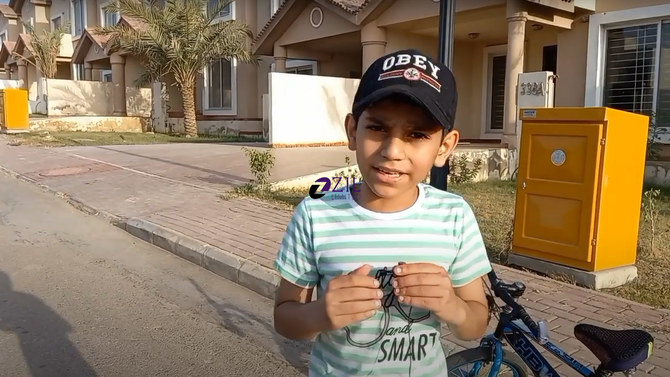
‘Embracing life’: Inspiring journey of Pakistani child battling cancer one YouTube video at a time

Short Url
Updated 03 June 2023
Follow

‘Embracing life’: Inspiring journey of Pakistani child battling cancer one YouTube video at a time

  • Owais Shehzad, only nine years old, believes in celebrating life’s little wonders amid adversity
  • He finds solace in dancing and creating videos, portraying himself as any other fun-loving child

KARACHI: A young Pakistani child started sharing life’s fleeting moments on YouTube from the confines of a small room in his multistory residence in Karachi’s Baldia Town neighborhood after discovering that he was suffering from a debilitating disease.

Owais Shehzad, only nine years old, has been battling cancer for the last five years. Despite enduring intensely painful medical treatments, he found solace in dancing and creating videos, portraying himself as any other fun-loving child.

“I could neither eat nor drink, and I lost my hair and eyebrows due to chemotherapy,” he recalled, as he started reflecting on the days of enduring severe cancer treatment that caused mouth inflammation and painful blisters. “I lost my nails. It seemed like I was an alien who had come from another planet.”

“I was half-dead, yet I managed to handle the disease,” he added with a degree of pride. “My eyes sunk deep, and I could neither eat nor drink due to the blisters.”
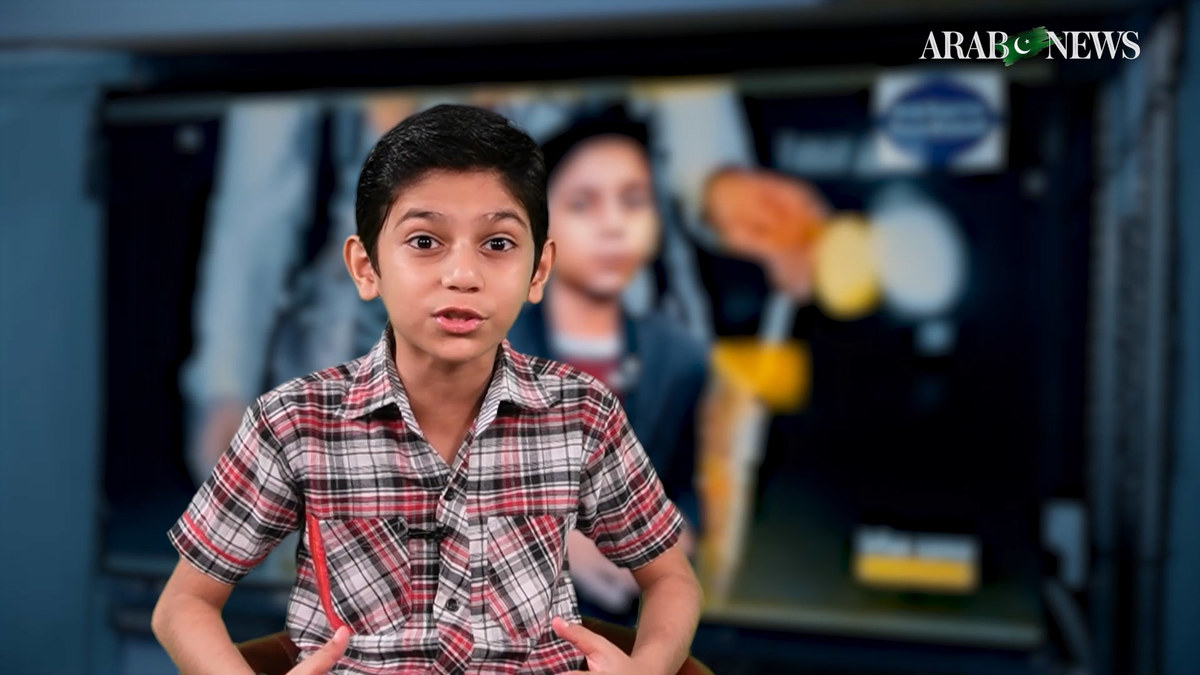


The still image taken from a video recorded on June 1, 2023 shows Owais Shehzad, a child youtuber from Karachi, Pakistan. (AN Photo)

Owais’s battle with cancer hasn’t stopped since he has been diagnosed with a type of blood cancer in which the harmful pathogens never truly go away. However, the painful treatments he endured over the last five years have kept him alive.

His passion for dance also brought him happiness even in the darkest moments, and he served as an inspiration to fellow cancer patients at the hospital.

“My bone marrow test was done and fluid was drained through an IV injection in my back,” he said. “Even in that situation, I was dancing on the bed... I was motivating children, and they were happy to see me.”



The still image taken from a video recorded on June 1, 2023 shows Owais Shehzad, a child youtuber from Karachi, Pakistan. (AN Photo)

“Not only did it cheer me up, but it also brought happiness to the entire Indus Hospital, the children in the cancer ward, and my parents as well,” he reminisced.

Owais admitted to shedding tears, however, when he closed the door of his room, not wanting his parents to be hurt by his struggles.

He said that the road ahead remained uncertain, though he had always wanted to adopt a joyful and enthusiastic approach to life.

Nadeem Shehzad, Owais’s father and a local journalist, acknowledged that his son’s resilience uplifted the spirits of other parents when they were feeling weak.

“As a father, it was extremely difficult to witness my son in pain,” he told Arab News. “Whenever our strength and spirits wavered, we received a boost by witnessing the spirit and strength of this child.”

He informed that Owais had been diagnosed with B-all type blood cancer, with a recovery ratio ranging from two to five percent, which necessitates constant care to keep him alive.

“While treatment and care can prolong his life, the germs still remain in his body, and without complete care, they can become active at any time,” Nadeem explained, adding that it was also the reason why his son could not continue attending school.

Despite being unable to pursue education in a formal setting due to health issues, Owais’s passion for compels him to wear a school uniform and keep a bag at home.

“I wish to go to school,” he said. “However, my disease is such that I can neither sit nor stand due to the injections.”

Last year, the nine-year-old had one of his longstanding desires fulfilled when he embarked on a journey to Saudi Arabia for the Umrah pilgrimage.

“I had always wished to perform Umrah, to visit the house of Allah and witness His divine abode. Allah granted me an invitation... The experience of Umrah was truly amazing, and now I also aspire to perform Hajj,” he shared with gratitude.
Owais believes that those who remain happy even in sickness bring joy to God as well.

“May Allah grant me a long life, but whatever life I have, I’m living it to the fullest,” he said. “Currently, I am embracing life with utmost spirit and enthusiasm.”

He added that he harbors deep love for both journalism and the army, making his professional destination uncertain in life.

“Let’s see which of these two paths life takes me on,” he smiled.


IMF warns against policy slippage amid weak recovery as it clears $1.2 billion for Pakistan

Updated 11 December 2025
Follow

IMF warns against policy slippage amid weak recovery as it clears $1.2 billion for Pakistan

  • Pakistan rebuilt reserves, cut its deficit and slowed inflation sharply over the past one year
  • Fund says climate shocks, energy debt, stalled reforms threaten stability despite recent gains

ISLAMABAD: Pakistan’s economic recovery remains fragile despite a year of painful stabilization measures that helped pull the country back from the brink of default, the International Monetary Fund (IMF) warned on Thursday, after it approved a fresh $1.2 billion disbursement under its ongoing loan program.

The approval covers the second review of Pakistan’s Extended Fund Facility (EFF) and the first review of its climate-focused Resilience and Sustainability Facility (RSF), bringing total disbursements since last year to about $3.3 billion.

Pakistan entered the IMF program in September 2024 after years of weak revenues, soaring fiscal deficits, import controls, currency depletion and repeated climate shocks left the economy close to external default. A smaller stopgap arrangement earlier that year helped avert immediate default, but the current 37-month program was designed to restore macroeconomic stability through strict monetary tightening, currency adjustments, subsidy rationalization and aggressive revenue measures.

The IMF’s new review shows that Pakistan has delivered significant gains since then. Growth recovered to 3 percent last year after shrinking the year before. Inflation fell from over 23 percent to low single digits before rising again after this year’s floods. The current account posted its first surplus in 14 years, helped by stronger remittances and a sharp reduction in imports. And the government delivered a primary budget surplus of 1.3 percent of GDP, a key program requirement. Foreign exchange reserves, which had dropped dangerously low in 2023, rose from US$9.4 billion to US$14.5 billion by June.

“Pakistan’s reform implementation under the EFF arrangement has helped preserve macroeconomic stability in the face of several recent shocks,” IMF Deputy Managing Director Nigel Clarke said in a statement after the Board meeting.

But he warned that Islamabad must “maintain prudent policies” and accelerate reforms needed for private-sector-led and sustainable growth.

The Fund noted that the 2025 monsoon floods, affecting nearly seven million people, damaging housing, livestock and key crops, and displacing more than four million, have set back the recovery. The IMF now expects GDP growth in FY26 to be slightly lower and forecasts inflation to rise to 8–10 percent in the coming months as food prices adjust.

The review warns Pakistan against relaxing monetary or fiscal discipline prematurely. It urges the State Bank to keep policy “appropriately tight,” allow exchange-rate flexibility and improve communication. Islamabad must also continue raising revenues, broadening the tax base and protecting social spending, the Fund said.

Despite the progress, Pakistan’s structural weaknesses remain severe.

Power-sector circular debt stands at about $5.7 billion, and gas-sector arrears have climbed to $11.3 billion despite tariff adjustments. Reform of state-owned enterprises has slowed, including delays in privatizing loss-making electricity distributors and Pakistan International Airlines. Key governance and anti-corruption reforms have also been pushed back.

The IMF welcomed Pakistan’s expansion of its flagship Benazir Income Support Program, which raises cash transfers for low-income families and expands coverage, saying social protection is essential as climate shocks intensify. But it warned that high public debt, about 72 percent of GDP, thin external buffers and climate exposure leave the country vulnerable if reform momentum weakens.

The Fund said Pakistan’s challenge now is to convert short-term stabilization into sustained recovery after years of economic volatility, with its ability to maintain discipline, rather than the size of external financing alone, determining the durability of its gains.