

International artists explore Saudi landscape in new exhibition

1 / 3
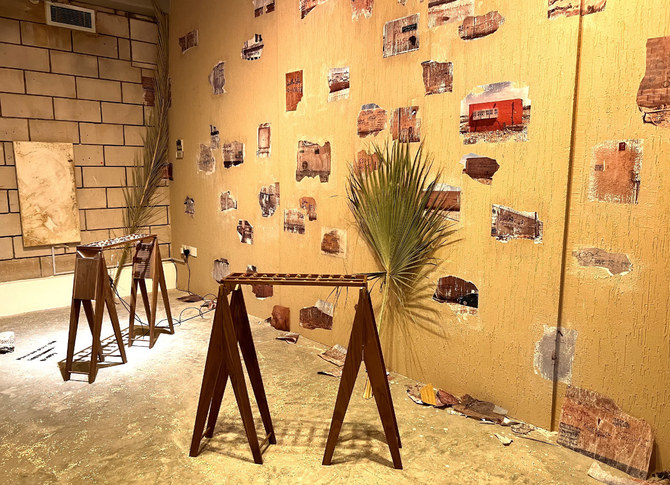
Artist Dia Mrad found hope for Riyadh’s architecture in his studio. The Lebanese photographer spent months in researching to create the work ‘Traditions of Change.’ (AN photo)
2 / 3
Liao Lihong, a Chinese artist living in Paris, derives an innovative technique to music creation from ancient devices: the abacus, used for math calculations, which she assimilated to the Arabian Qanun and Oud instruments in its shape during her time in the residency. (AN photo)
3 / 3
Areej Khaoud's studio wall is postered with phrases: ‘Can one heal uprootedness with food?’ ‘Is being home a state of ‘non-hunger’?’ ‘Insatiable in diaspora.’ (AN photo)
Short Url
Updated 03 June 2023
Follow

International artists explore Saudi landscape in new exhibition

  • Misk Art Institute’s latest Masaha Residency art showcase features 11 global and local artists and two writers whose

RIYADH: The Misk Art Institute’s latest Masaha Residency art showcase features 11 global and local artists and two writers whose projects explore tradition in the context of social development.

The fifth cycle of the three-month cross-cultural program brought together an international cohort of artists to develop fresh, research-driven art projects. Through architecture, music, and culture, several artists discovered traces of their own homes in the Saudi landscape.

Fahdah Althonayan, director of the education department at Misk, told Arab News: “Each cycle has its own uniqueness. Within this one, we had the opportunity to experiment with dual artists … it is a new thing that we tried with (them) to work together on their artwork, which surprised us as well.
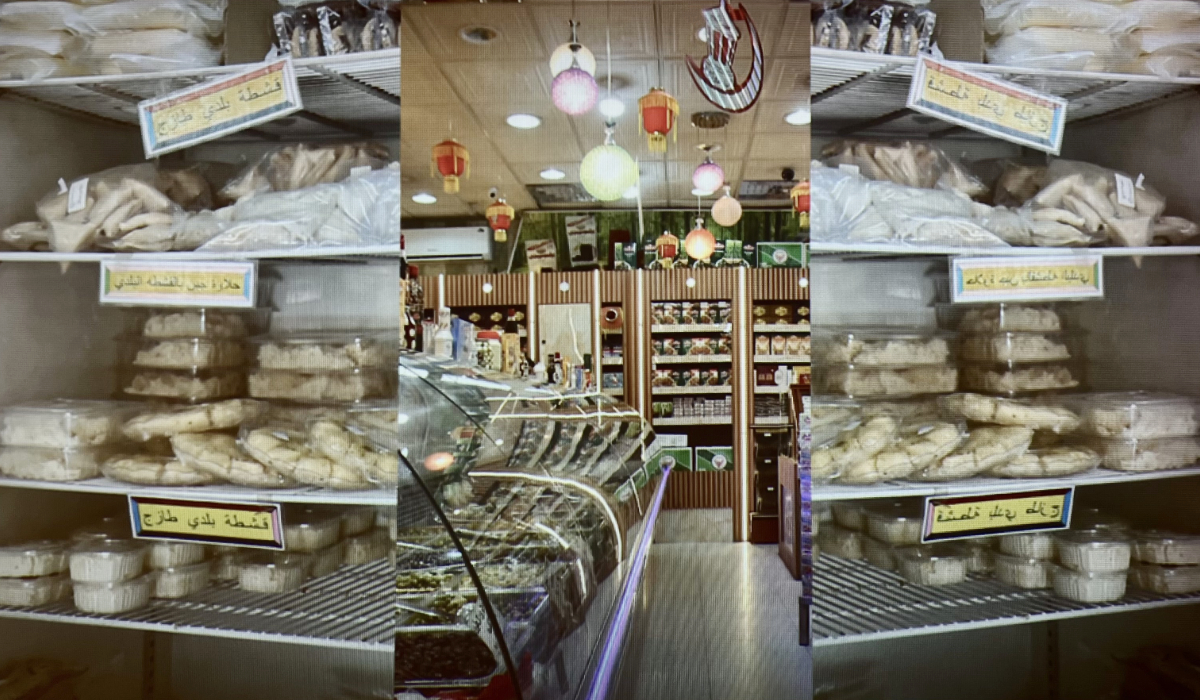


Palestinian artist Areej Khaoud, who currently lives and works in London, took to the marketplaces of Riyadh to find remanences of belonging in her piece ‘Still Hungry.’ (AN photo)

“The variety of Saudi, khaleeji, and foreigners from different continents was amazing. It is an enriching experience.”

Ilyas Hajji, a photographer, and Nastya Indrikova, a researcher, are a Russian duo who worked on reconstructing the Hajj pilgrimage route, which was often dangerous.

Although it was modernized, many still struggled to make the trip from Russia, including the Muslim population in Dagestan during and after the fall of the Soviet Union.
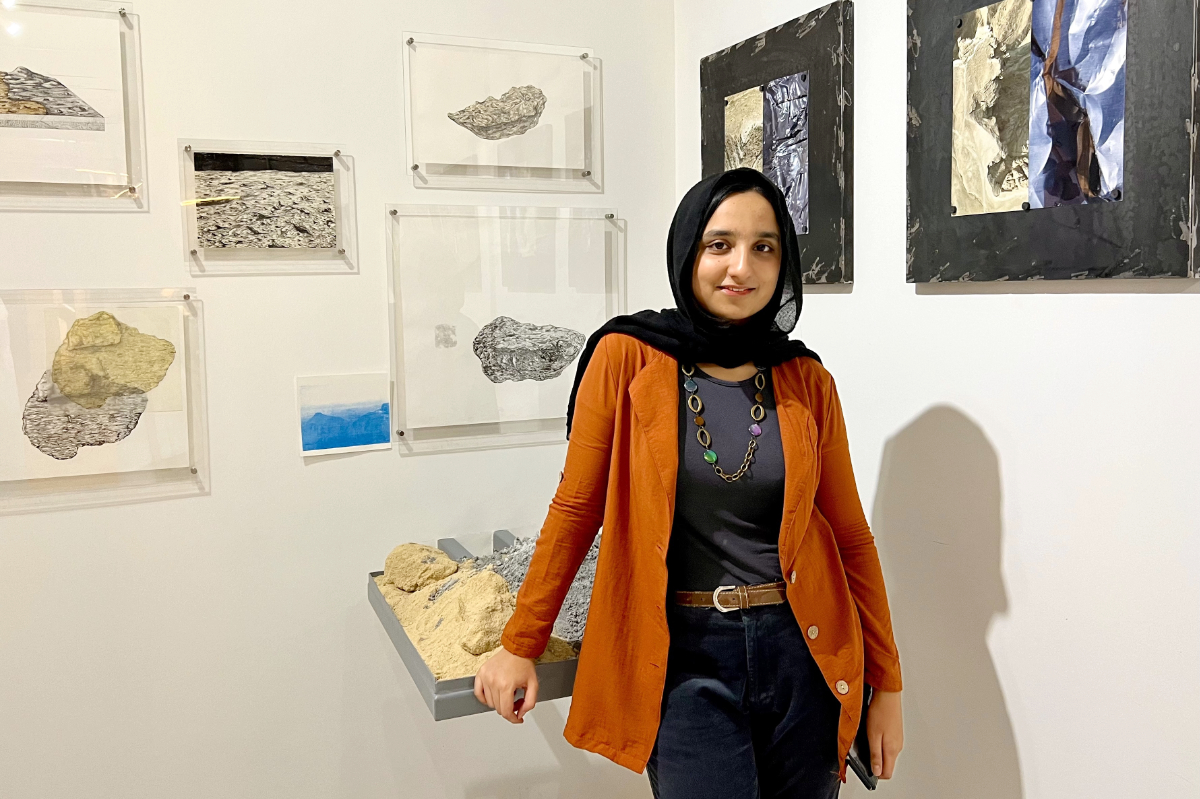


Aleena Khan's artwork, “A Calling from the Moon,” toys with a popular Myth in Pakistan that the call to prayer, Adhan, was heard upon Neil Armstrong’s arrival to the moon. (AN photo)

The pair used items brought back from Hajj to highlight the effect on millions who were free to travel after the union’s dissolution.

Palestinian artist Areej Kaoud, who lives and works in London, took to the marketplaces of Riyadh to find a sense of belonging in her piece “Still Hungry.”

“In all these spaces, they pick things. You think that the owner is just trying to sell you things but he’s also trying to heal his own uprootedness,” Kaoud told Arab News.
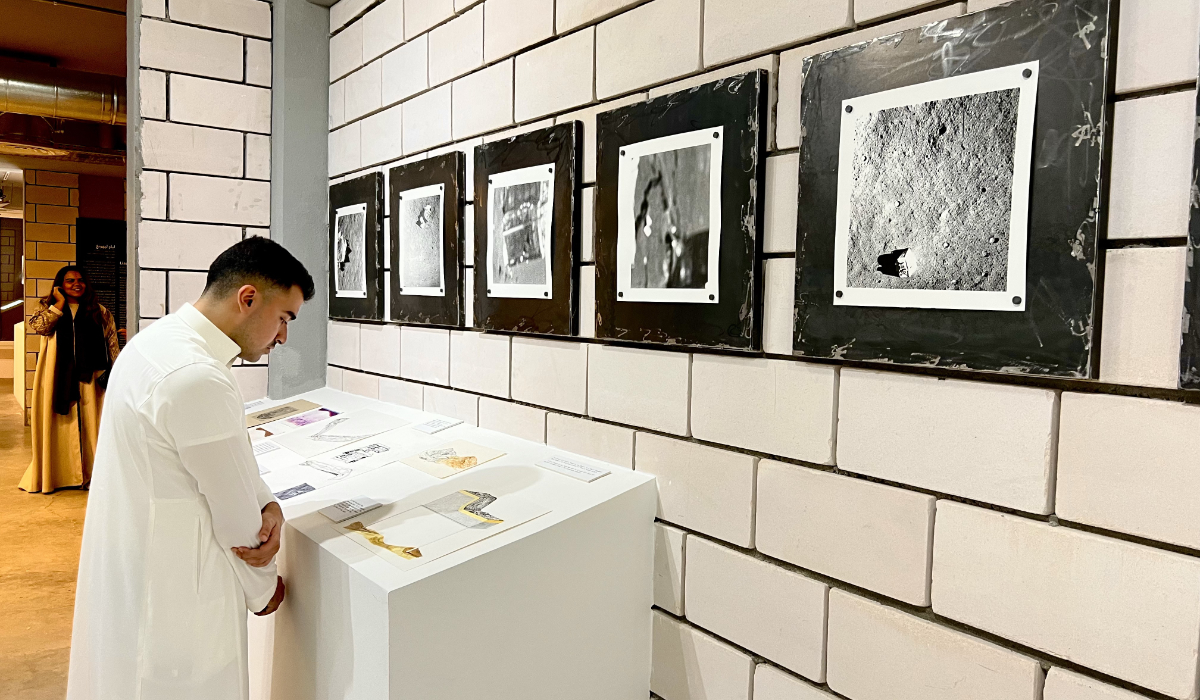


Drawing comparison between the moon landing and the Arabian desert landscape, Khan's parafiction multimedia work diffuses the idea of universality and explores a more subjective path to truth. (AN photo)

Kaoud’s studio is the backdrop for a video documenting the offerings of a market staffed by diaspora from other countries, who preserve and share the traditions of back home.

The studio wall is covered with phrases including “Can one heal uprootedness with food?,” “Is being home a state of ‘non-hunger’?” and “Insatiable in diaspora.”

Liao Lihong, a Chinese artist living in Paris, merged an abacus with the shapes of a qanun and an oud to create a unique musical instrument.
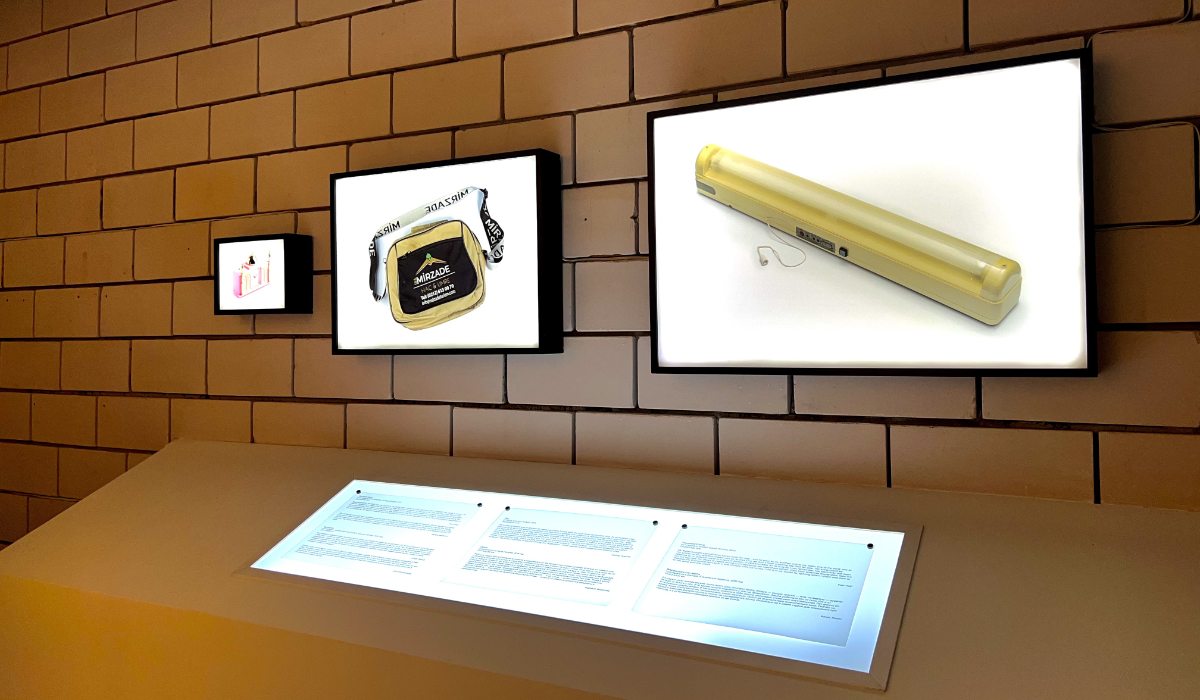


Centering the fall of the Soviet Union, the Russian artist duo Ilyas Hajji and researcher Nastya Indrikova, highlighted the presence of millions who were once again free to travel, made concrete through the items they brought back from their Hajj journey. (AN photo)

“When I studied in China in elementary school, we had a class using the abacus, but now we do not use it anymore because we have calculators,” she said. “But the sound (they make) was always in my mind. The idea is when people use the abacus to calculate numbers, it also plays music."

Aleena Khan bolsters Saudi Arabia’s historical first — a female astronaut and her colleague reaching the International Space Station last month.

Her artwork “A Calling from the Moon” toys with a popular myth in Pakistan that the Adhan, the call to prayer, was heard by Neil Armstrong on the moon.
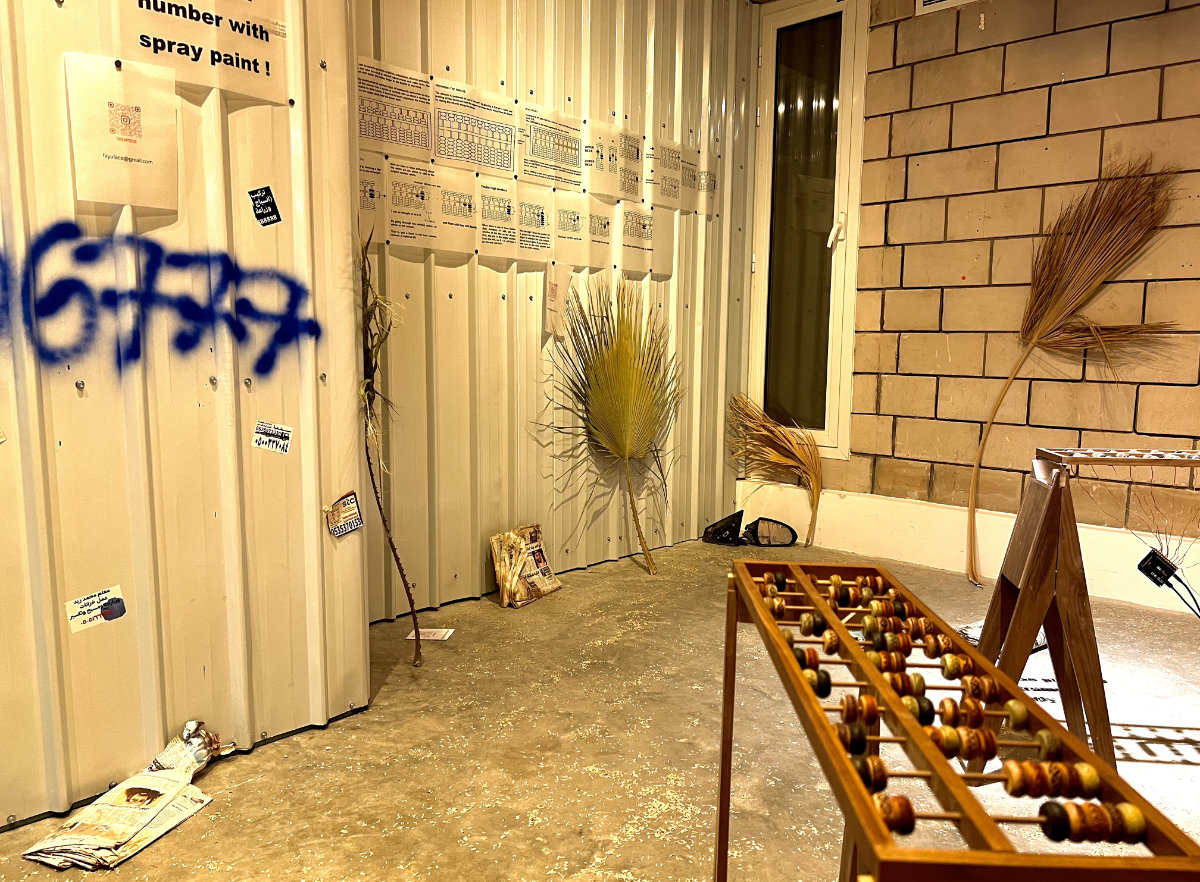


Taking collected receipts from her stay and graffiti-d numbers across the city as inspiration for “sheet music,” Lihong fabricated a way for the numbers to create sounds on the abacus using a computing method. (AN photo)

Her work draws comparisons between the moon’s landscape and an Arabian desert.

She said: “I started to draw what the material on the moon looks like and then I sourced anything that looks similar to it and took it to the desert and shot it.

“What if these landscapes were one?”

In the fragments of Riyadh’s demolished architecture, artist Dia Mrad found hope for their new beginning in his studio. The Lebanese photographer spent months researching and photographing changes in the city’s neighborhoods to create the work “Traditions of Change.”

In line with his practice, which looks to extract narratives from a built environment, he screen-printed fallen pieces of debris with photos of homes that are scheduled for demolition in Riyadh.

“The Kingdom goes through cycles of change — every 30 or 40 years, a big change happens. The latest change that’s happening is Vision 2030, and it’s such a massive change that it’s affecting everything and it’s manifesting largely within the built environment. The history of a city is embedded within its materiality,” Mrad explained.

The exhibition, which spans various mediums including installation, textile, silkscreen and Arabic writing among others, can be viewed at the Prince Faisal bin Fahd Arts Hall in Riyadh until June 10.


Threat to Kingdom’s security is ‘red line’ that will be ‘addressed and neutralized,’ Saudi envoy says

Updated 14 January 2026
Follow

Threat to Kingdom’s security is ‘red line’ that will be ‘addressed and neutralized,’ Saudi envoy says

  • Abdulaziz Alwasil tells UN Security Council the situation in southern Yemen is ‘a just cause with social and historic dimensions’ that can only be resolved through dialogue
  • Recent military activity in the south was unilateral, resulting in an escalation that harms the interests of Yemeni people and undermines efforts to address issues in the south, he said

NEW YORK CITY: Any attempt to threaten Saudi Arabia’s national security is a “red line” and will be met with decisive action, the Kingdom’s ambassador to the UN told the Security Council on Wednesday.

Speaking during a meeting of the council to discuss Yemen, Abdulaziz Alwasil said the situation in the south of the country is “a just cause with social and historic dimensions” that can only be resolved through dialogue.

“We stress that any attempt to threaten our national security is a red line, and we will not hesitate to take the necessary actions and steps to address it and neutralize it,” he added.

Alwasil reaffirmed Saudi Arabia’s support for Yemeni President Rashad Al-Alimi, the Presidential Leadership Council, and the Yemeni government in their efforts to achieve security, stability, development and peace while preserving national unity.

He said military activity by Southern Transitional Council forces in Hadramout and Al-Mahra on Dec. 2, 2025, was unilateral, did not have the approval of the Presidential Leadership Council, and was not carried out in coordination with the Coalition to Restore Legitimacy in Yemen.

It had resulted in an unjustified escalation that harmed the interests of the Yemeni people, undermined efforts to address the issues in the south, and ran counter to the coalition’s objectives, Alwasil added.

The Kingdom, working with its coalition partners, the Presidential Leadership Council and the Yemeni government, had moved to contain the situation by dispatching a military force to coordinate arrangements with the Southern Transitional Council in Aden, he said.

The aim was to ensure the return of the southern council’s forces to their previous positions outside of Hadramout and Al-Mahra, and the handover of camps to legitimate government forces and local authorities in line with agreed procedures, Alwasil added.

He expressed regret over the military operations that took place in Hadramout and Al-Mahra, close to Saudi Arabia’s southern border, which he said posed a direct threat to the Kingdom’s national security, as well as the security of Yemen and regional stability. Such steps were extremely dangerous, he added, and contradicted the principles on which the Coalition to Restore Legitimacy in Yemen had been founded.

Alwasil welcomed a prisoner and detainee exchange agreement signed in Muscat on Dec. 23, which he described as an important humanitarian measure to alleviate suffering and build confidence.

He praised Oman for hosting and sponsoring the consultations and supporting negotiations, and commended the efforts of UN’s special envoy for Yemen, Hans Grundberg, the International Committee of the Red Cross and all others that has played a part.

Regarding the political efforts to resolve the crisis, Alwasil said Saudi Arabia welcomed President Al-Alimi’s call for an inclusive conference in Riyadh to bring together all stakeholders to discuss just solutions to the situation in southern Yemen.

Preparations for the conference have begun, he added, in cooperation with the Yemeni government and southern representatives, reflecting the close ties between the two countries and their shared interests in stabilizing Yemen.

He urged all southern stakeholders to participate actively and constructively in the talks, to help find comprehensive and just solutions that meet the legitimate aspirations of the people of southern Yemen.

Alwasil called on all Yemeni forces and stakeholders to cooperate and intensify their efforts to reach a lasting political settlement that would ensure security and stability.

He described the southern issue as “a just cause with social and historic dimensions,” adding that “the only way to address it is through dialogue that leads to a comprehensive political solution” based on nationally and internationally agreed terms of reference.