

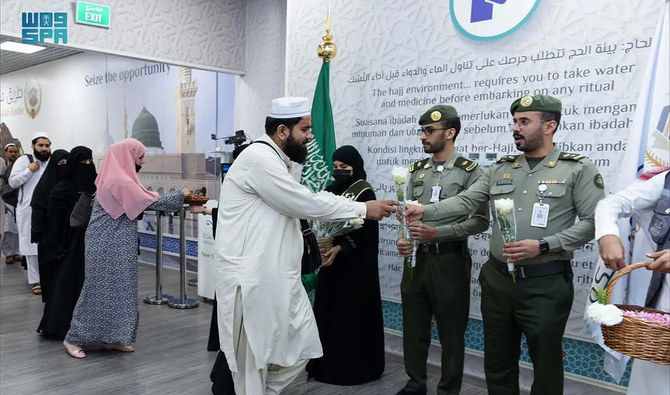
Direct Hajj flights from Pakistan to Makkah to commence from June 5

In this picture taken, on May 22, 2023, a Pakistani Hajj pilgrim arrives at the Prince Mohammad bin Abdulaziz International Airport in Madinah, Saudi Arabia. (Photo courtesy: Saudi Press Agency)
Short Url
Updated 02 June 2023
Follow

Direct Hajj flights from Pakistan to Makkah to commence from June 5

  • Pakistan has so far only transported pilgrims performing Hajj under the official scheme to Madinah
  • People traveling straight to Makkah will have an eight-day stay in Madinah after finishing their Hajj

ISLAMABAD: Pakistan is prepared to initiate direct Hajj flights to the holy city of Makkah from Monday, confirmed an official statement released by the religious affairs ministry this week.

The government started transporting pilgrims to Saudi Arabia under the official Hajj scheme on May 21. However, these flights from the country have only landed in Madinah so far.

Many of the Pakistani pilgrims in the kingdom have also started moving to Makkah, as the annual Islamic pilgrimage draws closer.

“The first direct flights from Pakistan to Jeddah Airport are scheduled to begin on June 5,” the ministry said in a recent statement.

According to the state-owned Associated Press of Pakistan (APP) news agency, the flights to Makkah will be operated from 10 cities in the country, including Rahim Yar Khan and Sukkur.

The pilgrims, who will directly travel to Makkah, will have an eight-day stay in Madinah after finishing Hajj.

Pakistan will launch the post-hajj flight operation to bring back its nationals from Saudi Arabia on July 4.

The kingdom restored Pakistan’s pre-pandemic Hajj quota of 179,210 pilgrims in January and removed the upper age limit of 65.

The country plans to send 80,000 people to perform pilgrimage under the government scheme while the rest of them will be facilitated by private tour operators.


Pakistan to promote mineral sector at Saudi forum this month with 13 companies

Updated 02 January 2026
Follow

Pakistan to promote mineral sector at Saudi forum this month with 13 companies

  • Delegation will take part in the Future Minerals Forum in Riyadh from Jan. 13-15
  • Petroleum minister will lead Pakistan, participate in a 90-minute country session

ISLAMABAD: Around 13 Pakistani state-owned and private companies will attend the Future Minerals Forum (FMF) in Saudi Arabia from Jan. 13 to 15, an official statement said on Friday, as the country seeks to ramp up global engagement to develop its mineral resources.

The FMF is an international conference and investment platform for the mining sector, hosted by mineral-rich countries to attract global investors, companies and governments.

Petroleum Minister Ali Pervaiz Malik confirmed Pakistan’s participation in a meeting with the Saudi envoy, Nawaf bin Said Al-Malki.

Pakistan hosts one of the world’s largest copper-gold zones. The Reko Diq mine in southwestern Balochistan, with an estimated 5.9 billion tons of ore, is partly owned by Barrick Gold, which calls it one of the world’s largest underdeveloped copper-gold deposits. Its development is expected to boost Pakistan’s struggling economy.

“Upon an invitation of the Government of the Kingdom of Saudi Arabia, the Federal Minister informed the Ambassador that Pakistan will fully participate in the upcoming Future Minerals Forum (FMF), scheduled to be held in Riyadh later this month,” Pakistan’s Press Information Department (PID) said in an official statement.

The Pakistani minister will lead his country’s delegation at the FMF and take part in a 90-minute country showcase session titled “Unleashing Potential: Accelerating Pakistan’s Mineral Revolution” along with local and foreign investors.

Pakistan will also establish a dedicated pavilion to highlight the vast potential of its rich geological landscape to the global mineral community.

The Saudi envoy welcomed Pakistan’s decision to participate in the forum and discussed enhancing bilateral cooperation in the minerals and energy sectors during the meeting.

According to the statement, he highlighted the potential for cooperation between Saudi Arabia and Pakistan in the minerals and energy sectors, expressing confidence that the FMF would provide a platform to expand collaboration.
Pakistan’s mineral sector, despite its rich reserves of salt, copper, gold and coal, contributes only 3.2 percent to the country’s GDP and just 0.1 percent to global mineral exports.

However, many countries, including the United States, have shown interest in Pakistan’s underdeveloped mineral sector, particularly in copper, gold and other critical resources.

In October, Pakistan dispatched its first-ever shipment of rare earth and critical minerals to the United States, according to a Chicago-based US public relations firm’s report.