

Indian fishermen released from Pakistani jail remember fellow inmates who died last month

Two Indian fishermen are pictured as they depart from a railway station after Pakistan authorities released them, in Karachi on June 1, 2023, allegedly arrested for trespassing into its territorial waters. (AN photo)
Short Url
Updated 01 June 2023
Follow

Indian fishermen released from Pakistani jail remember fellow inmates who died last month

  • Pakistan releases 200 Indian fishermen from Malir prison as goodwill gesture toward India 
  • Two Indian fishermen in Malir prison passed away last month due to health complications

KARACHI: Pakistani authorities released 200 Indian fishermen on Thursday, who expressed happiness at the thought of meeting their families again but were sad to leave behind fellow Indian prisoners who passed away in Malir prison. 

Indian and Pakistani fishermen are routinely detained by both maritime agencies on charges of illegally entering each other’s territorial waters. The nuclear-armed nations’ borders are not clearly defined in the Arabian Sea and many fishing boats lack the technology to steer clear of any intrusion.

Karachi’s Malir prison has been in the headlines since the past year after several detainees of Afghan and Indian origin passed away due to health complications. In May, two Indian fishermen Balo Jetha and Soma Deva passed away after their health deteriorated in prison. Jail authorities insist inmates are treated well and provided medical treatment whenever they fall ill. 

Parmar Sajjan, one of the Indian fishermen released on Thursday, expressed joy at being released but said he would miss his friend Deva, whose body is currently kept at a morgue in Karachi. 

“We used to live together [in jail], and if he were alive, he would have accompanied us [to India],” Sajjan told Arab News. “I am happy, and I believe he would have been happy too,” he added. Sajjan said his friend was provided health care in jail before he was taken to the hospital for treatment.
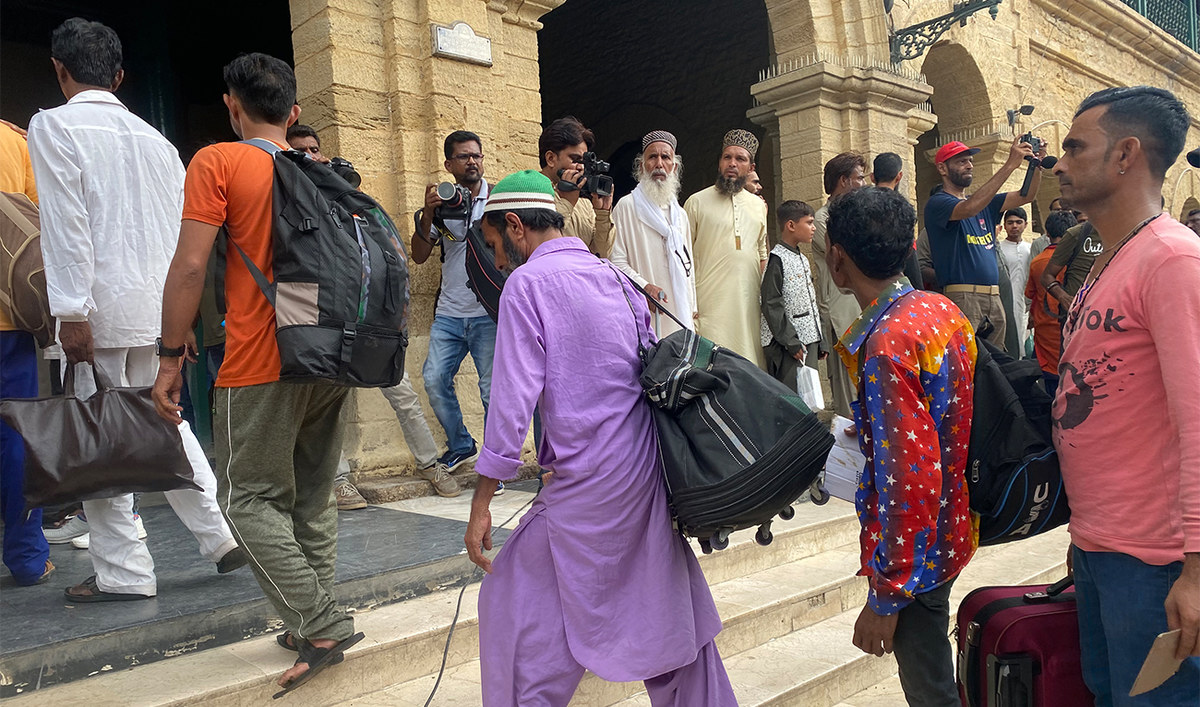


Indian fishermen depart from a railway station after Pakistan authorities released them, in Karachi on June 1, 2023, allegedly arrested for trespassing into its territorial waters. (AN photo)

Sajjan thanked Pakistani authorities for releasing him, adding that he was “extremely happy” that he would finally get to meet his family. 

Another Indian fisherman, Hussain Rahim, wished India would reciprocate the move and release Pakistani fishermen who were languishing in Indian prisons. “I want to express that just as we fishermen are being released here, I hope that the Pakistani fishermen imprisoned in India will also be freed as soon as possible,” Rahim told Arab News.

When asked about the facilities being provided to Indian fishermen in Malir jail, Rahim said they were “treated like brothers” there. 

Fatima Majeed, a Pakistani fisherwomen and activist, said she could feel the pain of the Indian inmates as her father was also imprisoned in India in 1988. 

“I can feel their pain from very close because I have experienced this time too, I have also passed through it,” Majeed told Arab News. “It’s a very painful time.” She said when fishermen are arrested, the women in their families have to seek work in the informal sector to feed their families. 
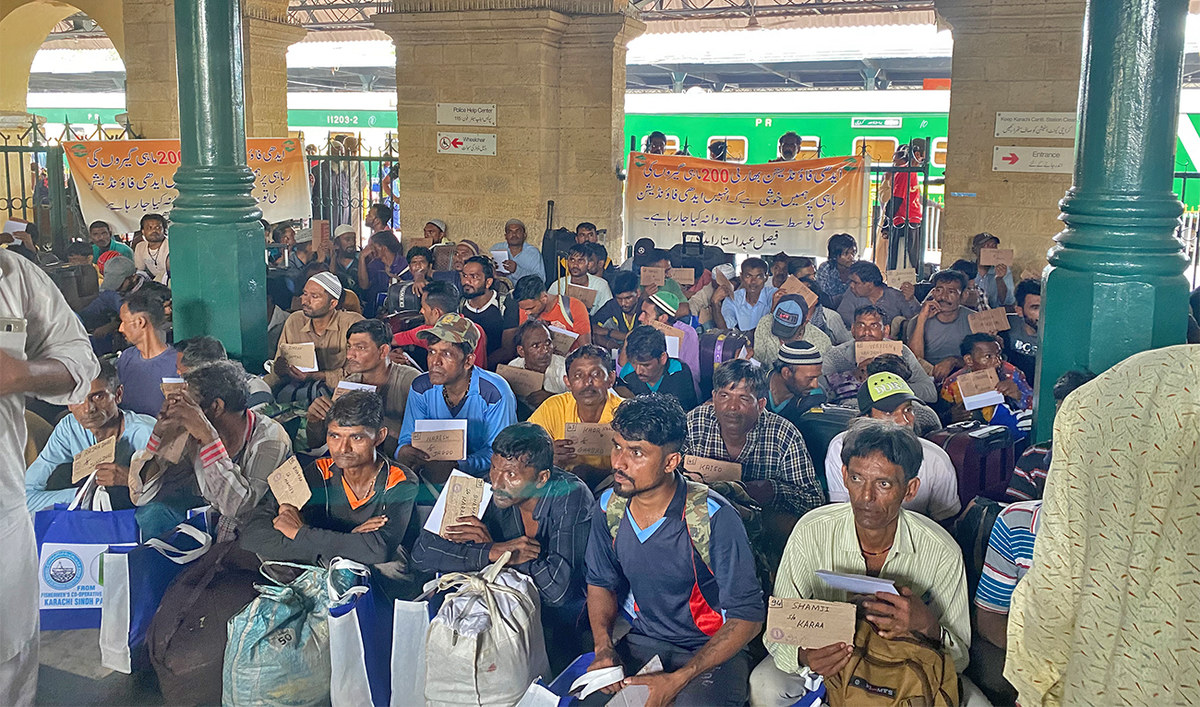


Indian fishermen show their identity card as they departs from a railway station in Karachi, Pakistan, on June 1, 2023, allegedly arrested for trespassing into its territorial waters. (AN photo)

Pakistan’s Foreign Office Spokesperson Mumtaz Zahra Baloch, in response to a question during a weekly briefing, said by releasing Indian prisoners, Pakistan had demonstrated its “consistent policy of not politicizing humanitarian matters.” She hoped India should also release Pakistani fishermen who were imprisoned in Indian jails. 

When asked whether a judicial commission existed to ensure the swift release of fishermen, Baloch responded in the affirmative. 

“The commission surely exists and the two sides have remained in contact on the mechanics of such visits which we hope will facilitate the civilians and fishermen who are held in prisons in Pakistan and India,” she said. 


Qatar, Pakistan resolve to boost strategic, economic cooperation at Doha talks

Updated 24 February 2026
Follow

Qatar, Pakistan resolve to boost strategic, economic cooperation at Doha talks

  • Both countries urge dialogue on Afghanistan amid renewed border tensions between Islamabad and Kabul
  • Discussions focus on bilateral trade and investment, energy, defense, manpower and labor and culture

ISLAMABAD: Pakistan and Qatar on Tuesday agreed to deepen their strategic and economic cooperation during high-level talks between Prime Minister Shehbaz Sharif and his Qatari counterpart Sheikh Mohammed bin Abdulrahman bin Jassim Al Thani, Sharif’s office said.

Sharif visited Qatar along with a high-level delegation on the invitation of Qatari emir Sheikh Tamim bin Hamad Al Thani. The Pakistani premier also held meetings with Qatar’s trade and defense ministers to discuss cooperation in various domains.

The visit came at a time when Pakistan is seeking closer economic engagement with Gulf partners amid its broader push to stabilize the economy and attract investment, while maintaining security and defense cooperation with key regional states.

During their meeting in Doha, PM Sharif and Qatar’s Sheikh Mohammed discussed bilateral relations and exchanged views on regional and international developments, according to the Pakistan prime minister’s office.

“They reaffirmed the strong brotherly relations between Pakistan and Qatar and expressed satisfaction at the growing momentum in political, economic and institutional ties,” Sharif’s office said.

“Discussions focused on enhancing cooperation in the fields of trade and investment, energy, defense, manpower and labor and culture, with both sides stressing the importance of their task force to accelerate cooperation in all these areas.”

Pakistan and Qatar maintain strong trade and investment ties. In 2022, the office of Qatar’s emir said the Qatar Investment Authority planned to invest $3 billion in Pakistan, targeting sectors including transport, aviation, education, health, media, technology and labor.

Nearly 300,000 Pakistanis live and work in Qatar, according to Pakistan’s foreign office, with many employed in health, education, engineering and public services, as well as construction and transport. The two countries engage through forums such as the Bilateral Political Consultations and the Joint Ministerial Commission.

Sharif said he had productive discussions with Qatar’s emir, Sheikh Tamim bin Hamad Al Thani, on how the two sides could transform their brotherly ties into mutually beneficial economic relationships. 

“We also took stock of the regional situation,” he said on X. “Pakistan and Qatar will continue to work together for peace and stability in the region and beyond.”

Prime Minister Shehbaz Sharif (second right) meets the Qatari Emir Qatar’s emir Sheikh Tamim bin Hamad Al Thani (left) in Doha, Qatar, on February 24, 2026. (PID)

DIALOGUE WITH AFGHANISTAN

Earlier, Sharif and Qatar’s Deputy PM Sheikh Saoud Al-Thani discussed the situation in Afghanistan and called for dialogue to support regional stability.

The meeting took place amid renewed tensions after Islamabad carried out airstrikes last week on what it described as Tehreek-e-Taliban Pakistan (TTP) targets inside Afghanistan. Kabul said the strikes killed civilians and vowed to respond to what it called a violation of its sovereignty.

“Regional developments were also discussed, in particular the situation in Iran and Afghanistan,” Sharif’s office said in a statement. “Both sides emphasized the importance of dialogue, de-escalation and collective efforts to promote peace and stability in the region.”

This was the second time in less than six months that Pakistan conducted airstrikes in Afghanistan. The last strikes triggered heavy, weeklong clashes between the neighbors along their border before Qatar and Turkiye mediated a ceasefire between them in Oct. last year.

Separately, Sharif held meetings with Qatar’s State Minister for Trade Dr. Ahmed bin Mohammed Al-Sayed and a delegation of the Qatar Businessmen Association (QBA), highlighting Pakistan’s investment-friendly reforms.

He invited QBA members to explore opportunities in infrastructure, logistics, energy, agriculture, technology and export-oriented manufacturing, his office said.