T20 break gives longer formats time in spotlight

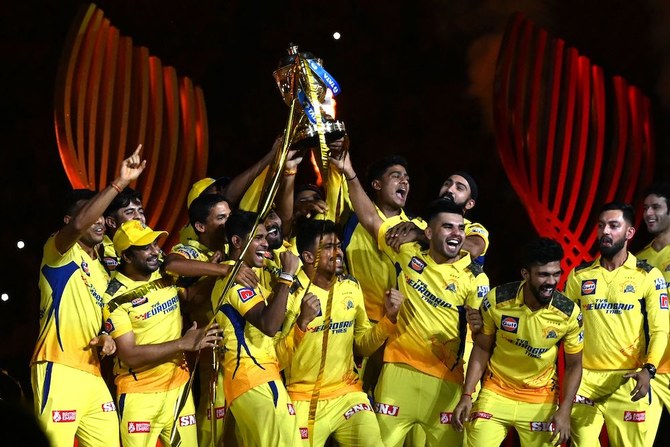
TOPSHOT - Chennai Super Kings' players celebrate with the trophy after their victory against Gujarat Titans in the Indian Premier League (IPL) Twenty20 final cricket match at the Narendra Modi Stadium in Ahmedabad on May 30, 2023. (AFP)
Short Url
Updated 01 June 2023
Follow

T20 break gives longer formats time in spotlight

  • Fears franchise cricket remuneration would persuade top players to jettison Test matches proven unfounded

Finally, in the early hours of Tuesday in Ahmedabad, the 2023 Indian Premier League ended after a marathon 74 matches.

Chennai Super Kings triumphed dramatically over Gujarat Titans, last year’s winners, off the last ball, to claim their fifth IPL success.

Attention will now turn away from the Twenty20 format, which threatens to devour professional cricket, to the longer forms, both of which have existentialist concerns.

England began a sequence of six Test matches on June 1. The first of these, against Ireland at Lord’s, represents only the seventh Test played by Ireland since becoming an International Cricket Council full member in 2018. It is a prelude to a five-match Ashes series against Australia. While the match against Ireland will not be sold out, those against Australia will be, for sure.

In between England’s match against Ireland and the start of the Ashes, India and Australia will contest the World Test Championship at The Oval, in London. The two teams finished in the top two places out of nine full members who participated in the 2021 to 2023 cycle.

Each team was scheduled to play six series, three at home and three away. This meant that each team did not play each other equally, playing six of the other eight members. A series consists of between two and five matches, all scheduled to be played over five days.

The unevenness of the tournament led to teams playing a different number of matches. England played the most, 22, Sri Lanka and Bangladesh the least, with 12 each.

Final places were determined by ranking teams according to the percentage of points obtained out of the total number of points contested. Twelve points were awarded for a win, six for a tie, and four for a draw, with points deducted for slow over rates, England being the prime losers in that area. Australia achieved a 66.7 percentage of points available, India, 58.8, ahead of South Africa’s 55.6.

In mid-August 2022, South Africa led the table with a points percentage of 75. After that, they fell away, losing twice to England before succumbing to Australia in December and January.

In particular, South Africa’s batting was disappointing. The team was forced into transition, as some of its best players chose to focus on T20 franchise cricket. Indeed, at least one of them was playing in Australia’s Big Bash at the same time the Test team was struggling in Australia. Given that new T20 franchise tournaments were about to open in South Africa and the UAE, much soul-searching about the future of Test cricket occurred.

It generated various views and suggestions. One was that the 12 full members be divided into two equal groups with promotion and relegation between groups. This was based on the view that, if Tests became too one-sided, spectators would lose interest. Others argued that only by playing the stronger teams would the weaker ones improve.

In any event, the 12 full members have signed up to the Future Tours Program and WTC for the next eight years. The prize money available in the current cycle totals $3.8 million. The winning team will receive $1.6 million and the runner-up, $800,000. Teams placed between third and ninth positions will get between $450,000 and $100,000.

An often-expressed fear is that the remuneration available in franchise cricket will persuade top players to jettison Test cricket. Yet, most of these players continue to emphasize that Test cricket is the pinnacle of the game, the ultimate test of their physical, technical, and mental attributes.

There is little doubt that Test cricket is alive and well in Australia, England, and India. Concerns exist about other countries, largely because they do not generate sufficient income from Tests, as attendances are low. This means that national boards are either unable or unwilling to pay players sufficient salaries to prevent them turning their heads toward the more rewarding franchises.

Cricket South Africa’s financial problems led to its espousal of a T20 franchise tournament, while constrained opportunities for Pakistani players to boost incomes in the IPL and Indian-owned franchises are well documented.

Many people would like to peer into a crystal ball to foresee the landscape of cricket in 15 to 20 years’ time. In 2002, the prospect of T20 cricket being a dominant mode would have been laughed off. How wrong that view was, the format initially derided as “pyjama cricket.” Now, the straws in the wind appear to be forming a pattern.

T20 cricket, especially in franchise format, is here to stay for the foreseeable future, with one or, possibly, two additional franchises to come – the US Major League will start in July. Certain domestic structures, especially in England, pose challenges to further franchise expansion.

Test cricket is likely to prosper, primarily in three to four countries, with others playing their part according to finances and scheduling opportunities within the FTP.

One-day cricket is under threat but is set to continue at international level in World Cup format, with its extensive qualifying stages, at least until 2031.

There does appear to be a growing consensus among those who hold the future of the game in their gift that strategies to achieve co-existence between the various formats is the optimum way forward.

In moving toward that consensus, it is possible for everyone, or nearly everyone, to benefit. The game is nothing without high-quality players. That is why national boards must keep their elite players sufficiently remunerated. Failure to do so could lead to the crumbling of current structures.

Underneath the elite level, there are already signs of changing allegiances. A prime example is that of England’s Jason Roy, who asked for his incremental contract with his national board to be cancelled so that he could play more profitably in the US.

That does not mean he will never play again for England. However, the agreement signified a recognition by both parties of an action which represents another stage in the shifting relationships between players and boards.


Expressions of disquiet concerning cricket’s power base

Updated 29 January 2026
Follow

Expressions of disquiet concerning cricket’s power base

  • Increasing number of players, coaches may be prepared to oppose overconcentration of power in game

Last week’s crisis over Bangladesh’s participation in the upcoming men’s T20 World Cup ended with the International Cricket Council’s decision to replace Bangladesh with Scotland. In a show of support for Bangladesh, the Pakistan Cricket Board indulged in saber rattling by suggesting that it may boycott the tournament.

This is unlikely and would invite severe repercussions, effectively creating a schism in cricket. The stance may be interpreted as a continuation of Pakistan’s ongoing challenge to India’s hegemony of the game.

In a sign of the way in which views have polarized, Jason Gillespie, a former Australian cricketer and international coach, posted the following on X: “Has there been an explanation from the ICC why Bangladesh could not play their matches outside of India? From memory, India refused to play Champions Trophy matches in Pakistan and were allowed to play those matches outside of Pakistan. Can someone make this make sense?”

Among the plentiful responses were many from Indian sources, who were not kindly disposed towards Gillespie’s question. He took the post down, saying: “I got abused for asking a simple question.”

On the surface it may appear to be a simple question, but it hits at the heart of a complex issue. Gillespie’s critics have been quick to seize on the fact that he was, for six months in 2024, coach of the Pakistan national men’s Test team and that he will be the coach of the new Kingsman Hyderabad franchise in the Pakistan Super League in April. This involvement has been interpreted as evidence of bias against India.

Another respected player, Jason Holder, former captain of the West Indies, expressed some forthright thoughts in a podcast earlier this month. One of these related to the selection of Pakistani players in franchise leagues. He commented that it was sad that “certain Pakistanis can’t be involved in certain teams because they are owned by Indian owners.” Holder also expressed his sadness at the impact on cricket of relations between India and Pakistan.

Separately, Moeen Ali, of England, went further in an interview given while playing in the Bangladesh Premier League in January. His view is that the ICC does not act like a neutral guardian of the game, effectively serving the interests of “one cricket nation.” Ali added that everyone inside the game knows “who actually runs things,” but few are willing to say so publicly.

Neither did he directly, but we are safe to assume the glaringly obvious — that he was referring to India. It is understandable that many within the game are reluctant to rock the boat, partly out of fear about the opprobrium which follows, and to which Azeem Rafiq can testify.

Gillespie has been the source of social media abuse and Holder has also been subject to negative comment. He has played for franchises owned by Indians in India, South Africa, the UAE and the Caribbean. Ali has done likewise and it is noticeable that in December 2025 he announced that will play in the Pakistan Super League in April 2026, rather than the Indian Premier League, where he has represented three franchises since 2018. The league is now adopting an Indian, youth-driven strategy, which is reducing opportunities for experienced overseas players. In a surprise announcement this week, Ali announced that he will play for Yorkshire in the T20 Blast in 2026. This reverses his decision during 2025 to retire from English domestic cricket.

Opportunities for cricketers to play in franchise leagues are still on the increase. Almost 11 months ago I was fortunate to interview Abhishek Bachchan, who had been revealed as a co-owner of the European T20 Premier League. The league, which is approved by the ICC, consists of a partnership between the national cricket boards of Ireland, Scotland and the Netherlands. At the time of the interview the intention of the owners was to hold the first edition of the event between July 15 and Aug. 3, 2025.

In my column, following the interview, I suggested that the ETPL’s promoters had their work cut out, given that there were only five months to go until mid-July. It was clear that discussions with players and their agents were underway, as were those with potential franchisees and investors. At the time that space was crowded because the focus of these stakeholders was on the sale of equity in The Hundred. Postponement of the ETPL was announced in early June 2025. In the intervening months, time has been well spent leading to last week’s announcement that the ETPL will launch in August 2026.

Exact dates and format have not been revealed, but it is understood that late August to mid-September is the preferred option. The original idea was to hold the league prior to The Hundred, which occupies most of August. Instead, it is now planned to open after the 2026 Hundred concludes on Aug. 16. Originally a six-franchise league was proposed, based on teams in Dublin, Belfast, Edinburgh, Glasgow, Amsterdam and Rotterdam. This remains the case and, to date, three teams have been confirmed for Amsterdam, Belfast and Edinburgh.

It was a surprise to learn the identities of the owners. The rights to own the Amsterdam Flames have been acquired by a trio consisting of Steve Waugh, the former Australian captain; Jamie Dwyer, one of Australia’s greatest-ever male hockey players; and Tim Thomas, former CEO of the Centre for Australia-India Relations.

Another Australian cricketer, a current one, Glenn Maxwell, will own the Belfast-based Irish Wolves franchise, along with Rohan Lund, formerly CEO of the NRMA Group in Australia. In Edinburgh, the rights for the Castle Rockers lie with two former New Zealand cricketers, Kyle Mills and Nathan McCullum, older brother of Brendon McCullum, the current coach of the England men’s cricket team.

None of these individuals appear to have had any previous involvement in the ownership of franchise teams. Indeed, Waugh said that he has “always been selective about where I invest my time and energy in cricket. In many ways it marks a return to the game for me — but in a very different role. This is about helping uphold the standards and spirit of cricket while supporting its growth into Europe, which remains the game’s last great frontier.”

A stated aim of the ETPL promoters is to develop local talent. This was echoed by Kyle Mills, who referred to a partnership with Otago Cricket Board in New Zealand. This is intended to bring a pipeline of young talent through to the Rockers, along with the potential to develop local players and inspire the next generation to take up cricket. Each of the three franchises has secured big-name Australian and New Zealand cricketers for the inaugural competition.

So far, there is a different feel to the ETPL. As yet, the franchises are not funded by existing franchise owners in other leagues, some of which are dependent on Indian money. The Big Bash League is heading for privatization in Australia and there is little doubt that there will be strong interest from Indian investors. However, if an increasing number of players and coaches are prepared to express their disquiet about the overconcentration of power in the game, and alternative investors emerge, then the engulfing of cricket by one nation may be challenged.