OSLO: NATO on Thursday ramped up pressure on its member Turkiye to drop its objections to Sweden’s membership as the military organization seeks to deal with the issue by the time US President Joe Biden and his counterparts meet next month.
Fearing that they might be targeted after Russia invaded Ukraine last year, Sweden and Finland abandoned their traditional positions of military nonalignment to seek protection under NATO’s security umbrella. Finland became NATO’s 31st member country in April.
NATO must agree unanimously for countries to join. Turkiye’s government accuses Sweden of being too lenient on terrorist organizations and security threats, including militant Kurdish groups and people associated with a 2016 coup attempt.
Hungary has also delayed its approval, but the reasons why have not been made publicly clear.
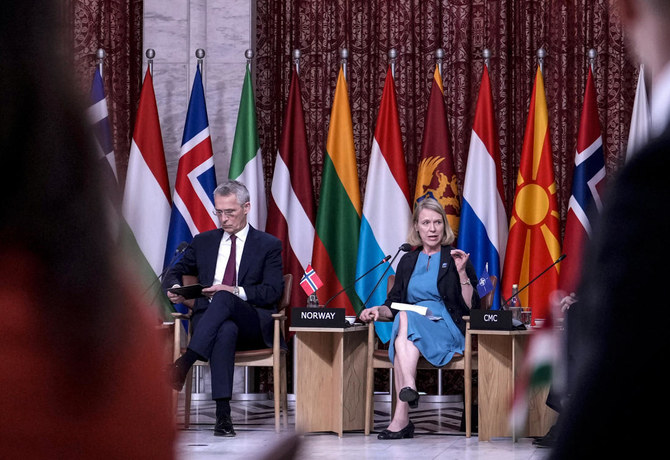
“It’s time for Sweden to join now,” Norwegian Foreign Minister Anniken Huitfeldt told reporters in Oslo, where she was hosting a meeting with her counterparts to prepare for NATO’s July 11-12 summit in Lithuania.
NATO Secretary-General Jens Stoltenberg said that he would travel to Ankara “in the near future to continue to address how we can ensure the fastest possible accession of Sweden.” He was unable to provide a precise date for his trip.
“I’m confident that also Hungary will ratify the accession protocol,” Stoltenberg said.
German Foreign Minister Annalena Baerbock said that “it is essential that we can finally welcome Sweden as the 32nd member.” She stressed that the Swedish government has Berlin’s “full support.”
Sweden’s foreign minister, Tobias Billström, said that “it is time for Turkiye and Hungary to start the ratification of the Swedish membership to NATO.” He said that “everything (that) bars Sweden joining NATO will be seen as wine for (Russian president Vladimir) Putin.”
For months Sweden, Finland and Turkiye have been holding talks to try to address Ankara’s concerns. Billström said that he expects things to be made clear at a new meeting of this “permanent joint mechanism” in coming weeks.
He noted that as of Thursday Sweden had tightened its antiterrorism laws. It is now it illegal to finance, recruit for or publicly encourage “a terrorist organization,” or to travel abroad with the intention of joining such groups.
The time may be ripe for movement. Sweden’s membership became embroiled in campaigning for elections in Turkiye, which President Recep Tayyip Erdogan won on Sunday. Erdogan has also been seeking upgraded US fighter jets, and Washington signaled this week that they might be delivered.
“I spoke to Erdogan and he still wants to work on something on the F-16s. I told him we wanted a deal with Sweden. So let’s get that done,” Biden said Monday.
On Tuesday, US Secretary of State Antony Blinken insisted that the issues of Sweden’s membership and the fighter jets were distinct. However, he stressed that the completion of both would dramatically strengthen European security.
“Both of these are vital, in our judgment, to European security,” Blinken told reporters. “We believe that both should go forward as quickly as possible; that is to say Sweden’s accession and moving forward on the F-16 package more broadly.”


![]()


NATO presses Turkiye to drop objections to Sweden’s membership as summit looms
Short Url
https://arab.news/86yvd
NATO presses Turkiye to drop objections to Sweden’s membership as summit looms
- The military organization wants to bring Sweden into the fold in time for the summit in Lithuania next month
- Turkiye’s government accuses Sweden of being too lenient on terrorist organizations and security threats, including militant Kurdish groups and people associated with a 2016 coup attempt


Uganda army denies seizing opposition leader as vote result looms
KAMPALA: Uganda’s army denied claims on Saturday that opposition leader Bobi Wine had been abducted from his home, as counting continued in an election marred by reports of at least 10 deaths amid an Internet blackout.
President Yoweri Museveni, 81, looked set to be declared winner and extend his 40-year rule later on Saturday, with a commanding lead against Wine, a former singer turned politician.
Wine said Friday that he was under house arrest, and his party later wrote on X that he had been “forcibly taken” by an army helicopter from his compound.
The army denied that claim.
“The rumors of his so-called arrest are baseless and unfounded,” army spokesman Chris Magezi told AFP.
“They are designed to incite his supporters into acts of violence,” he added.
AFP journalists said the situation was calm outside Wine’s residence early Saturday, but they were unable to contact members of the party due to continued communications interruptions.
A nearby stall-owner, 29-year-old Prince Jerard, said he heard a drone and helicopter at the home the previous night, with a heavy security presence.
“Many people have left (the area),” he said. “We have a lot of fear.”
With more than 80 percent of votes counted on Friday, Museveni was leading on 73.7 percent to Wine’s 22.7, the Electoral Commission said.
Final results were due around 1300 GMT on Saturday.
Wine, 43, whose real name is Robert Kyagulanyi, has emerged as the main challenger to Museveni in recent years, styling himself the “ghetto president” after the slum areas where he grew up in the capital, Kampala.
He has accused the government of “massive ballot stuffing” and attacking several of his party officials under cover of the Internet blackout, which was imposed ahead of Thursday’s polls and remained in place on Saturday.
His claims could not be independently verified, but the United Nations rights office said last week that the elections were taking place in an environment marked by “widespread repression and intimidation” against the opposition.
- Reports of violence -
Analysts have long viewed the election as a formality.
Museveni, a former guerrilla fighter who seized power in 1986, has total control over the state and security apparatus, and has ruthlessly crushed any challenger during his rule.
Election day was marred by significant technical problems after biometric machines — used to confirm voters’ identities — malfunctioned and ballot papers were undelivered for several hours in many areas.
There were reports of violence against the opposition in other parts of the country.
Muwanga Kivumbi, member of parliament for Wine’s party in the Butambala area of central Uganda, told AFP’s Nairobi office by phone that security forces had killed 10 of his campaign agents after storming his home.
President Yoweri Museveni, 81, looked set to be declared winner and extend his 40-year rule later on Saturday, with a commanding lead against Wine, a former singer turned politician.
Wine said Friday that he was under house arrest, and his party later wrote on X that he had been “forcibly taken” by an army helicopter from his compound.
The army denied that claim.
“The rumors of his so-called arrest are baseless and unfounded,” army spokesman Chris Magezi told AFP.
“They are designed to incite his supporters into acts of violence,” he added.
AFP journalists said the situation was calm outside Wine’s residence early Saturday, but they were unable to contact members of the party due to continued communications interruptions.
A nearby stall-owner, 29-year-old Prince Jerard, said he heard a drone and helicopter at the home the previous night, with a heavy security presence.
“Many people have left (the area),” he said. “We have a lot of fear.”
With more than 80 percent of votes counted on Friday, Museveni was leading on 73.7 percent to Wine’s 22.7, the Electoral Commission said.
Final results were due around 1300 GMT on Saturday.
Wine, 43, whose real name is Robert Kyagulanyi, has emerged as the main challenger to Museveni in recent years, styling himself the “ghetto president” after the slum areas where he grew up in the capital, Kampala.
He has accused the government of “massive ballot stuffing” and attacking several of his party officials under cover of the Internet blackout, which was imposed ahead of Thursday’s polls and remained in place on Saturday.
His claims could not be independently verified, but the United Nations rights office said last week that the elections were taking place in an environment marked by “widespread repression and intimidation” against the opposition.
- Reports of violence -
Analysts have long viewed the election as a formality.
Museveni, a former guerrilla fighter who seized power in 1986, has total control over the state and security apparatus, and has ruthlessly crushed any challenger during his rule.
Election day was marred by significant technical problems after biometric machines — used to confirm voters’ identities — malfunctioned and ballot papers were undelivered for several hours in many areas.
There were reports of violence against the opposition in other parts of the country.
Muwanga Kivumbi, member of parliament for Wine’s party in the Butambala area of central Uganda, told AFP’s Nairobi office by phone that security forces had killed 10 of his campaign agents after storming his home.
Latest updates


© 2026 SAUDI RESEARCH & PUBLISHING COMPANY, All Rights Reserved And subject to Terms of Use Agreement.