

Ex-PM Khan’s former aides explore new political options, reestablish contacts within party

Pakistani Foreign Minister Shah Mehmood Qureshi (R) speaks next to Minister of Information and Broadcasting Fawad Chaudhry during a press conference in Islamabad, Pakistan on February 13, 2019. (AFP/File)
Short Url
Updated 01 June 2023
Follow

Ex-PM Khan’s former aides explore new political options, reestablish contacts within party

  • Chaudhry Fawad Hussain holds a meeting with Shah Mahmood Qureshi in an apparent bid to make him quit PTI
  • Some PTI leaders react to the development, say there is ‘no politics’ without former prime minister Imran Khan

ISLAMABAD: A group of high-profile politicians, who recently abandoned former prime minister Imran Khan’s Pakistan Tehreek-e-Insaf (PTI) party, held a meeting with Shah Mahmood Qureshi on Wednesday in an apparent attempt to make him quit his political faction.

The PTI stalwarts announced to leave their party in recent weeks after they were thrown into prison in the wake of the violent protests that broke out after Khan was arrested by the authorities on corruption charges last month.

Many of these people were Khan’s close aides who exercised their influence over the decision-making process within the party.

With the crackdown continuing against the PTI, they justified their political activities by saying the current administration of the country could not be allowed to have an open political field.

“We have had a detailed conversation with Shah Mahmood Qureshi,” said Chaudhry Fawad Hussain, who served as information minister in Khan’s PTI administration, after visiting a prison in Rawalpindi where Qureshi has been kept. “We believe that Pakistan needs to move toward a durable solution [amid all the political instability].”

Hussain was accompanied by former governor of Sindh province, Imran Ismail, along with other PTI defectors. He said his group was also in contact with other former colleagues that included Asad Umar, Pervez Khattak, Asad Qaisar, Ali Zaidi, Hammad Azhar and Farrukh Habib.

“The current political administration of the country is directly responsible for the constitutional, political and economic uncertainty prevailing in Pakistan,” he continued.

“Pakistan is a country of 250 million people according to the new census. The nation of 250 million cannot be left to Asif Zardari and Nawaz Sharif,” he added while naming two of the top leaders belonging to the ruling coalition.

Khan had reportedly named Qureshi, his second-in-command in the party, as someone who could lead PTI if the former PM was disqualified from politics.

Responding to the recent political activity generated by Hussain and his group, some PTI members said there was “no politics without Imran Khan.”

Others, like Asad Qaisar, denied being contacted by anyone to discuss any future political strategy.

Qureshi’s son also said that his father supported the PTI ideology and was still the vice chairman of the party.


Pakistan launches $136 million Ramadan relief package for 12.1 million families

Updated 8 sec ago
Follow

Pakistan launches $136 million Ramadan relief package for 12.1 million families

  • Rs13,000 per family to be transferred via bank accounts, mobile wallets under cashless system
  • Pakistan’s national space agency says the Muslim fasting month is likely to begin from Feb. 19

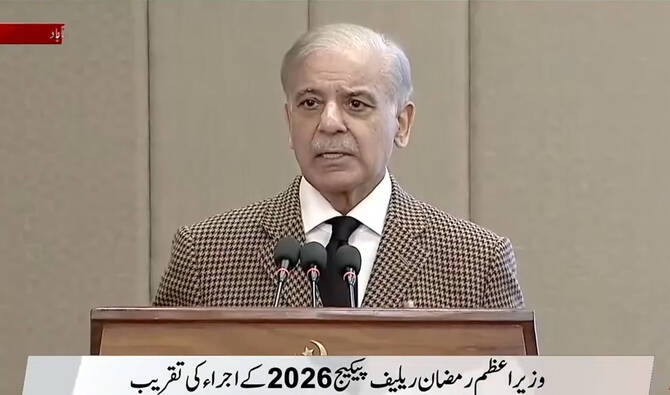
ISLAMABAD: Prime Minister Shehbaz Sharif on Saturday launched a Rs38 billion ($136 million) Ramadan relief package, pledging direct digital cash transfers of Rs13,000 ($47) each to 12.1 million low-income families across Pakistan.

Pakistan’s national space agency announced a day earlier the Ramadan crescent would likely be visible on Feb. 18, with the first fast expected to fall on Feb. 19, subject to official confirmation.

The government will distribute the relief package through bank accounts and regulated mobile wallet platforms, fully replacing the previous utility store-based subsidy model with a digital payment mechanism overseen by the State Bank of Pakistan.

“This year, Rs38 billion have been allocated ... that will not only be distributed to the rightful people in all four provinces, but also to Gilgit-Baltistan and Azad Kashmir through these wallets and digital bank accounts,” the prime minister said during a ceremony in the federal capital, adding that 12.1 million families would benefit.

The allocation marks a sharp increase from last year’s Rs 20 billion ($72 million) Ramadan program, as the government expands coverage and deepens its shift toward cash-based targeted subsidies.

Officials said Rs28 billion ($101 million) has been earmarked for families not currently receiving support under any federal income assistance program, while an additional Rs10 billion ($36 million) will go to those already registered under existing social protection schemes.

Syed Imran Shah, federal minister for poverty alleviation and social security, said the digital framework would allow transfers to be made in a “safe, effective and easy way,” reducing leakages and preserving beneficiaries’ dignity by eliminating long queues and physical distribution centers.

Amir Ali Ahmed, secretary of the Benazir Income Support Program (BISP), said the 2026 rollout builds on last year’s digital transition, when around two million beneficiaries received payments electronically.

A third-party validation report issued in December 2025 confirmed the transparency and operational effectiveness of the system, he added.

The prime minister said he would personally oversee periodic reviews of the program to ensure timely disbursement.

The government had scrapped the Utility Store-based Ramadan subsidy system last year, arguing that it led to quality concerns, long queues and administrative inefficiencies.

The digital transfer model aims to move toward a targeted subsidy regime aligned with broader efforts to expand financial inclusion and reduce cash-based leakages.
