

Charity slams EU’s ‘staggering neglect of Afghans’ after just 271 resettled in 2022

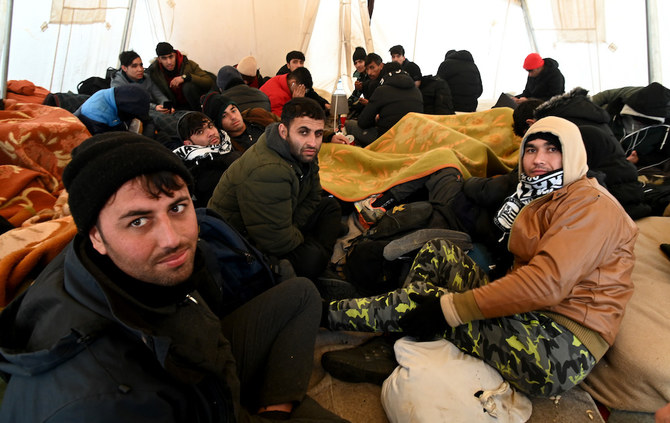
Above, migrants in transit, mostly from Afghanistan, rest in a tent near the railway station in Rijeka on the Adriatic coast in western Croatia on Feb. 6, 2023. (AFP)
Short Url
Updated 31 May 2023
Follow

Charity slams EU’s ‘staggering neglect of Afghans’ after just 271 resettled in 2022

  • International Rescue Committee: Many remain trapped in ‘prison-like’ conditions in Greece
  • Charity: Since fall of Kabul, some member states have failed to resettle a single Afghan

LONDON: Only 271 out of 270,000 Afghans judged as needing protection were resettled in the EU last year, with a charity criticizing member states for failing refugees, The Guardian reported on Wednesday.

The International Rescue Committee said the figures represent “staggering neglect” of Afghan refugees, with EU member states falling short of meeting their resettlement pledges.

Many of the Afghans remain in “prison-like” conditions in border centers across the Greek islands, a common entry point into Europe for refugees.

The charity said a program launched by Germany in 2021 to resettle up to 1,000 Afghans per month has failed to accept a single person, while Italy has only accepted half the number of refugees it pledged to welcome.

From 2021 to 2022, amid the Taliban takeover of Afghanistan, about 41,500 Afghans were fast-tracked into EU member-state entry programs.

But the IRC described the response as “vastly insufficient,” adding that since the fall of Kabul, some EU states have failed to resettle a single Afghan.

A report by the charity warned that Afghans seeking refuge in Europe still lack legal pathways to resettlement.

IRC CEO David Miliband said: “This report highlights staggering neglect of Afghans by the member states of the EU, which puts them at risk at every step of their journeys in search of protection.

“While some states’ well-intentioned plans to bring Afghans to safety have hit repeated delays and obstacles, other countries have failed to make any pledges at all, or to guarantee adequate protection and inclusion for the tiny proportion of Afghan refugees who manage to reach Europe.”

The report also warned that a study from January to March this year showed that more than 90 percent of the Afghans in contact with IRC teams on the Greek island of Lesbos and the capital Athens were suffering from anxiety. A further 86 percent also demonstrated symptoms of depression, the charity added.

Miliband drew comparisons between EU member-state treatment of Ukrainian and Afghan refugees, saying acceptance of the former demonstrated the capacity of states to resettle the latter.

He added: “There is simply no excuse for treating Afghans, and refugees forced from their homes elsewhere, any differently.”

However, the report excluded other pathways that some EU states have launched to accept refugees through other means.

Germany accepted about 286,000 Afghans in 2022, the country’s national statistics office said in March.

The IRC called for EU member states to target Afghan resettlement numbers of 42,500 each over the next five years.

Zahra, 60, a refugee who waited two and a half years for resettlement in Germany, told the charity: “Waiting for an answer was a very difficult and anxious time for me, as I was without my two children in this foreign country whose culture I did not know.

“I had no choice but to wait and hope that one day I would be able to offer my children a safe life here.”


Afghan barbers under pressure as morality police take on short beards

Updated 4 sec ago
Follow

Afghan barbers under pressure as morality police take on short beards

KABUL: Barbers in Afghanistan risk detention for trimming men’s beards too short, they told AFP, as the Taliban authorities enforce their strict interpretation of Islamic law with increasing zeal.
Last month, the Ministry for the Propagation of Virtue and Prevention of Vice said it was now “obligatory” to grow beards longer than a fist, doubling down on an earlier order.
Minister Khalid Hanafi said it was the government’s “responsibility to guide the nation to have an appearance according to sharia,” or Islamic law.
Officials tasked with promoting virtue “are obliged to implement the Islamic system,” he said.
With ministry officials patrolling city streets to ensure the rule is followed, the men interviewed by AFP all spoke on condition of anonymity due to security concerns.
In the southeastern province of Ghazni, a 30-year-old barber said he was detained for three nights after officials found out that one of his employees had given a client a Western-style haircut.
“First, I was held in a cold hall. Later, after I insisted on being released, they transferred me to a cold (shipping) container,” he said.
He was eventually released without charge and continues to work, but usually hides with his clients when the patrols pass by.
“The thing is that no one can argue or question” the ministry officials, the barber said.
“Everyone fears them.”
He added that in some cases where both a barber and clients were detained, “the clients have been let out, but they kept the barber” in custody.
Last year, three barbers in Kunar province were jailed for three to five months for breaching the ministry’s rules, according to a UN report.

‘Personal space’

Alongside the uptick in enforcement, the religious affairs ministry has also issued stricter orders.
In an eight-page guide to imams issued in November, prayer leaders were told to describe shaving beards as a “major sin” in their sermons.
The religious affairs ministry’s arguments against trimming state that by shaving their beards, men were “trying to look like women.”
The orders have also reached universities — where only men study because women have been banned.
A 22-year-old Kabul University student said lecturers “have warned us... that if we don’t have a proper Islamic appearance, which includes beards and head covering, they will deduct our marks.”
In the capital Kabul, a 25-year-old barber lamented that “there are a lot of restrictions” which go against his young clients’ preference for closer shaves.
“Barbers are private businesses, beards and heads are something personal, they should be able to cut the way they want,” he said.
Hanafi, the virtue propagation minister, has dismissed such arguments, saying last month that telling men “to grow a beard according to sharia” cannot be considered “invading the personal space.”

Business slump

In Afghanistan, the majority are practicing Muslims, but before the Taliban authorities returned to power in 2021, residents of major cities could choose their own appearance.
In areas where Taliban fighters were battling US-backed forces, men would grow beards either out of fear or by choice.
As fewer and fewer men opt for a close shave, the 25-year-old Kabul barber said he was already losing business.
Many civil servants, for example, “used to sort their hair a couple of times a week, but now, most of them have grown beards, they don’t show up even in a month,” he said.
A 50-year-old barber in Kabul said morality patrols “visit and check every day.”
In one incident this month, the barber said that an officer came into the shop and asked: “Why did you cut the hair like this?“
“After trying to explain that he is a child, he told us: ‘No, do Islamic hair, not English hair’.”
