BRYAN, Texas: Theranos founder Elizabeth Holmes entered a Texas prison Tuesday where she could spend the next 11 years for overseeing a blood-testing hoax that became a parable about greed and hubris in Silicon Valley.
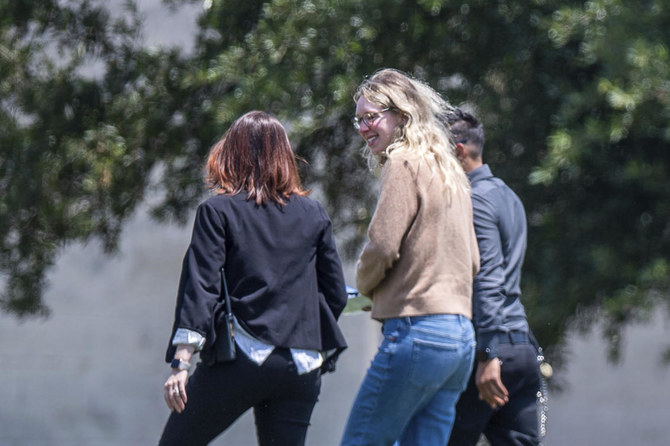
Holmes, 39, could be seen from outside the prison’s gates walking into the federal women’s prison camp located in Bryan, Texas, wearing jeans, a brown sweater and smiling as she spoke with two prison employees accompanying her.
The minimum-security facility — where the federal judge who sentenced Holmes in November recommended she be incarcerated — is about 150 kilometers northwest of Houston, where she grew up aspiring to become a technology visionary along the lines of Apple co-founder Steve Jobs.
As she begins her sentence, Holmes is leaving behind two young children — a son born in July 2021 a few weeks before the start of her trial and a 3-month-old daughter who was conceived after a jury convicted her on four felony counts of fraud and conspiracy in January 2022.
She was free on bail up until Tuesday, most recently living in the San Diego area with the children’s father, William “Billy” Evans. The couple met in 2017 around the same time Holmes was under investigation for the collapse of Theranos, a startup she founded after dropping out of Stanford University when she was just 19.
While she was building up Theranos, Holmes grew closer to Ramesh, “Sunny” Balwani, who would become her romantic partner as well as an investor and fellow executive in the Palo Alto, California, company.
Together, Holmes and Balwani promised Theranos would revolutionize health care with a technology that could quickly scan for diseases and other problems with a few drops of blood taken with a finger prick.
The hype surrounding that purported breakthrough helped Theranos raise nearly $1 billion from enthralled investors, assemble an influential board of directors that include former Presidential cabinet members George Shultz, Henry Kissinger and James Mattis and turned Holmes into a Silicon Valley sensation with a fortune valued at $4.5 billion on paper in 2014.
But it all blew up after serious dangerous flaws in Theranos’ technology were exposed in a series of explosive articles in The Wall Street Journal that Holmes and Balwani tried to thwart. Holmes and Balwani, who had been secretly living together while running Theranos, broke up after the Journal’s revelations and the company collapsed. In 2018, the US Justice Department charged both with a litany of white-collar crimes in a case aimed at putting a stop to the Silicon Valley practice of overselling the capabilities of a still-developing technology — a technique that became known as “fake it ‘til you make it.”
Holmes admitted making mistakes at Theranos, but steadfastly denied committing crimes during seven often-fascinating days of testimony on the witness stand during her trial. At one point, she told the jury about being sexually and emotionally abused by Balwani while he controlled her in ways that she said clouded her thinking. Balwani’s attorney steadfastly denied Holmes allegations, which was one of the key reasons they were tried separately.
Balwani, 57, was convicted on 12 felony counts of fraud and conspiracy in a trial that began two months after Holmes’ ended. He is currently serving a nearly 13-year sentence in a Southern California prison.
Maintaining she was treated unfairly during the trial, Holmes sought to remain free while she appeals her conviction. But that bid was rejected by US District Judge Edward Davila, who presided over her trial, and the Ninth Circuit Court of Appeals, leaving her no other avenue left to follow but the one that will take her to prison nearly 20 years after she founded Theranos.
Attorneys representing Holmes did not immediately respond when contacted by The Associated Press for statement on Tuesday.
FPC Bryan, a minimum-security prison camp located encompasses about 37 acres (15 hectares) of land and houses about 650 women — including “Real Housewives of Salt Lake City” star Jennifer Shah, who was sentenced earlier this year to 6 1/2 years in prison for defrauding thousands of people in a yearslong telemarketing scam.
Most federal prison camps don’t even have fences and house those the Bureau of Prisons considers to be the lowest security risk. The prison camps also often have minimal staffing and many of the people incarcerated there work at prison jobs.
According to a 2016 FPC Bryan inmate handbook, those in the Texas facility who are eligible to work can earn between 12 cents and $1.15 per hour in their job assignments, which include food service roles and factory employment operated by Federal Prison Industries.
Federal prison camps were originally designed with low security to make operations easier and to allow inmates tasked with performing work at the prison, like landscaping and maintenance, to avoid repeatedly checking in and out of a main prison facility. But the lax security opened a gateway for contraband, such as drugs, cellphones and weapons. The limited security has also led to a number of escapes from prison camps.
In November, a man incarcerated at another federal prison camp in Arizona pulled out a smuggled gun in a visitation area and tried to shoot his wife in the head. The gun jammed and no one was injured. But the incident exposed major security flaws at the facility and the agency’s director ordered a review of security at all federal prison camps around the US.

Elizabeth Holmes enters Texas prison to begin 11-year sentence for notorious blood-testing hoax
Short Url
https://arab.news/j9d3h
Elizabeth Holmes enters Texas prison to begin 11-year sentence for notorious blood-testing hoax
- Blood-testing hoax raised nearly $1 billion from enthralled investors
- Flaws in Theranos’ technology were exposed in a series of articles in The Wall Street Journal
Over 400 civilians killed in fighting in eastern Congo, despite US-mediated peace deal
GOMA: More than 400 civilians have been killed as the Rwanda-backed M23 armed group continues its offensive in Kivu province in eastern Congo, regional officials said late Wednesday, adding that Rwandan special forces were in the strategic city of Uvira.
M23’s latest offensive comes despite a US-mediated peace agreement signed last week by the Congolese and Rwandan presidents in Washington. The accord didn’t include the rebel group, which is negotiating separately with Congo and agreed earlier this year to a ceasefire that both sides accuse the other of violating. However, it obliges Rwanda to halt support for armed groups and work to end hostilities.
“More than 413 civilians (have been) killed by bullets, grenades, and bombs, including many women, children, and young people” in localities between Uvira and Bukavu, the regional capital, the South Kivu government spokesperson said in a statement late Wednesday.
“According to the information gathered, the forces present in the city are composed of Rwandan special forces and some of their foreign mercenaries, operating in clear violation of the ceasefire as well as the Washington and Doha agreements, in total disregard of the commitments made,” the statement added.
M23 said it had taken control of the strategic city of Uvira in eastern Congo on Wednesday afternoon, following a rapid offensive since the start of the month.
The announcement by M23 spokesperson Lawrence Kanyuka, posted on the social platform X, encouraged citizens who fled to return to their homes. Uvira is an important port city on the northern tip of Lake Tanganyika and is directly across from neighboring Burundi’s largest city, Bujumbura.
Congo, the US and UN experts accuse Rwanda of backing M23, which had hundreds of members in 2021. Now, according to the UN, the group has around 6,500 fighters.
While Rwanda denies that claim, it acknowledged last year that it has troops and missile systems in eastern Congo, allegedly to safeguard its security. UN experts estimate there are up to 4,000 Rwandan forces in Congo.
Burundian Foreign Minister Edouard Bizimana, in an interview with French state media RFI on Wednesday, urged the US to pressure Rwandan President Paul Kagame to ensure the implementation of the agreement signed in the US, saying, “M23 without Kagame, without Rwanda, is nothing.”
Bizimana said the capture of Uvira poses a threat to the economic capital, Bujumbura.
“We have registered more than 30,000 refugees and asylum seekers in the last three days… Uvira and Bujumbura are coastal cities. What threatens Uvira also threatens Bujumbura.”
In a statement Wednesday, the US Embassy in Kinshasa urged M23 and Rwandan troops to cease all offensive operations and for the Rwandan Defense Forces to withdraw to Rwanda.
On Wednesday morning, the Rwandan Ministry of Foreign Affairs blamed the Congolese armed forces for the recent ceasefire violations in a statement on X.
“The DRC has openly stated that it would not observe any ceasefire, and was fighting to recapture territories lost to AFC/M23, even as the peace process unfolded,” it said.
More than 100 armed groups are vying for a foothold in mineral-rich eastern Congo near the border with Rwanda, most prominently M23. The conflict has created one of the world’s most significant humanitarian crises, with more than 7 million people displaced, officials say.
Local UN partners report that more than 200,000 people have been displaced across the province since Dec. 2, with more than 70 killed. Civilians also have crossed into Burundi, and there have been reports of shells falling in the town of Rugombo, on the Burundian side of the border, raising concerns about the conflict spilling over into Burundian territory.
M23’s latest offensive comes despite a US-mediated peace agreement signed last week by the Congolese and Rwandan presidents in Washington. The accord didn’t include the rebel group, which is negotiating separately with Congo and agreed earlier this year to a ceasefire that both sides accuse the other of violating. However, it obliges Rwanda to halt support for armed groups and work to end hostilities.
“More than 413 civilians (have been) killed by bullets, grenades, and bombs, including many women, children, and young people” in localities between Uvira and Bukavu, the regional capital, the South Kivu government spokesperson said in a statement late Wednesday.
“According to the information gathered, the forces present in the city are composed of Rwandan special forces and some of their foreign mercenaries, operating in clear violation of the ceasefire as well as the Washington and Doha agreements, in total disregard of the commitments made,” the statement added.
M23 said it had taken control of the strategic city of Uvira in eastern Congo on Wednesday afternoon, following a rapid offensive since the start of the month.
The announcement by M23 spokesperson Lawrence Kanyuka, posted on the social platform X, encouraged citizens who fled to return to their homes. Uvira is an important port city on the northern tip of Lake Tanganyika and is directly across from neighboring Burundi’s largest city, Bujumbura.
Congo, the US and UN experts accuse Rwanda of backing M23, which had hundreds of members in 2021. Now, according to the UN, the group has around 6,500 fighters.
While Rwanda denies that claim, it acknowledged last year that it has troops and missile systems in eastern Congo, allegedly to safeguard its security. UN experts estimate there are up to 4,000 Rwandan forces in Congo.
Burundian Foreign Minister Edouard Bizimana, in an interview with French state media RFI on Wednesday, urged the US to pressure Rwandan President Paul Kagame to ensure the implementation of the agreement signed in the US, saying, “M23 without Kagame, without Rwanda, is nothing.”
Bizimana said the capture of Uvira poses a threat to the economic capital, Bujumbura.
“We have registered more than 30,000 refugees and asylum seekers in the last three days… Uvira and Bujumbura are coastal cities. What threatens Uvira also threatens Bujumbura.”
In a statement Wednesday, the US Embassy in Kinshasa urged M23 and Rwandan troops to cease all offensive operations and for the Rwandan Defense Forces to withdraw to Rwanda.
On Wednesday morning, the Rwandan Ministry of Foreign Affairs blamed the Congolese armed forces for the recent ceasefire violations in a statement on X.
“The DRC has openly stated that it would not observe any ceasefire, and was fighting to recapture territories lost to AFC/M23, even as the peace process unfolded,” it said.
More than 100 armed groups are vying for a foothold in mineral-rich eastern Congo near the border with Rwanda, most prominently M23. The conflict has created one of the world’s most significant humanitarian crises, with more than 7 million people displaced, officials say.
Local UN partners report that more than 200,000 people have been displaced across the province since Dec. 2, with more than 70 killed. Civilians also have crossed into Burundi, and there have been reports of shells falling in the town of Rugombo, on the Burundian side of the border, raising concerns about the conflict spilling over into Burundian territory.
© 2025 SAUDI RESEARCH & PUBLISHING COMPANY, All Rights Reserved And subject to Terms of Use Agreement.