Amid delayed bailout, Pakistan accuses IMF of ‘interfering’ in domestic political affairs

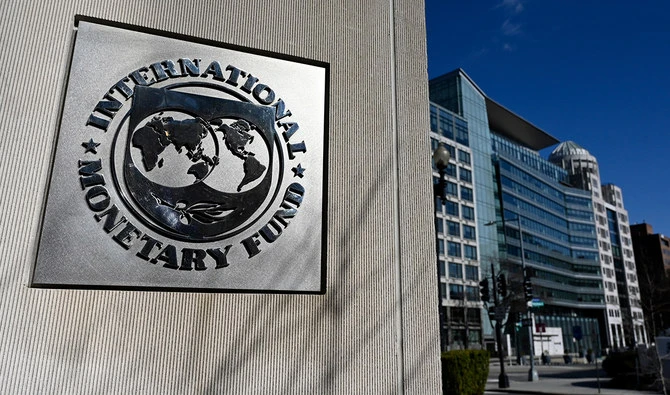
The seal for the International Monetary Fund is seen in Washington, DC, on January 26, 2022. (AFP/File)
Short Url
Updated 31 May 2023
Follow

Amid delayed bailout, Pakistan accuses IMF of ‘interfering’ in domestic political affairs

  • The IMF mission chief recently spoke of maintaining rule of law amid political turbulence in Pakistan
  • Aisha Ghaus Pasha says government wants to complete the IMF program, though it does have a ‘Plan B’

ISLAMABAD: Pakistan’s state minister for finance Dr. Aisha Ghaus Pasha on Wednesday described a statement by a senior International Monetary Fund (IMF) official as “interference” in domestic politics after he spoke about the necessity of maintaining the “rule of law” in the country.

Pakistan has been facing significant political turbulence since the ouster of former prime minister Imran Khan from power in a parliamentary no-trust vote last year. The situation further exacerbated after Khan was arrested on graft charges on May 9 which led to violent protests by his supporters who torched government buildings and military installations.

The country’s civilian and military authorities launched a crackdown against the ex-premier’s Pakistan Tehreek-e-Insaf (PTI) party, saying that some of its protesting members would be tried under military laws.

Discussing Pakistan’s progress in terms of unlocking a stalled IMF loan program, the international lender’s mission chief Nathan Porter said in an interview this week he hoped that “a peaceful way forward is found in line with the constitution and rule of law” in the country.

“I guess it is extraordinary what the IMF has said,” the Pakistani minister noted during brief media interaction in Islamabad. “The IMF usually doesn’t say such things.”

She maintained that “interference” in Pakistan’s internal affairs was not part of the IMF mandate.

“The IMF should not include these extraordinary things at the moment,” she added. “As for the rule of the law, we have to move ahead as per the rule of the law. We are promoters of democracy and we want the institutions to perform within the ambit of the constitution.”

Pasha said any delay in the $6.5 billion loan program signed in 2019 was neither in the interest of Pakistan nor the IMF.

The global lending agency is yet to release about $1.2 billion to help Pakistan’s cash-strapped economy since last November.

“We firmly hope to get the IMF bailout,” she continued. “We are in the [IMF] program, and certainly there is Plan B. It’s not like the finance ministry is sitting with its eyes closed.”

However, Pasha pointed out her country was fully committed to completing the IMF program.

“We are not even thinking of a scenario without IMF,” she said while expressing her optimism that the country would reach a staff-level agreement before the new budget on June 9.

Pakistan is witnessing a major economic crisis amid declining forex reserves and rapidly depreciating national currency.

The country needs external financing, though the IMF loan program continues to remains stalled.

Pakistan says IMF has not imposed new conditions under $7 billion bailout

Updated 4 sec ago
Follow

Pakistan says IMF has not imposed new conditions under $7 billion bailout

  • Finance ministry says measures cited as ‘new conditions’ are phased extensions of reforms already agreed
  • Media described steps like civil servants’ asset disclosures and sugar industry deregulation as new demands

ISLAMABAD: Pakistan said on Sunday some of the reform measures mentioned in the media and linked to the International Monetary Fund (IMF) bailout program are not “new conditions” imposed by the lender but extensions of commitments already agreed under the arrangement.

Local media and social platforms have described a series of IMF-linked structural benchmarks as fresh conditions under the $7 billion loan for Pakistan in recent weeks. News reports published and broadcast in India also mentioned 11 measures under the loan, describing them as new IMF demands imposed on the country.

“The Ministry of Finance has clarified the intent, context, and continuity of reform measures under Pakistan’s IMF Extended Fund Facility (EFF) program, particularly in response to recent commentary regarding so-called ‘new conditions,’” said an official statement circulated in Islamabad.

“The purpose is to reaffirm that the measures referenced are part of a phased, medium-term reform agenda agreed with the IMF, many of which are extensions or logical progressions of reforms already initiated by the Government of Pakistan,” it added.

The ministry said the EFF is designed to support medium-term structural reforms implemented in a sequenced manner, with each program review building on prior actions to meet policy objectives agreed at the outset.

It provided detailed clarification on 11 measures that had been characterized as new conditions, including public disclosure of asset declarations of civil servants, strengthening the operational effectiveness of the National Accountability Bureau, empowering provincial anti-corruption bodies through access to financial intelligence and facilitating foreign remittances.

Other measures cited included the development of the local currency bond market, deregulation of the sugar industry, a comprehensive reform roadmap for the Federal Board of Revenue, a medium-term tax reform strategy, phased privatization of power distribution companies, regulatory reforms to strengthen corporate compliance and contingency measures to address potential revenue shortfalls.

The ministry said several of these reforms had been embedded in the Memorandum of Economic and Financial Policies (MEFP), a document detailing mutually agreed commitments, dating back to May 2024 and March 2025, including pledges related to tax policy, governance, energy sector restructuring and revenue mobilization.

“During discussions and negotiations with the IMF, the Government of Pakistan presents its planned policy reform initiatives,” the statement added. “Where the IMF assesses that these initiatives contribute to the agreed program objectives, they are incorporated into the MEFP.”

“As a result,” it continued, “many of the structural benchmarks and actions included in the latest MEFP are derived from reforms already undertaken or initiated by the Government of Pakistan, rather than being externally imposed or newly introduced conditions.”

The statement noted the measures outlined in the latest MEFP represent “continuity, sequencing and deepening of Pakistan’s agreed reform agenda” under the IMF loan, rather than the “imposition of abrupt or unprecedented conditions.”