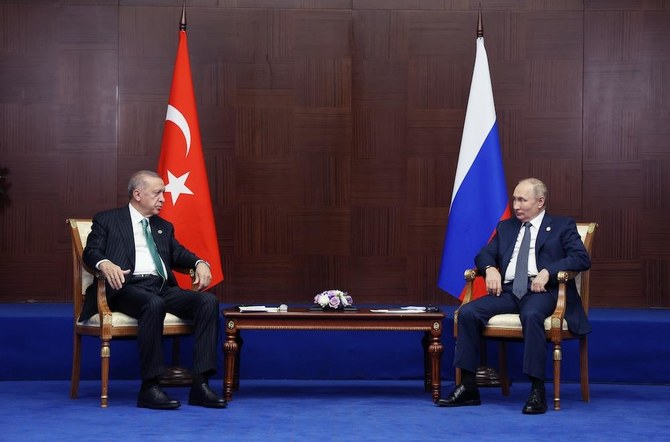
MOSCOW: The Kremlin said on Wednesday President Vladimir Putin and his Turkish counterpart Recep Tayyip Erdogan would hold a meeting in the foreseeable future, although it was not yet agreed when and where the meeting would take place.
Putin congratulated his “dear friend” Erdogan after the latter’s victory in Turkiye’s presidential election on Sunday.
Ankara has conducted a diplomatic balancing act since Russia sent troops into Ukraine in February last year, opposing Western sanctions on Russia while retaining close ties with both Moscow and Kyiv, its Black Sea neighbors.


![]()


Kremlin: Putin, Erdogan to meet in foreseeable future
Short Url
https://arab.news/pw6xu
Kremlin: Putin, Erdogan to meet in foreseeable future
- Ankara has conducted a diplomatic balancing act since Russia sent troops into Ukraine in February last year


Kremlin welcomes US sanctions waiver says US and Russia share interest in stable energy markets
DUBAI: Russia sees a U.S. sanctions waiver on its oil as an attempt by Washington to stabilise global energy markets, and the two countries have a shared interest in this, Kremlin spokesman Dmitry Peskov said on Friday.
"We see actions by the United States aimed at trying to stabilise energy markets. In this respect, our interests coincide," he said.
US Treasury Secretary Scott Bessent announced a temporary authorisation allowing countries around the world to purchase Russian oil currently stranded at sea on Thursday extending a measure that had previously been granted only to Indian refiners.
Bessent stressed in a post on X that the authorisation would not provide significant financial benefit to the Russian government.
“This narrowly tailored, short-term measure applies only to oil already in transit and will not provide significant financial benefit to the Russian government, which derives the majority of its energy revenue from taxes assessed at the point of extraction,” Bessent said on a post on X.
However, the measure received mix reviews in European capitals, with many fearing it could help replenish Russia's assualt on Ukraine.
"I am concerned that we are further filling Putin's war chest," German Economy Minister Katherina Reiche said in Berlin on Friday.
Reiche said that she saw both sides to the United States' decision to issue a 30-day waiver for the purchase of Russian oil products, understanding the increasing ecnomic and political turnout from the oil crisis, particurlarly in South Korea and Japan.
"It seems to me that domestic political pressure in the United States is very, very high," Reiche said.
German Chancellor Friedrich Merz was more direct, saying on Friday that it was wrong to ease sanctions against Russia for whatever reason. The sentiment was echoed by Norway’s Prime Minister, who also said sanctions should not be eased.
Oil prices held gains above $100 Friday and most equity markets dropped after Iran's leader called for the blocking of the crucial Strait of Hormuz and the opening up of new fronts in the war against the United States and Israel.
With the conflict heading towards its third week and showing no signs of ending, investors are growing increasingly worried about an extended crisis that could fan inflation and hammer the global economy.


Latest updates





© 2026 SAUDI RESEARCH & PUBLISHING COMPANY, All Rights Reserved And subject to Terms of Use Agreement.