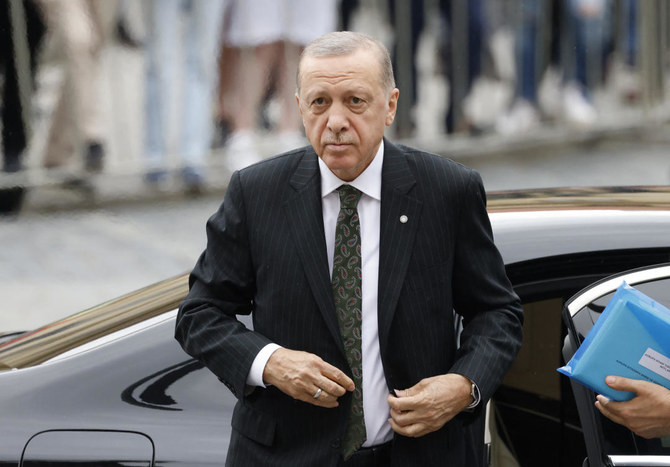
ISTANBUL: Turkey’s President Recep Tayyip Erdogan is likely to meet Russian leader Vladimir Putin on the margins of a regional summit in the Kazakh capital Astana this week, a Turkish official told AFP.
The official initially said the meeting would be on Wednesday, but later said it appeared Erdogan was likely to meet Putin on Thursday, according to the latest program.
Erdogan is scheduled to fly to Astana on Wednesday for talks with Kazakh President Kassym-Jomart Tokayev, said the Turkish official.
Turkey, which has stayed neutral throughout the conflict in Ukraine, has good relations with its two Black Sea neighbors — Russia and Ukraine.
Erdogan has not yet commented on mass Russian strikes across Ukraine on Monday, which Ukrainian emergency services said killed at least 19 people and wounded more than 100.
But Turkish Foreign Minister Mevlut Cavusoglu held a telephone call with Ukrainian counterpart Dmytro Kuleba after the attacks, a Turkish diplomatic source said, without elaborating further.
Erdogan met Putin on the sidelines of a regional summit in Uzbekistan last month.
The Turkish leader still hopes to bring Putin and Ukrainian President Volodymyr Zelensky together for truce talks that neither side particularly wants but which Turkish officials insist are essential and realistic.
NATO member Turkey has refrained from joining Western sanctions against Russia.
Erdogan is keen to boost trade with Moscow as he tries to stabilize the battered Turkish economy in the run up to elections next June.
Last month Ankara bowed to pressure from the United States and confirmed the last three Turkish banks still processing Russian card payments were pulling the plug.
The decision followed weeks of increasingly blunt warnings from Washington for Turkey to either limit economic ties with Russia or face the threat of sanctions itself.

Erdogan to meet Putin in Astana: Turkish official
https://arab.news/vftqk
Erdogan to meet Putin in Astana: Turkish official
- Erdogan met Putin on the sidelines of a regional summit in Uzbekistan last month
- The Turkish leader still hopes to bring Putin and Ukrainian President Volodymyr Zelensky together for truce talks
Hamas retakes control of daily life in Gaza
- “Everyone knows that Hamas possesses the real power in Gaza,” said Shaaban, a displaced Palestinian
- “Currently, we operate only in areas under Hamas control,” said a merchant
GAZA CITY, Palestinian Territories: Hamas has reasserted control over large parts of Gaza from which the Israeli military withdrew under the US-sponsored ceasefire, exercising power through police and working to restart public administration.
The inaugural meeting of US President Donald Trump’s “Board of Peace” on Thursday included an announcement on the recruitment of a new transitional Palestinian police force in Gaza meant to take over security from Palestinian Islamist movement Hamas.
It also saw several countries pledge to send troops for the nascent International Stabilization Force in the Gaza Strip, without any timetable set.
Hamas still refuses to lay down its arms under the conditions set by Israel, but it has pledged to hand over power, insisting it no longer wants to administer the territory it seized by force nearly 20 years ago.
“Everyone knows that Hamas possesses the real power in Gaza,” said Jaber Shaaban, a displaced Palestinian living in a tent in Gaza City.
“Hamas is the strongest and largest organized entity and it has power, police and a government,” the 64-year-old added.
“Without Hamas, the committee cannot work,” he said, referring to the 15-member Palestinian technocratic committee formed to handle day-to-day governance of Gaza.
Since a ceasefire between Hamas and Israel began on October 10, Gaza has been divided by a so-called “Yellow Line” beyond which Israeli forces are stationed and which leaves the military in control of just over half of the territory.
“Currently, we operate only in areas under Hamas control,” said Abu Ashraf Barbah, a merchant who before the war supplied food items across the territory of more than two million Palestinians.
“The Hamas ministry is the one that deals with traders and controls the markets, while the Hamas police carry out campaigns against tax evaders,” he added.
The newly-formed Palestinian technocratic body is primarily mandated to oversee civilian services such as health, education and municipal affairs.
- In the markets, on the streets -
Phase two of Trump’s Gaza ceasefire plan, which the UN Security Council endorsed in November, stipulates that Hamas should disarm and the Strip’s day-to-day governance be handed over to the technocratic committee.
But Israeli officials say Hamas still has around 20,000 fighters in Gaza and several thousand rockets.
The return to some form of public order is one of the challenges of the second phase, which the United States launched last month.
Concrete results have been slow to materialize.
While waiting for the transitional authority to take shape, Gaza’s existing police force — which answers to Hamas authorities — has returned to the streets since the ceasefire took effect.
AFP journalists reported that uniformed, armed police have deployed at major intersections, hospital entrances and government buildings, directing traffic and regulating markets.
With many police stations destroyed during Israeli air strikes, some units have resumed operations from temporary tents, residents said.
For traders, Hamas’s influence is most visible.
“The one controlling everything in Gaza’s economy is Hamas,” said 41-year-old merchant Samir Abu Adnan.
“Hamas has started collecting taxes, the ministry of economy publishes daily price lists, and the police and ministries are still affiliated with Hamas,” he said.
Several traders confirmed to AFP that civil servants were collecting taxes in markets and shops, relying on police enforcement in cases of non-compliance.
- ‘Hamas controls the levers’ -
In rare testimony to the media, a police captain in Gaza City told AFP that the force would maintain law and order regardless of who formally governs the territory.
“We are a police force that carries out the government’s instructions,” the 44-year-old officer said, declining to be identified for security reasons.
“We do not care who will be in the political leadership of the government,” he added.
“What matters to me is that the incoming government is not affiliated with the occupation,” he said, referring to Israel.
“If the committee takes over Gaza, we will help it.”
But there is uncertainty over how the transitional technocratic committee would be deployed in the territory and what would happen to the current police force.
Amani Ashtiwi, a teacher living in a tent in central Gaza, said the committee would need “very strong support from the Palestinian Authority, Egypt and America to be able to govern Gaza.”
“The committee faces a long and difficult road because Hamas controls the levers of life in Gaza,” Ashtiwi added.
For merchant Abu Adnan, Hamas still “holds the power.”
“If the committee takes over, it will need Hamas’s approval for every decision,” he said.


