

Pakistani court extends ex-PM Khan’s interim bail in corruption case until June 19

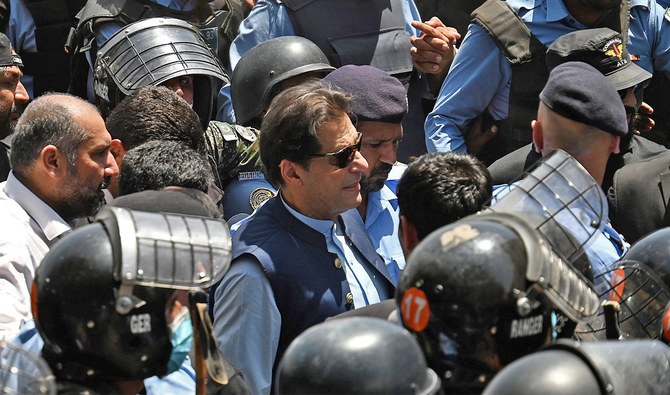
Police cammandos escort former Pakistan's Prime Minister Imran Khan (C) as he arrives at the high court in Islamabad, Pakistan, on May 12, 2023. (AFP/File)
Short Url
Updated 31 May 2023
Follow

Pakistani court extends ex-PM Khan’s interim bail in corruption case until June 19

  • Imran Khan faces the allegation of receiving valuable land as a bribe from a real estate developer in Pakistan
  • Police in Islamabad announced imposition of restrictions on political gatherings ahead of Khan’s court appearance

ISLAMABAD: A Pakistani court extended former prime minister Imran Khan’s interim bail in a corruption case on Wednesday, confirmed his Pakistan Tehreek-e-Insaf (PTI) party in a brief statement.

Khan was arrested by the country’s anti-graft body, the National Accountability Bureau (NAB), earlier this month to carry out investigation into the same case, popularly called the Al-Qadir Trust corruption reference, in which he is said to have received valuable land as a bribe from a real estate developer in the country.

The former prime minister is accused of getting undue benefit from the business tycoon after granting him a settlement in £190 million seized by the United Kingdom’s National Crime Agency in a property deal.

The government said Khan used the Al-Qadir Trust, jointly owned by him and his wife, as a front to secure financial benefits. The trust was originally created to set up a university outside the federal capital to study science, spirituality and Islamic teachings.

“Chairman Imran Khan’s interim bail granted by NAB court till June 19 in Al-Qadir University case,” PTI said in a Twitter post. “Apart from this, protective bail was granted in all the cases which were registered [against him] in Islamabad.”

Khan was brought before the Islamabad High Court (IHC) after his arrest which offered him a protective bail on May 12, asking the authorities not to arrest him in any case, known or undisclosed, until May 31. One Wednesday, the ex-premier appeared before the court due to the expiration of protection it previously offered him against arrest by law enforcement officials.

The Islamabad police reminded the former prime minister’s supporters earlier in the day that Section 144 of Criminal Procedure Code, which prohibits large public gatherings, had been enforced in the federal capital.

“No political activity is allowed in the high security/Red Zone,” the police said in a Twitter post. “If four or more than four people gather together, legal action will be taken [against them].”

However, the social media post announced that all transportation routes in Islamabad remained open for the residents of the city.


Pakistani politicians urge dialogue with Imran Khan’s party as PM offers talks

Updated 07 January 2026
Follow

Pakistani politicians urge dialogue with Imran Khan’s party as PM offers talks

  • National Dialogue Committee group organizes summit attended by prominent lawyers, politicians and journalists in Islamabad
  • Participants urge government to lift alleged ban on political activities and media restrictions, form committee for negotiations 

ISLAMABAD: Participants of a meeting featuring prominent politicians, lawyers and civil society members on Wednesday urged the government to initiate talks with former prime minister Imran Khan’s Pakistan Tehreek-e-Insaf (PTI) party, lift alleged bans on political activities after Prime Minister Shehbaz Sharif recently invited the PTI for talks. 

The summit was organized by the National Dialogue Committee (NDC), a political group formed last month by former PTI members Chaudhry Fawad Husain, ex-Sindh governor Imran Ismail and Mehmood Moulvi. The NDC has called for efforts to ease political tensions in the country and facilitate dialogue between the government and Khan’s party. 

The development takes place amid rising tensions between the PTI and Pakistan’s military and government. Khan, who remains in jail on a slew of charges he says are politically motivated, blames the military and the government for colluding to keep him away from power by rigging the 2024 general election and implicating him in false cases. Both deny his allegations. 

Since Khan was ousted in a parliamentary vote in April 2022, the PTI has complained of a widespread state crackdown, while Khan and his senior party colleagues have been embroiled in dozens of legal cases. Prime Minister Shehbaz Sharif last month invited the PTI for talks during a meeting of the federal cabinet, saying harmony among political forces was essential for the country’s progress.

“The prime objective of the dialogue is that we want to bring the political temperatures down,” Ismail told Arab News after the conference concluded. 

“At the moment, the heat is so much that people— especially in politics— they do not want to sit across the table and discuss the pertaining issues of Pakistan which is blocking the way for investment.”

Former prime minister Shahid Khaqan Abbasi, who heads the Awaam Pakistan political party, attended the summit along with Jamaat-e-Islami senior leader Liaquat Baloch, Muttahida Quami Movement-Pakistan’s Waseem Akhtar and Haroon Ur Rashid, president of the Supreme Court Bar Association. Journalists Asma Shirazi and Fahd Husain also attended the meeting. 

Members of the Pakistan Peoples Party, the ruling Pakistan Muslim League-Nawaz (PML-N) and the PTI did not attend the gathering. 

The NDC urged Prime Minister Shehbaz Sharif, President Asif Ali Zardari and PML-N chief Nawaz Sharif to initiate talks with the opposition. It said after the government forms its team, the NDC will announce the names of the opposition negotiating team after holding consultations with its jailed members. 

“Let us create some environment. Let us bring some temperatures down and then we will do it,” Ismail said regarding a potential meeting with the jailed Khan. 

Muhammad Ali Saif, a former adviser to the Khyber Pakhtunkhwa chief minister, told participants of the meeting that Pakistan was currently in a “dysfunctional state” due to extreme political polarization.

“The tension between the PTI and the institutions, particularly the army, at the moment is the most fundamental, the most prominent and the most crucial issue,” Saif noted. 

‘CHANGED FACES’

The summit proposed six specific confidence-building measures. These included lifting an alleged ban on political activities and the appointment of the leaders of opposition in Pakistan’s Senate and National Assembly. 

The joint communique called for the immediate release of women political prisoners, such as Khan’s wife Bushra Bibi and PTI leader Yasmin Rashid, and the withdrawal of cases against supporters of political parties.

The communiqué also called for an end to media censorship and proposed that the government and opposition should “neither use the Pakistan Armed Forces for their politics nor engage in negative propaganda against them.”

Amir Khan, an overseas Pakistani businessperson, complained that frequent political changes in the country had undermined investors’ confidence.

“I came here with investment ideas, I came to know that faces have changed after a year,” Amir Khan said, referring to the frequent change in government personnel. 

Khan’s party, on the other hand, has been calling for a “meaningful” political dialogue with the government. 

However, it has accused the government of denying PTI members meetings with Khan in the Rawalpindi prison where he remains incarcerated. 

“For dialogue to be meaningful, it is essential that these authorized representatives are allowed regular and unhindered access to Imran Khan so that any engagement accurately reflects his views and PTI’s collective position,” PTI leader Azhar Leghari told Arab News last week.