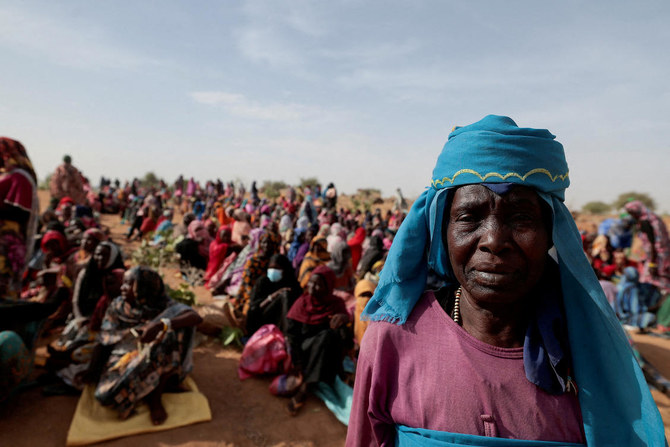
Sudan refugees strain cash-strapped Chad’s hospitality

They are among 90,000 people who have escaped to Chad since fighting broke out in Sudan in mid-April. (Reuters)
Short Url
Updated 30 May 2023
Follow

Sudan refugees strain cash-strapped Chad’s hospitality

  • They are among 90,000 people who have escaped to Chad since fighting broke out in Sudan in mid-April
  • Tensions have risen over water use, which is traditionally sourced from communal wells

KOUFROUN: There used to be one family in Fanna Hamit’s compound, now there are 11 families struggling to get by selling roasted crickets after she took in relatives fleeing the conflict in Sudan.
They are among 90,000 people who have escaped to Chad since fighting broke out in Sudan in mid-April — a major extra burden on one of the world’s poorest countries.
Even before this emergency, Chad was hosting 600,000 refugees from its war-torn neighbors and grappling with a fourth consecutive year of acute food shortages. Overall, around 2.3 million people are in urgent need of food aid, the World Food Programme warned earlier in May.
“The extraordinary hospitality of the Chadian government and its people has been demonstrated yet again ... but the scale of this crisis requires more funding to save lives,” UN aid agency OCHA said in a call for increased international support.
Hamit, a 58-year-old widow with six children of her own, has had to make careful economies to provide for those sheltering in her compound, most of whom arrived in this border village of Koufron with nothing.
Squeezed into the open-air compound, the women cook together over small braziers in the sand as children play around them.
“They share everything with us: their food, their toilet, their clothes and all the rest,” said 78-year-old Kaltouma Yaya Abderahmane, who pitched up at Hamit’s door in the middle of the night in late April.
The sudden arrival of large numbers of people has also distorted the market for goods and squeezed water supplies in Chad’s remote and arid borderlands.
“Let’s not even talk about sugar ... it’s doubled in price,” Hamit said, also lamenting the higher cost of grains and peanuts.
Tensions have risen over water use, which is traditionally sourced from communal wells. Some refugees at the Goungour refugee camp, south of Koufroun, told Reuters they had been barred by locals from drawing water in a nearby village and had to dig their own wells in dry riverbeds.
Hamit said she tried to help “even the refugees who have set up shelters nearby .... they come to us for water”.

“The situation is tough for everyone.”


UN’s top court opens Myanmar Rohingya genocide case

Updated 14 min 8 sec ago
Follow

UN’s top court opens Myanmar Rohingya genocide case

  • The Gambia filed a case against Myanmar at the UN’s top court in 2019
  • Verdict expected to impact Israel’s genocide case over war on Gaza

DHAKA: The International Court of Justice on Monday opened a landmark case accusing Myanmar of genocide against its mostly Muslim Rohingya minority.

The Gambia filed a case against Myanmar at the UN’s top court in 2019, two years after a military offensive forced hundreds of thousands of Rohingya from their homes into neighboring Bangladesh.

The hearings will last three weeks and conclude on Jan. 29.

“The ICJ must secure justice for the persecuted Rohingya. This process should not take much longer, as we all know that justice delayed is justice denied,” said Asma Begum, who has been living in the Kutupalong refugee camp in Bangladesh’s Cox’s Bazar district since 2017.

A mostly Muslim ethnic minority, the Rohingya have lived for centuries in Myanmar’s western Rakhine state but were stripped of their citizenship in the 1980s and have faced systemic persecution ever since.

In 2017 alone, some 750,000 of them fled military atrocities and crossed to Bangladesh, in what the UN has called a textbook case of ethnic cleansing by Myanmar.

Today, about 1.3 million Rohingya shelter in 33 camps in Cox’s Bazar, turning the coastal district into the world’s largest refugee settlement.

“We experienced horrific acts such as arson, killings and rape in 2017, and fled to Bangladesh,” Begum told Arab News.

“I believe the ICJ verdict will pave the way for our repatriation to our homeland. The world should not forget us.”

A UN fact-finding mission has concluded that the Myanmar 2017 offensive included “genocidal acts” — an accusation rejected by Myanmar, which said it was a “clearance operation” against militants.

Now, there is hope for justice and a new future for those who have been displaced for years.

“We also have the right to live with dignity. I want to return to my homeland and live the rest of my life in my ancestral land. My children will reconnect with their roots and be able to build their own future,” said Syed Ahmed, who fled Myanmar in 2017 and has since been raising his four children in the Kutupalong camp.

“Despite the delay, I am optimistic that the perpetrators will be held accountable through the ICJ verdict. It will set a strong precedent for the world.”

The Myanmar trial is the first genocide case in more than a decade to be taken up by the ICJ. The outcome will also impact the genocide case that Israel is facing over its war on Gaza.

“The momentum of this case at the ICJ will send a strong message to all those (places) around the world where crimes against humanity have been committed,” Nur Khan, a Bangladeshi lawyer and human rights activist, told Arab News.

“The ICJ will play a significant role in ensuring justice regarding accusations of genocide in other parts of the world, such as the genocide and crimes against humanity committed by Israel against the people of Gaza.”