

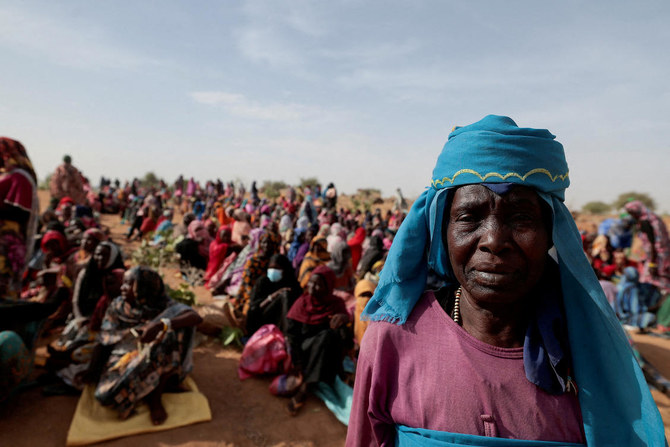
Sudan refugees strain cash-strapped Chad’s hospitality

They are among 90,000 people who have escaped to Chad since fighting broke out in Sudan in mid-April. (Reuters)
Short Url
Updated 30 May 2023
Follow

Sudan refugees strain cash-strapped Chad’s hospitality

  • They are among 90,000 people who have escaped to Chad since fighting broke out in Sudan in mid-April
  • Tensions have risen over water use, which is traditionally sourced from communal wells

KOUFROUN: There used to be one family in Fanna Hamit’s compound, now there are 11 families struggling to get by selling roasted crickets after she took in relatives fleeing the conflict in Sudan.
They are among 90,000 people who have escaped to Chad since fighting broke out in Sudan in mid-April — a major extra burden on one of the world’s poorest countries.
Even before this emergency, Chad was hosting 600,000 refugees from its war-torn neighbors and grappling with a fourth consecutive year of acute food shortages. Overall, around 2.3 million people are in urgent need of food aid, the World Food Programme warned earlier in May.
“The extraordinary hospitality of the Chadian government and its people has been demonstrated yet again ... but the scale of this crisis requires more funding to save lives,” UN aid agency OCHA said in a call for increased international support.
Hamit, a 58-year-old widow with six children of her own, has had to make careful economies to provide for those sheltering in her compound, most of whom arrived in this border village of Koufron with nothing.
Squeezed into the open-air compound, the women cook together over small braziers in the sand as children play around them.
“They share everything with us: their food, their toilet, their clothes and all the rest,” said 78-year-old Kaltouma Yaya Abderahmane, who pitched up at Hamit’s door in the middle of the night in late April.
The sudden arrival of large numbers of people has also distorted the market for goods and squeezed water supplies in Chad’s remote and arid borderlands.
“Let’s not even talk about sugar ... it’s doubled in price,” Hamit said, also lamenting the higher cost of grains and peanuts.
Tensions have risen over water use, which is traditionally sourced from communal wells. Some refugees at the Goungour refugee camp, south of Koufroun, told Reuters they had been barred by locals from drawing water in a nearby village and had to dig their own wells in dry riverbeds.
Hamit said she tried to help “even the refugees who have set up shelters nearby .... they come to us for water”.

“The situation is tough for everyone.”


UN chief calls on Israel to reverse NGOs ban in Gaza

Updated 03 January 2026
Follow

UN chief calls on Israel to reverse NGOs ban in Gaza

  • In November, authorities in Gaza said more than 70,000 people had been killed there since the war broke out
  • Israel on Thursday suspended 37 foreign humanitarian organizations from accessing the Gaza Strip after they had refused to share lists of their Palestinian employees with government officials

UNITED NATIONS, United States: UN Secretary General Antonio Guterres called on Friday for Israel to end a ban on humanitarian agencies that provided aid in Gaza, saying he was “deeply concerned” at the development.
Guterres “calls for this measure to be reversed, stressing that international non-governmental organizations are indispensable to life-saving humanitarian work and that the suspension risks undermining the fragile progress made during the ceasefire,” his spokesperson Stephane Dujarric said in a statement.
“This recent action will further exacerbate the humanitarian crisis facing Palestinians,” he added.
Israel on Thursday suspended 37 foreign humanitarian organizations from accessing the Gaza Strip after they had refused to share lists of their Palestinian employees with government officials.
The ban includes Doctors Without Borders (MSF), which has 1,200 staff members in the Palestinian territories — the majority of whom are in Gaza.
NGOs included in the ban have been ordered to cease their operations by March 1.
Several NGOS have said the requirements contravene international humanitarian law or endanger their independence.
Israel says the new regulation aims to prevent bodies it accuses of supporting terrorism from operating in the Palestinian territories.
On Thursday, 18 Israel-based left-wing NGOs denounced the decision to ban their international peers, saying “the new registration framework violates core humanitarian principles of independence and neutrality.”
A fragile ceasefire has been in place since October, following a deadly war waged by Israel in response to Hamas’s unprecedented October 7, 2023, attack on Israel.
In November, authorities in Gaza said more than 70,000 people had been killed there since the war broke out.
Nearly 80 percent of buildings in Gaza have been destroyed or damaged by the war, according to UN data, leaving infrastructure decimated.
About 1.5 million of Gaza’s more than two million residents have lost their homes, said Amjad Al-Shawa, director of the Palestinian NGO Network in Gaza.