

Pakistan monkeypox-free as last two patients recover, discharged from hospital

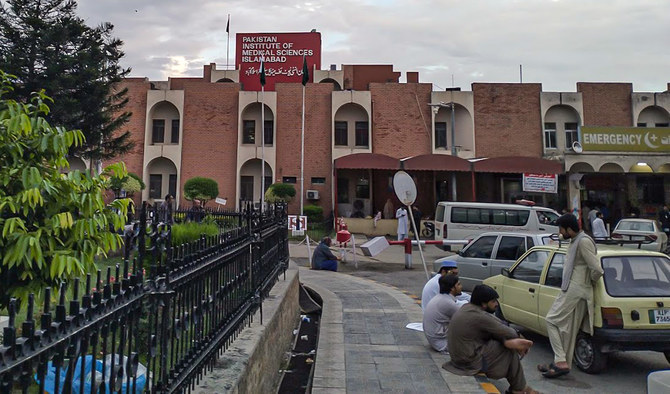
In his undated file picture people wait outside a government hospital, the Pakistan Institute Of Medical Sciences (PIMS), in Islamabad. (Photo courtesy: Google)
Short Url
Updated 30 May 2023
Follow

Pakistan monkeypox-free as last two patients recover, discharged from hospital

  • First case of mpox in Pakistan was confirmed by the National Institute of Health late in April
  • Pakistan went on to confirm four more cases, all five patients now discharged from hospital

ISLAMABAD: The Pakistan Institute of Medical Sciences (PIMS) said on Monday two patients of monkeypox admitted at the hospital had recovered and been discharged, with all five cases of the infection diagnosed in Pakistan now cured.

Monkeypox, or mpox, is a zoonotic infection that can spread from animals to humans. The viral disease can also be contracted from one person to another and causes high fever and body pains as well as pus-filled skin lesions.

The first case of mpox in Pakistan was confirmed by the National Institute of Health in the capital, Islamabad, late in April. The country went on to confirm four more cases.

“Both patients of monkeypox admitted in PIMS have been discharged,” PIMS said in a message to journalists.

Mpox was declared a global health emergency by the World Health Organization in July 2022. Earlier this month, WHO said the global outbreak of mpox, which initially baffled experts as the disease spread to more than 100 countries last year, was no longer an international emergency, after a dramatic drop in cases in recent months.

In Pakistan, the NIH, provincial health departments, border health services and district health authorities were advised after the first case to ensure surveillance through laboratory diagnostics, contact tracing, rapid identification of suspected cases, and to provide care and isolate cases to prevent transmission.


Pakistan says it is moving toward phased crypto regulation after Binance, HTX approvals

Updated 8 sec ago
Follow

Pakistan says it is moving toward phased crypto regulation after Binance, HTX approvals

  • The country is among the world’s largest crypto adoption markets, with nearly 40 million users
  • Bilal bin Saqib says the government is not promoting crypto but moving to regulate the sector

ISLAMABAD: Pakistan’s top virtual asset regulatory official said on Sunday the country was laying the foundation for a phased and tightly supervised crypto framework after granting conditional approvals to two global exchanges, signaling a shift from years of regulatory ambiguity toward formal oversight of digital assets.

The Pakistan Virtual Assets Regulatory Authority (PVARA) said this week it had issued no objection certificates (NOCs) to global crypto exchanges Binance and Huobi (HTX). Pakistan has also signed a memorandum of understanding with them to explore what the finance ministry described as the “tokenization” of up to $2 billion in sovereign bonds, treasury bills and commodity reserves, an initiative aimed at boosting liquidity and attracting investors.

“The no objection certificate given to Binance and Huobi is the first practical step of this new thinking,” PVARA chief Bilal bin Saqib said at a briefing. “Let me make it clear that this NOC is not a shortcut. This is not a blanket approval.”

He said the approvals marked the start of a risk-mitigated, phased and supervised entry framework, adding that platforms would be subject to strict anti-money laundering and counter-terrorism financing requirements, ownership transparency checks and enforcement-linked licensing timelines.

“This is not a new experiment,” he said, pointing to phased regulatory approaches adopted in financial centers such as Dubai, the United Kingdom and Singapore, where firms are first brought under supervision before being allowed to expand operations.

Pakistan is among the world’s largest crypto adoption markets, with estimates putting the number of users between 30 and 40 million, despite the absence of a comprehensive regulatory framework. Saqib said ignoring the sector was no longer viable, warning that unregulated adoption posed greater risks to the economy and consumers.

“We don’t want to promote crypto,” he said. “We want to regulate crypto. Adoption is already there.”

​He said the framework was designed to prepare Pakistan for longer-term developments in digital finance, including tokenized assets, compliance technology, blockchain analytics and digital payment infrastructure, while ensuring that local talent is channeled into regulated and productive use.

“For the international community, the message is clear,” Saqib said. “Pakistan is not running away from innovation. Pakistan is welcoming innovation. Pakistan is regulating innovation.”