

Pakistan’s digital footprint gains momentum with rising e-banking, PoS transactions — central bank

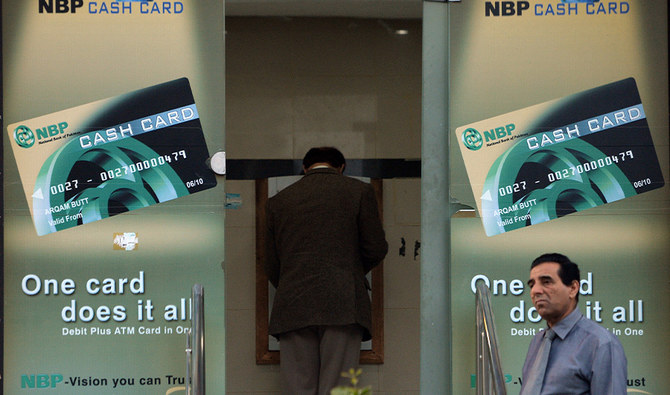
This photograph taken on March 4, 2015 shows a Pakistani resident waiting to withdraw currency from an ATM in Islamabad. (AFP/File)
Short Url
Updated 29 May 2023
Follow

Pakistan’s digital footprint gains momentum with rising e-banking, PoS transactions — central bank

  • During Q3 FY23, e-banking transactions increased by 4.3% in volume, 11.2% in value
  • Around 81% of all debit card holders in Pakistan are male while only 19.2% are female

KARACHI: The volume and value of digital transactions in Pakistan continue to grow, with the South Asian country witnessing an expanding digital footprint as it pushes for the digitalization of its payment systems, the central bank said on Monday.

Increasing collaboration between banks and fintech companies has provided efficient, accessible and user-friendly digital payments platform for customers, allowing a greater number of customers to use digital channels to make payments, the State Bank of Pakistan said in its third quarterly review of Payment Systems for Fiscal Year 2022-23, which covers the January-March 2023 period.

Pakistan’s central bank expects migration to electronic means will boost Pakistan’s GDP by 7%, create four million jobs, and result in new deposits of $263 billion and represent a potential market of $36 billion by 2025.

“Adoption and acceptance of digital instruments has been increasing steadily,” the central bank report, released on Monday, said.  

During the third quarter of fiscal year 2023, overall e-banking transactions increased by 4.3% in terms of volume and 11.2% in terms of value. Internet and mobile phone banking transactions also grew in volume by 9.9% from 200.7 million to 220.5 million and in value by 19.1% from Rs9,167.6 billion to Rs10,922.3 billion, the State Bank of Pakistan reported.  

At the end of March 2023, there were 9.3 million internet banking, 15.3 million mobile phone banking and 48.4 million branchless banking app users. In addition to this, holders of e-wallets reached 1.6 million.

Customers using Raast, Pakistan’s first instant payment system, for online Person-to-Person (P2P) funds transfers increased to 29.2 million users from 25.8 million. P2P value and volume of transactions processed through Raast during the third quarter grew by 92.3% and 55.6% respectively, with 41.2 million transactions amounting to Rs872.8 billion respectively.

With increasing number of digital platforms and online shopping avenues, transactions through Point-of-Sale (PoS) have also witnessed growth, with volume of transactions increasing by 6.8% and value by 10.1%.  

However, ATMs transactions remained similar to the previous quarter in terms of volume but increased 6% in value, according to the SBP report.  

The average ticket size of transactions through PoS was Rs5,463 per transaction while for ATM based transactions, it was Rs15,429 per transaction, according to the report.  

The value of e-commerce transactions processed by banks increased by 7.1% to reach Rs36.6 billion by the end of the third quarter of FY23.

There were 112,302 PoS machines installed across the country by the end of Q3 FY23, increasing from 96,975 PoS machines in the same quarter last year.

The volume of paper-based transactions declined from 95.5 million in Q2 FY23 to 94.3 million in Q3 FY23. However, its value increased by 3% to Rs1,646.6 billion during the quarter.

“As of quarter-end Mar-23, total payment cards issued in Pakistan stood at 48.4 million of which, 46.0 million are issued by Banks/ Micro Finance Banks (MFBs) while the remaining 2.4 million are issued by EMIs,” the report said.

Payment cards in Pakistan can be categorized into four categories, debit, credit, pre-paid and social welfare cards. Out of total cards in circulation, there are 37.1 million debit cards capturing 76.7% share of total cards followed by 9.2 million social welfare cards that make up 19.1%, 1.9 million credit cards, which is 4%, and 0.2% prepaid cards.  

However, the gap between male and female debt and credit card holders remains large in Pakistan.  

“Around 81% of all debit card holders are male, 19.2% female,” the report said.  


India favorites as T20 World Cup to begin after Pakistan, Bangladesh controversies

Updated 4 sec ago
Follow

India favorites as T20 World Cup to begin after Pakistan, Bangladesh controversies

  • Bangladesh were replaced by the ICC in this World Cup and Pakistan has refused to face India in group stage clash
  • The top two teams from each of the four groups of five teams will advance to the Super Eight stage of the World Cup

NEW DELHI: Cricket’s T20 World Cup begins Saturday after an acrimonious buildup overshadowed by political turmoil, with Bangladesh kicked out and Pakistan refusing to face arch-rivals and co-hosts India.

When the first ball is finally bowled after a chaotic lead-in, Pakistan will open the tournament against the Netherlands in Colombo.

Defending champions and tournament favorites India will make their tournament bow in the night match on day one against the United States in Mumbai, carrying the hopes of a billion-plus home cricket supporters.

Led by Suryakumar Yadav, India will start as firm tournament favorites and are expected to ease into the Super Eight stage from Group A.

But they will be wary of the United States, who are looking to take down another cricketing powerhouse, having shocked Pakistan to make the Super Eights in 2024.

Former champions Australia and England are also strong contenders to lift the trophy and deny holders India the title for a record second straight time.

The 2021 winners Australia have been hit hard by the absence of pace spearhead Pat Cummins, who was ruled out with a lower back injury.

Pace bowler Josh Hazlewood will miss the early stages as he recovers from hamstring and Achilles injuries.

Led by Mitchell Marsh, the Australians should still ease into the next round from Group B against Ireland, who they play first on Wednesday, plus co-hosts Sri Lanka Oman and Zimbabwe.

Harry Brook’s England, full of confidence after a 3-0 T20 series win in Sri Lanka this week, are expected to make the Super Eights from a Group C that also features two-time winners West Indies, debutants Italy, Nepal and Scotland.

Brook, under intense scrutiny after having to apologize for an incident with a night club bouncer in New Zealand last year, takes charge at a global tournament for the first time since he replaced Jos Buttler as white ball captain.

England, who start with a match against Nepal on Sunday in Mumbai, won the tournament in 2010 and 2022.

Scotland, after their 11th-hour call-up to replace Bangladesh, will take guard on the opening day when they face the West Indies in Kolkata.

Football powerhouse Italy will make an appearance at a cricket World Cup for the first time, and will kick off against the Scots in Kolkata on Monday.

South Africa, the runners-up in 2024, have never won a white ball World Cup, but are buoyed by winning the World Test Championship last year.

They will be a threat but must first emerge from a tough-looking Group D that contains dangerous opponents in New Zealand and Afghanistan.

They begin against Canada on Monday in Ahmedabad, with the UAE the other team in that group.

The top two teams from each of the four groups of five teams will advance to the Super Eights, with the top four making the semifinals.

POLITICS, PULLOUTS

There will be relief at the weekend when the action gets under way finally after weeks of political posturing that has dominated the build-up to 10th edition of the showpiece tournament.

Bangladesh refused to play in India, citing security concerns, as relations between the two countries soured and were kicked out by the International Cricket Council (ICC) from England’s Group C.

The ICC is led by Jay Shah, the former Indian cricket board secretary and son of the powerful Indian home minister Amit Shah.

Pakistan, who had backed Bangladesh’s plea to have their games moved to Sri Lanka, were cleared to play by the Islamabad government but they ordered the team not to play the marquee group clash against fierce rivals India on February 15.

According to media reports, the ICC is still waiting formal communication from the Pakistan Cricket Board on the boycott, leaving the door slightly ajar for a last-minute deal to get the game on.

If India are awarded a walkover, Pakistan will lose two points and take a big hit to their net run rate.
If any of their other three Group A games are lost to the weather then it could make it almost impossible for Pakistan to qualify.

Pakistan’s pullout will result in a loss of millions of dollars in revenue for broadcasters, and will be a huge letdown for fans on both sides.

The crisis was triggered last month when India’s cricket board ordered the IPL’s Kolkata Knight Riders to drop Bangladesh fast bowler Mustafizur Rahman, a move that deepened political strains between the neighbors.

The tournament will conclude with the final on March 8 in Ahmedabad or Colombo, depending on whether Pakistan go that far.