

Palestinian security officer due to wed killed by Israeli forces in West Bank

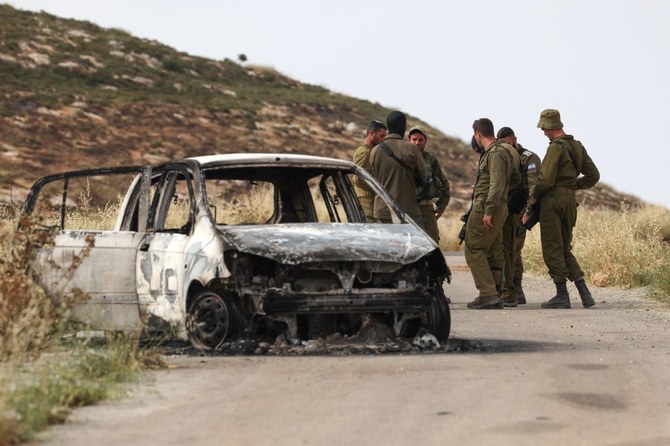
Dozens of Palestinians have been killed in Jenin in recent months, including minors and militants. (File/AFP)
Short Url
Updated 29 May 2023
Follow

Palestinian security officer due to wed killed by Israeli forces in West Bank

  • Eight people were also injured in the latest of now almost daily Israeli offensives in Jenin and its camp

RAMALLAH: A Palestinian security officer, who was soon due to be married, has been killed during clashes on Monday with Israeli forces in the occupied West Bank flashpoint city of Jenin.

The death of 37-year-old Ashraf Ibrahim, reported by Palestinian health officials, took the number of people estimated to have been killed by the Israeli army and settlers since the beginning of the year to 158, including 36 from the Gaza Strip in May, and 26 children.

Eight people were also injured in the latest of now almost daily Israeli offensives in Jenin and its camp.

Thousands of people attended the funeral of Ibrahim, a colonel in the Palestinian General Intelligence Service who had spent 11 years in Israeli prisons before joining the Palestinian Authority agency.

In a statement, the Hamas movement said: “Our steadfast and heroic people will make the occupation’s crimes a nightmare for its soldiers and settlers.”

More than 10 Palestinian security officers have been killed, dozens arrested, and several remain in detention, since the start of Israel’s military operation in the West Bank in early March last year.

Retired Maj. Gen. Adnan Al-Damiri, a former spokesman for the Palestinian security services, told Arab News that the Israeli army regularly targeted Palestinian security officers.

He said: “What is the fault of the Palestinian security officer who lives next to someone the Israeli army wants to be killed? The message to them is that they will be killed irrespective of whether they fight or do not fight the Israeli army.”

Some Palestinian leaders believe the security clampdown in the West Bank is a ploy by Israel to force Palestinian President Mahmoud Abbas to accept a meeting with Israeli Prime Minister Benjamin Netanyahu to arrange temporary solutions instead of tackling key issues such as Jerusalem, refugees, and borders.

A Palestinian security officer with the rank of colonel, who wished to remain anonymous, told Arab News: “If we cannot protect ourselves and the lives of our colleagues, how can we provide security for our security tasks and our people?”

He said that the actions of the Israelis had damaged the Palestinian security services’ credibility with the public and its ability to cooperate with Israel on almost any matter.

“How can a Palestinian security officer work in such an environment? We are suffering from a psychological, operational, professional, and financial crisis,” he added.

The number of Palestinians arrested by the Israeli army and being held in administrative detention without trial had reportedly reached 1,200.

Also, on Monday, Jewish settlers in the West Bank said they had set up a religious school in a dismantled outpost after the Israeli government lifted a ban on settlements in several evacuated areas in the northern part of the territory.

The US State Department said re-establishing the school contradicted commitments made by the Netanyahu government.

The school was built in Homesh, one of four West Bank outposts abandoned as part of Israel’s 2005 withdrawal from the Gaza Strip.

Homesh has been at the center of settler efforts to strengthen Israel’s hold on the northern West Bank. Homesh settlers also burned palm trees in the town of Burqa, northwest of Nablus.

The Israeli Knesset recently approved the cancellation of a disengagement bill from the areas of the northern West Bank, effectively making the outpost legal and officially free to be transformed into a settlement.

Settler attacks have also increased against Palestinian Christians in Jerusalem since the beginning of the year. Churches, monasteries, and cemeteries have been stormed, and in the latest incident on Sunday, verbal insults were directed at Christians in the Old City of Jerusalem.

Tombstones and crosses of more than 30 graves in the Protestant cemetery have also been destroyed.


In Gaza hospital, patients cling to MSF as Israel orders it out

Updated 2 sec ago
Follow

In Gaza hospital, patients cling to MSF as Israel orders it out

KHAN YUNIS: At a hospital in Gaza, wards are filled with patients fearing they will be left without care if Doctors Without Borders (MSF) is forced out under an Israeli ban due to take effect in March.
Last month, Israel announced it would prevent 37 aid organizations, including MSF, from operating in Gaza from March 1 for failing to provide detailed information on their Palestinian staff.
“They stood by us throughout the war,” said 10-year-old Adam Asfour, his left arm pinned with metal rods after he was wounded by shrapnel in a bombing in September.
“When I heard it was possible they would stop providing services, it made me very sad,” he added from his bed at Gaza’s Nasser Hospital.
Israel’s Ministry of Diaspora Affairs and Combating Antisemitism, which oversees NGO registrations, has accused two MSF employees of links to Palestinian militant groups Hamas and Islamic Jihad, allegations MSF vehemently denies.
The ministry’s decision triggered international condemnation, with aid groups warning it would severely disrupt food and medical supplies to Gaza, where relief items are already scarce after more than two years of war.
Inside the packed Nasser Hospital in southern Gaza, one of the few medical facilities still functioning in the territory, MSF staff were still tending to children with burns, shrapnel wounds and chronic illnesses, an AFP journalist reported.
But their presence may end soon.
The prospect was unthinkable for Fayrouz Barhoum, whose grandson is being treated at the facility.
“Say bye to the lady, blow her a kiss,” she told her 18-month-old grandson, Joud, as MSF official Claire Nicolet left the room.
Joud’s head was wrapped in bandages covering burns on his cheek after boiling water spilled on him when strong winds battered the family’s makeshift shelter.
“At first his condition was very serious, but then it improved considerably,” Barhoum said.
“The scarring on his face has largely diminished. We need continuity of care,” she said.

- ‘We will continue working’ -

AFP spoke with patients and relatives at Nasser Hospital, all of whom expressed the same fear: that without MSF, there would be nowhere left to turn.
MSF says it currently provides at least 20 percent of hospital beds in Gaza and operates around 20 health centers.
In 2025 alone, it carried out more than 800,000 medical consultations and over 10,000 deliveries.
“It’s almost impossible to find an organization that will come here and be able to replace all what we are doing currently in Gaza,” Nicolet told AFP, noting that MSF not only provides medical care but also distributes drinking water to a population worn down by a prolonged war.
“So this is not really realistic.”
Since the start of the war in October 2023, triggered by Hamas’s deadly attack on southern Israel, Israeli officials and the military have repeatedly accused Hamas of using Gaza’s medical facilities as command centers.
Many have been damaged by two years of bombardments or overcrowded by casualties, while electricity, water and fuel supplies remain unreliable.
Aid groups warn that without international support, critical services such as emergency care, maternal health, and paediatric treatment could collapse entirely, leaving hundreds of thousands of residents without basic medical care.
Humanitarian sources say at least three international NGO employees whose files were rejected by Israeli authorities have already been prevented from entering Gaza through the Kerem Shalom crossing.
“For now, we will continue working as long as we can,” said Kelsie Meaden, an MSF logistics manager at Nasser Hospital, adding that constraints were already mounting.
“We can’t have any more international staff enter into Gaza, as well as supplies... we will run into shortages.”