

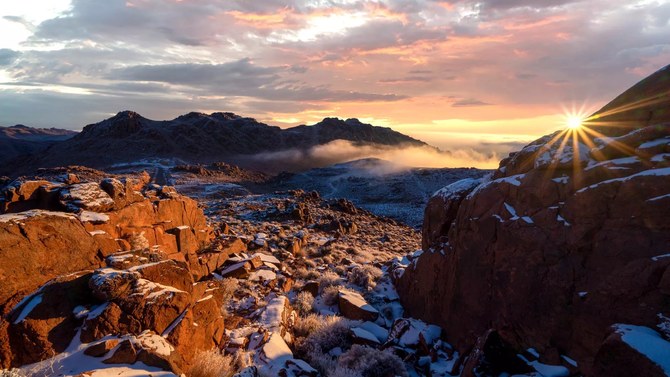
NEOM sets ambitious target to preserve natural environment

NEOM has pledged to allocate 95 percent of its total area for preservation. Supplied
Short Url
Updated 28 May 2023
Follow

NEOM sets ambitious target to preserve natural environment

RIYADH: As part of Saudi Arabia’s efforts to protect the environment and promote sustainable living, NEOM has pledged to allocate 95 percent of its total area for preservation.

It will also develop a facility in Al-Asilah to preserve the Arabian oryx, the Arabian sand gazelle, the mountain gazelle, and the ibex.

The reserve will be home to one of the biggest wildlife restoration programs in the world and will allow visitors to learn about NEOM’s programs for the development and rehabilitation of vegetation and wildlife.

The announcement was made at the second Tabuk Forum, which was organized by NEOM.

During the forum, NEOM officials highlighted various programs it is currently undertaking in different areas such as social responsibility, sports, tourism, media, career guidance management, human resources, contracts and purchases, hospitality, education, and scholarships.

Saudi Arabia is expanding its ambitions through projects such as The Line in NEOM, a zero-car environment that is part of a 100 percent sustainable transport system.

The city will be 200 meters wide, 170 km long, and rise 500 meters above sea level and will contribute to conserving 95 percent of NEOM’s land and support environmental sustainability.

Its design is based on a new concept of zero-gravity urbanism, the idea of layering city functions vertically while enabling inhabitants to move seamlessly in the city in three directions — up, down, and across — offering quick access to offices, schools, parks, and residential facilities.

The Line’s unique modular design ensures that all facilities and amenities can be accessed within a five-minute walk.

Using an innovative design that requires minimal space and less water, hydroponics gardens will grow fruit, vegetables, and flowers in half the time of traditional agriculture methods.

NEOM has several ongoing megaprojects, one of them being Trojena, a year-round winter sports complex designed by Iraqi British architect Zaha Hadid. And what will be the first outdoor ski resort in the Gulf Cooperation Council region, is set to host the Asian Winter Games in 2029.

Another megaproject is Sindalah Island, a luxury tourist destination.


Saudi minister at Davos urges collaboration on minerals

Global collaboration on minerals essential to ease geopolitical tensions and secure supply, WEF hears. (Supplied)
Updated 20 January 2026
Follow

Saudi minister at Davos urges collaboration on minerals

  • The reason of the tension of geopolitics is actually the criticality of the minerals

LONDON: Countries need to collaborate on mining and resources to help avoid geopolitical tensions, Saudi Arabia’s minister of industry and mineral resources told the World Economic Forum on Tuesday.

“The reason of the tension of geopolitics is actually the criticality of the minerals, the concentration in different areas of the world,” Bandar Alkhorayef told a panel discussion on the geopolitics of materials.

“The rational thing to do is to collaborate, and that’s what we are doing,” he added. “We are creating a platform of collaboration in Saudi Arabia.”

Bandar Alkhorayef, Saudi Minister of Industry and Mineral Resources 

The Kingdom last week hosted the Future Minerals Forum in Riyadh. Alkhorayef said the platform was launched by the government in 2022 as a contribution to the global community. “It’s very important to have a global movement, and that’s why we launched the Future Minerals Forum,” he said. “It is the most important platform of global mining leaders.”

The Kingdom has made mining one of the key pillars of its economy, rapidly expanding the sector under the Vision 2030 reform program with an eye on diversification. Saudi Arabia has an estimated $2.5 trillion in mineral wealth and the ramping up of extraction comes at a time of intense global competition for resources to drive technological development in areas like AI and renewables.

“We realized that unlocking the value that we have in our natural resources, of the different minerals that we have, will definitely help our economy to grow to diversify,” Alkhorayef said. The Kingdom has worked to reduce the timelines required to set up mines while also protecting local communities, he added. Obtaining mining permits in Saudi Arabia has been reduced to just 30 to 90 days compared to the many years required in other countries, Alkhorayef said.

“We learned very, very early that permitting is a bottleneck in the system,” he added. “We all know, and we have to be very, very frank about this, that mining doesn’t have a good reputation globally.

“We are trying to change this and cutting down the licensing process doesn’t only solve it. You need also to show the communities the impact of the mining on their lives.”

Saudi Arabia’s new mining investment laws have placed great emphasis on the development of society and local communities, along with protecting the environment and incorporating new technologies, Alkhorayef said. “We want to build the future mines; we don’t want to build old mines.”