

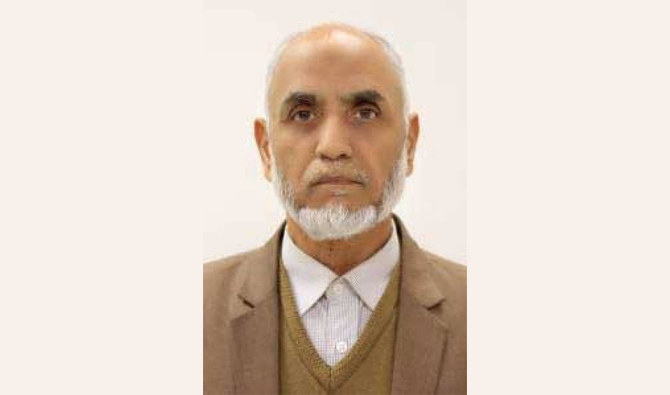
Veteran journalist and Arab News columnist Ashraf Mumtaz dies in Lahore

The undated photo shows veteran journalist Ashraf Mumtaz. (Photo courtesy: @AshrafMumtaz1)
Short Url
Updated 28 May 2023
Follow

Veteran journalist and Arab News columnist Ashraf Mumtaz dies in Lahore

  • The last stint of Ashraf Mumtaz's career was as a columnist for Arab News Pakistan, where he covered mostly domestic politics
  • His final opinion piece was published on May 20, wherein he hoped things in Pakistan will improve if Khan's party returned to parliament

LAHORE: Veteran journalist Ashraf Mumtaz died peacefully at his home in Lahore on Friday morning and was buried the same day in one of the city’s oldest graveyards, surrounded by members of the journalism community of which he was a part for over four decades.

The last stint of his career was as a columnist for Arab News Pakistan, where he covered mostly domestic politics with his signature style of reporting, historical context and sharp analysis. His final opinion piece on the current political crisis in the country was published on May 20, where he expressed hope that things in Pakistan would get better if the Pakistan Tehreek-e-Insaf (PTI) went back to Parliament.

Mumtaz worked as chief reporter for Dawn, before moving to a popular English daily, The Nation, as editor for reporting. Since 2022, he exclusively wrote opinion pieces for Arab News Pakistan. His interests lay squarely in Pakistani politics, and by his own admission: “Sometimes I appear to be over-enthusiastic after some political development in the country. That’s only because I have spent all my professional life in reporting or heading reporting teams,” he wrote in an email earlier this year.

His opinion pieces and pitches arrived promptly and on time every other Wednesday, and he is remembered at Arab News Pakistan as a thorough professional, who at his heart, remained a curious and enthusiastic reporter in the country he served all his life. 


Pakistani students recount perilous journey home from Iran as Middle East conflict escalates

Updated 13 sec ago
Follow

Pakistani students recount perilous journey home from Iran as Middle East conflict escalates

  • 792 Pakistanis repatriated via land and air corridors, officials say
  • Many evacuees are students enrolled in Iranian universities

ISLAMABAD: Hundreds of Pakistani students are fleeing Iran this week as escalating hostilities in the Middle East spill across key population centers, forcing them to abandon studies and undertake perilous overland journeys back home.

Iran has been rocked since last week by joint US and Israeli strikes that killed Supreme Leader Ayatollah Ali Khamenei, followed by retaliatory missile attacks targeting American military bases across the Gulf region. The escalation has disrupted air travel, heightened military activity along Iran’s southern coastline and turned strategic locations such as Bandar Abbas, near the Strait of Hormuz through which roughly 20 percent of global oil supplies pass, into flashpoints.

Among those returning is Misbah Hussain, a 22-year-old medical student from Pakistan’s coastal district of Badin in Sindh province. Her education in Iran’s Hormozgan province, which borders the Strait of Hormuz, was abruptly cut short by missile strikes near her university hostel.

“I cannot put those scenes into words,” said Hussain, describing the attacks near her hostel at the Hormozgan University of Medical Sciences in the Iranian coastal city of Bandar Abbas.

She said she had traveled by road from Bandar Abbas to the Pakistan-Iran border, changing three to four different cabs along the way as the security situation deteriorated. After crossing into Pakistan, she continued her journey to Karachi via the coastal highway in a vehicle arranged by the local administration, before heading onward to her hometown of Badin, where, she said, her family would witness her “second life.”

“Missiles landed a short distance from where we were staying,” she said, “and continued during our journey back. We could see missiles hitting along the way. There were moments when we felt we might not survive.”

Bandar Abbas, Iran’s main southern port, has seen intensified military activity in recent days as regional airspace remains largely restricted. Students described sirens, outgoing missile launches and the constant fear of further escalation.

“I had gone there 13 days ago, and the conditions worsened,” Hussain added, noting that examinations were abruptly canceled as students fled the city.

The students’ journey home has proved arduous. From Bandar Abbas, they traveled east through Iran’s Sistan-Baluchestan province toward the Gabd-Rimdan border crossing into Pakistan’s southwestern province of Balochistan. The route, normally a commercial corridor, has become a critical evacuation pathway for the roughly 35,000 Pakistanis currently residing in Iran, according to officials.

Nazir Hussain, another student at the university, described a chaotic departure marked by transport shortages and inflated fares.

“We left Iran under extreme fear,” Nazir told Arab News over the phone as he neared his home city of Hyderabad. “Transport was unreliable, drivers exploited the situation by charging excessive fares. At every stage, we felt uncertain and unsafe.”

The overland journey to the Gabd border spans nearly 800 kilometers (about 497 miles) from Bandar Abbas. Students said they could not wait for formal evacuation arrangements.

“We couldn’t wait for the government help to arrive. We just left a warzone, and this is what we could do, but the journey was extremely painful,” Nazir said.

After crossing into Pakistan, many students were assisted by local authorities in Gwadar before undertaking another nearly 700-kilometer (435-mile) journey to major cities such as Karachi and Hyderabad.

Speaking at a press conference, Pakistan’s Deputy Prime Minister and Foreign Minister Ishaq Dar said on Tuesday a 24-hour crisis management unit has been activated to assist Pakistani nationals across the Gulf, where an estimated 4.5 million Pakistanis live and work.

According to government figures, 792 Pakistanis have been repatriated from Iran so far, including 650 who crossed through the Gabd-Rimdan and Taftan border crossings in the past 48 hours. A significant number of those returning are students enrolled in Iranian universities.

“The safety of Pakistanis abroad and the sovereignty of Pakistan remain our foremost priorities,” Dar told reporters in Islamabad, adding that Azerbaijan has been designated as an additional evacuation base for Pakistanis in northern Iran.

Despite official assurances that authorities are working “round the clock,” some students say support on the ground has been limited.

“Assistance with transport and communication could make an enormous difference for students stranded in dangerous situations,” Nazir said. “But, unfortunately, in our case it didn’t exist.”

Officials estimate that around 3,000 Pakistani students remain in Iran. With airspace disruptions and ongoing hostilities, many face the difficult decision of staying in a volatile environment or risking long overland travel to reach safety.

“We had only heard about death before,” student Misbah Hussain said. “This time we saw it with our own eyes.”