

Veteran journalist and Arab News columnist Ashraf Mumtaz dies in Lahore

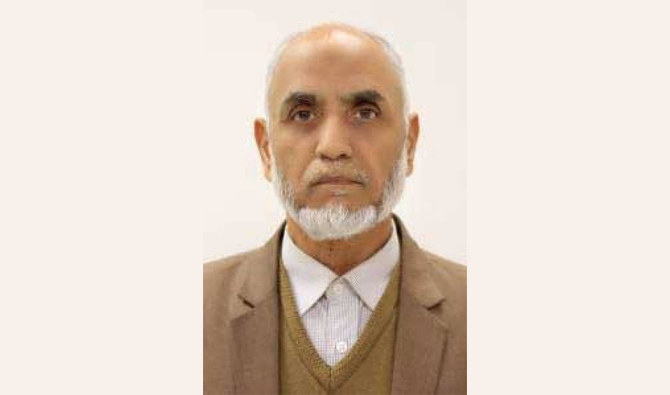
The undated photo shows veteran journalist Ashraf Mumtaz. (Photo courtesy: @AshrafMumtaz1)
Short Url
Updated 28 May 2023
Follow

Veteran journalist and Arab News columnist Ashraf Mumtaz dies in Lahore

  • The last stint of Ashraf Mumtaz's career was as a columnist for Arab News Pakistan, where he covered mostly domestic politics
  • His final opinion piece was published on May 20, wherein he hoped things in Pakistan will improve if Khan's party returned to parliament

LAHORE: Veteran journalist Ashraf Mumtaz died peacefully at his home in Lahore on Friday morning and was buried the same day in one of the city’s oldest graveyards, surrounded by members of the journalism community of which he was a part for over four decades.

The last stint of his career was as a columnist for Arab News Pakistan, where he covered mostly domestic politics with his signature style of reporting, historical context and sharp analysis. His final opinion piece on the current political crisis in the country was published on May 20, where he expressed hope that things in Pakistan would get better if the Pakistan Tehreek-e-Insaf (PTI) went back to Parliament.

Mumtaz worked as chief reporter for Dawn, before moving to a popular English daily, The Nation, as editor for reporting. Since 2022, he exclusively wrote opinion pieces for Arab News Pakistan. His interests lay squarely in Pakistani politics, and by his own admission: “Sometimes I appear to be over-enthusiastic after some political development in the country. That’s only because I have spent all my professional life in reporting or heading reporting teams,” he wrote in an email earlier this year.

His opinion pieces and pitches arrived promptly and on time every other Wednesday, and he is remembered at Arab News Pakistan as a thorough professional, who at his heart, remained a curious and enthusiastic reporter in the country he served all his life. 


Pakistan reports current account surplus in Jan. owing to improved trade, remittances

Updated 17 February 2026
Follow

Pakistan reports current account surplus in Jan. owing to improved trade, remittances

  • Pakistan’s exports crossed the $3 billion mark in Jan. as the country received $3.5 billion in remittances
  • Last month, IMF urged Pakistan to accelerate pace of structural reforms to strengthen economic growth

ISLAMABAD: Pakistan recorded a current account surplus of more than $120 million in January, the country’s finance adviser said on Tuesday, attributing it to improved trade balance and remittance inflows.

Pakistan’s exports rebounded in January 2026 after five months of weak performance, rising 3.73 percent year on year and surging 34.96 percent month on month, according to data released by the country’s statistics bureau.

Exports crossed the $3 billion mark for the first time in January to reach $3.061 billion, compared to $2.27 billion in Dec. 2025. The country received $3.5 billion in foreign remittances in Jan. 2026.

Khurram Schehzad, an adviser to the finance minister, said Pakistan reported a current account surplus of $121 million in Jan., compared to a current account deficit of $393 million in the same month last year.

“Improved trade balance in January 2026, strong remittance inflows, and sustained momentum in services exports (IT/Tech) continue to reinforce the country’s external account position,” he said on X.

Pakistan has undergone a difficult period of stabilization, marked by inflation, currency depreciation and financing gaps, and international rating agencies have acknowledged improvements after Islamabad began implementing reforms such as privatizing loss-making, state-owned enterprises (SOEs) and ending subsidies as part of a $7 billion International Monetary Fund (IMF) loan program.

Late last month, the IMF urged Pakistan to accelerate the pace of these structural reforms to strengthen economic growth.

Responding to questions from Arab News at a virtual media roundtable on emerging markets’ resilience, IMF’s director of the Middle East and Central Asia Jihad Azour said Islamabad’s implementation of the IMF requirements had been “strong” despite devastating floods that killed more than 1,000 people and devastated farmland, forcing the government to revise its 4.2 percent growth target to 3.9 percent.

“What is important going forward in order to strengthen growth and to maintain the level of macroeconomic stability is to accelerate the structural reforms,” he said at the meeting.

Azour underlined Pakistan’s plans to privatize some of the SOEs and improve financial management of important public entities, particularly power companies, as an important way for the country to boost its capacity to cater to the economy for additional exports.

“This comes in addition to the effort that the authorities have made in order to reform their tariffs, which will allow the private sector of Pakistan to become more competitive,” the IMF official said.