US conducts strike near site of Shabab attack in Somalia

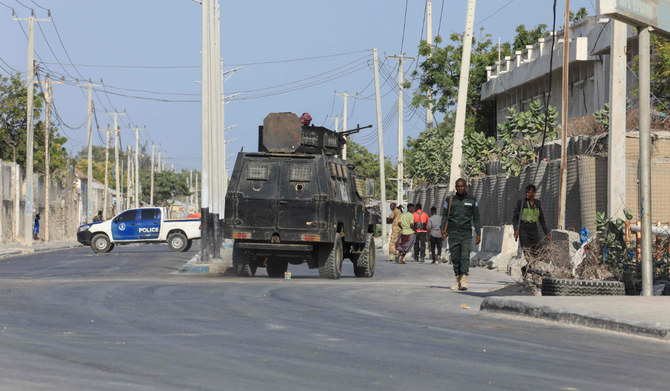
Security forces patrol outside a building which was attacked by suspected Al Shabaab militants in the Somalia's capital Mogadishu, on February 21, 2023. (AFP)
Short Url
Updated 28 May 2023
Follow

US conducts strike near site of Shabab attack in Somalia

  • Al-Shabab militants drove a car laden with explosives into the base, prompting a gunfight, local residents and a Somali military commander told AFP

WASHINGTON: The United States conducted an airstrike that destroyed stolen Al-Shabab weapons and equipment in Somalia near an African Union military base that was attacked by the group, officials reported Saturday.
The base in Bulo Marer, 120 kilometers (75 miles) southwest of the capital Mogadishu, was housing Ugandan troops when it was raided Friday in an attack claimed by the Al-Qaeda-linked jihadist group.
In a statement, US Africa Command said that it “destroyed weapons and equipment unlawfully taken by Al-Shabab fighters,” without specifying when or where the weapons were stolen.
“US Africa Command conducted an airstrike against militants in the vicinity” of Bulo Marer on Friday, in support of the Somali federal government and the AU force known as ATMIS, it said.
Al-Shabab militants drove a car laden with explosives into the base, prompting a gunfight, local residents and a Somali military commander told AFP.
It was not immediately known if there were any casualties from the Al-Shabab attack.
US Africa Command said its “initial assessment is that no civilians were injured or killed” in its operation.
Pro-government forces backed by ATMIS forces launched an offensive last August against Al-Shabab, which has been waging an insurgency in the fragile Horn of Africa nation for more than 15 years.
The 20,000-strong ATMIS force has a more offensive remit than its predecessor known as AMISOM.
The force is drawn from Uganda, Burundi, Djibouti, Ethiopia and Kenya, with troops deployed in southern and central Somalia.
Its goal is to hand over security responsibilities to Somalia’s army and police by 2024.


Russia’s war footing may remain after Ukraine war, Latvia spy chief warns

Updated 7 sec ago
Follow

Russia’s war footing may remain after Ukraine war, Latvia spy chief warns

MUNICH: Russia will not end the militarization of its economy after fighting in Ukraine ends, the head of Latvia’s intelligence agency told AFP on the sidelines of the Munich Security Conference which ends Sunday.
“The potential aggressiveness of Russia when the Ukraine war stops will depend of many factors: How the war ends, if it’s frozen or not, and if the sanctions remain,” Egils Zviedris, director of the Latvian intelligence service SAB, told AFP.
Some observers believe that Russia has so thoroughly embraced a war economy and full military mobilization that it will be difficult for it to reverse course, and that this could push Moscow to launch further offensives against European territories.
Zviedris said that lifting current sanctions “would allow Russia to develop its military capacities” more quickly.
He acknowledged that Russia has drawn up military plans to potentially attack Latvia and its Baltic neighbors, but also said that “Russia does not pose a military threat to Latvia at the moment.”
“The fact that Russia has made plans to invade the Baltics, as they have plans for many things, does not mean Russia is going to attack,” Zviedris told AFP.
However, the country is subject to other types of threats from Moscow, particularly cyberattacks, according to the agency he leads.
The SAB recently wrote in its 2025 annual report that Russia poses the main cyber threat to Latvia, because of broader strategic goals as well as Latvia’s staunch support of Ukraine.
The threat has “considerably increased” since Moscow’s full-scale invasion of Ukraine in 2022, it said.
The agency has also warned that Russia is seeking to exploit alleged grievances of Russian-speaking minorities in the Baltics — and in Latvia in particular.
Russia’s Ministry of Foreign Affairs has repeatedly claimed to be preparing cases against Latvia, Lithuania and Estonia at the UN International Court of Justice over the rights of their Russian-speaking minorities.
“The aim of litigation: to discredit Latvia on an international level and ensure long-term international pressure on Latvia to change its policy toward Russia and the Russian-speaking population,” the report said.
In 2025, approximately 23 percent of Latvia’s 1.8 million residents identified as being of Russian ethnicity, according to the national statistics office.
Following the Russian invasion of Ukraine in 2022, Latvian authorities decided to require Russian speakers residing in the country to take an exam to assess their knowledge of the Latvian language — with those failing at potential risk of deportation.