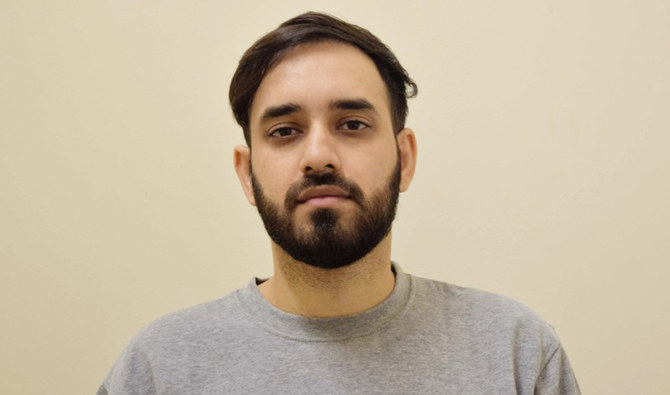

LONDON: A British man has been jailed after spending three years fighting with Daesh in Syria.
Shabazz Suleman, from High Wycombe, Buckinghamshire, had been a promising student in the UK, having recently completed his high school exams and been accepted onto a course to study at Keele University before he disappeared while on a family holiday in Turkiye in 2014.
He was detained by Turkish forces trying to cross into Syria, before being exchanged as part of a prisoner swap with Daesh in return for two Turkish diplomats.
Suleman, who was 18 at the time, styled himself as the “Jihadi Hipster,” a moniker he used on social media site Twitter. Adopting the name Abu Shamil Al-Britani, he became “disillusioned” with life under Daesh within a year, claiming the group targeted other Muslims and used its fighters as “cannon fodder.”
Ten months into his stay he was jailed by the group in Raqqa for refusing to fight. He was later released after agreeing to join Daesh’s security wing Amniyat.
Suleman was captured again by Turkish-backed forces in October 2017, and later traveled to Pakistan. He returned to the UK in 2021, where he was detained.
Suleman pleaded guilty to preparing acts of terrorism in April, and was sentenced to life with a minimum of nine-and-a-half years.
During his trial he claimed he spent most of his time with Amniyat playing computer games, but Judge Mark Lucraft KC said he must have known he was “supporting a terrorist organization that engaged in indiscriminate violence against civilians.”
The court heard that after joining an aid convoy to Syria in 2013, he told a friend he wanted to “go deeper where it’s more dangerous,” and that he had been visited by local police when his trip to the country was revealed.
He celebrated the deaths of journalists at the French satirical magazine Charlie Hebdo in 2015 on Twitter, and also detailed his life under Daesh, as well as posting an image of an alleged spy who was beheaded and crucified by the group. In another message he claimed he wanted to “behead some Americans.”
After disappearing on holiday, Suleman contacted his family to tell them: “I’m doing this for Allah, no one else. I’m not brainwashed or anything. I’ve been planning this for months.”
In 2015 he told journalists at The Times he had become “disillusioned” and was “brainwashed,” adding: “I found myself falling for the propaganda of (Daesh). Eventually, I no longer knew who I was.”
After he was captured in 2017, he told Sky News: “I take responsibility. I was with (Daesh), I was with a terrorist organization. But I didn’t kill anyone, I hope I didn’t oppress anyone. I did have a Kalashnikov and a military uniform, but I didn’t hit anyone.”
Prosecutor Duncan Atkinson KC said: “It is clear from the evidence that the defendant fully appreciated before he set off that he would be joining and supporting a terrorist organization which engaged in indiscriminate violence against civilians.
“He was warned not to go, due to the danger, and was told that there was a risk to his life as a UK national. He thus knew very well before traveling how harshly (Daesh) would treat foreigners who did not support (it), and in particular how it treated non-believers.”