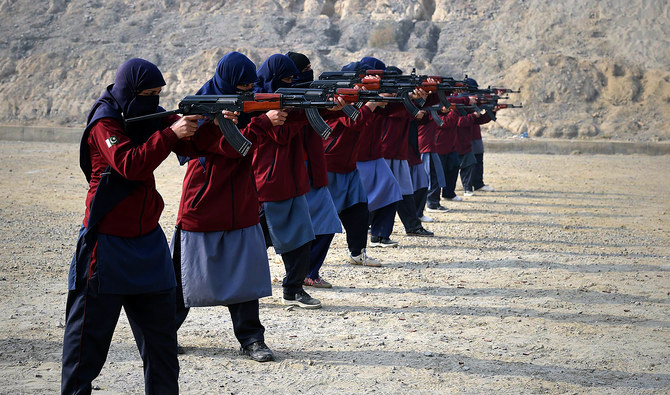

PESHAWAR: The number of woman police officers in Pakistan’s merged tribal districts remains strikingly low as compared to their male counterparts creating hurdles in dealing with gender-sensitive issues, officials and rights activists said on Saturday, pointing to cultural constraints and lack of facilities in these districts.
Bordered by Afghanistan, the region has seven tribal districts, formerly known as the Federally Administered Tribal Areas (FATA), that were integrated with Pakistan’s northwestern Khyber Pakhtunkhwa (KP) province in 2018.
Owing to the fragile security situation of the region, the KP government deployed more than 26,000 policemen in these districts, according to Riaz Yousafzai, a spokesperson for the KP police chief’s office. In comparison, only less than a hundred women police personnel are currently serving in these merged districts.
Government officials and rights activists believe that cultural restraints in the conservative tribal region and a lack of housing facilities play a major role in the low number of women officers in the police force, despite the need for enhanced security in the region which has long been a stronghold of the Pakistani Taliban and is recently witnessing a surge in militancy.
“Following the merger of these districts, strengthening of entire infrastructure and enhanced security was of paramount importance because stability in the erstwhile FATA was a matter of national security,” Barrister Feroze Jamal, information minister in the caretaker KP government, told Arab News.
“Hasty intervention to [increase] the number of female police personnel will not produce the desired results because of the deeply-rooted tribal traditions in the region, which saw a separate governance system for almost 70 years.”
He said the caretaker setup wanted to identify and streamline projects in tribal districts so that the next elected government could materialize them in the future.
“Strengthening of security and training of police personnel on advanced lines is our priority,” Jamal said. “We will extend every support to the police to recruit and deploy female police to the newly-merged districts to overcome domestic problems being faced by women there.”
According to the provincial government’s policy, a 10 percent quota has been fixed for women in all provincial services and the merged tribal districts are supposed to have around 3,000 woman police officers.
Women in merged districts continued facing serious domestic problems without any access to police or judicial services, where some of these districts had no woman police officers at all, said Naila Altaf, chairperson of the KP Commission on the Status of Women, a statuary body responsible for undertaking research, collecting data for policy recommendations, and monitoring violations of women’s rights.
“Women live in the cortex of problems [in these districts]. Amid cultural constraints, women in tribal areas can’t go to report their issues to male police stations,” she told Arab News.
“A series of awareness campaigns are needed to build public opinion in favor of deployment of woman police personnel, otherwise we will not be able to build a vibrant society.”
Referring to the gender imbalance in the regional police, Yousafzai said they planned to stabilize the system by gradually recruiting and deploying more woman officers to address the issue.
Faridullah Dawar, a social activist based in North Waziristan tribal district, believed that religious figures could play a “lead role” in addressing the issue.
“It is a daunting challenge for the police to deploy female officers, but religious leaders can play a lead role in changing public opinion in favor of female recruitment in police,” he said.
Altaf also pointed out a lack of separate residential facilities was another major factor hindering the recruitment of women in the police department.
Dr. Syed Akhtar Ali Shah, who has previously served as the KP police chief, said the deployment of woman police officers was of huge importance to tackle women’s issues in tribal districts.
“Female police could work in tribal areas the way female teachers and female doctors had been discharging their duties there,” Shah said.
“However, separate lodging and training facilities need to be built inside all police stations to ensure privacy of female officers, which would encourage parents to allow their daughters to join the police force.”