

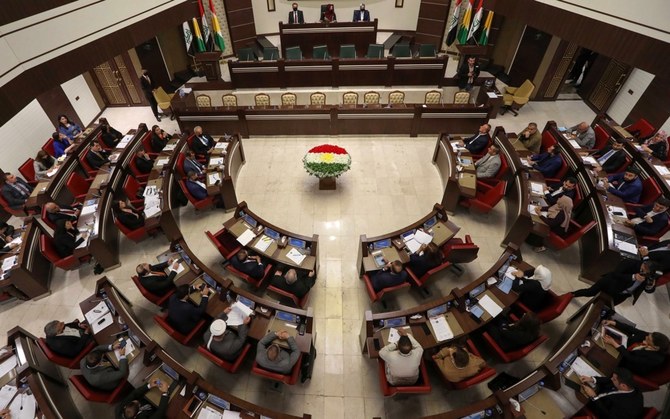
Iraq’s Kurd regional government opposes changes in budget

KRG said it would not abide by any other decision outside the agreement signed with Al-Sudani’s government. (AFP/File)
Short Url
Updated 26 May 2023
Follow

Iraq’s Kurd regional government opposes changes in budget

DUBAI: Iraq’s semi-autonomous Kurdistan regional government said on Friday it opposed changes in the draft Iraqi federal budget that infringe on the rights of the Kurdish people.

The Kurdistan Regional Government’s opposition poses a challenge to the prime minister of Iraq’s federal government, Mohammed Al-Sudani, in adopting a three-year budget, a flagship policy of his government that came to power late last year backed by a coalition of Shiite, Sunni and Kurdish parties.

KRG said it would not abide by any other decision outside the agreement signed with Al-Sudani’s government, which appeared to be a reference to a deal between the two governments setting a framework for the resumption of oil flows from the northern Iraqi region via Turkiye.

Before Al-Sudani formed his government, he struck a deal with the powerful Kurdish Democratic Party, which dominates the administration in Irbil, capital of the semi-autonomous region in northern Iraq. The agreement included ending a long-running dispute over budget transfers to Irbil and oil revenue sharing between the national government and Kurdistan, according to three Kurdish officials.

Under the Iraqi constitution, the Kurdish region is entitled to a portion of the national budget. But the arrangement collapsed in 2014 when the Kurds began selling crude independently from Kurdistan.

In 2017, Iraqi forces retook disputed territories including the oil city of Kirkuk. Baghdad resumed some budget payments, but they have been sporadic.

KRG called the changes in the draft budget, introduced by members of the parliament’s finance committee, unconstitutional and “inconsistent with the agreement signed between the regional government and the federal government.”

In March, Al-Sudani’s Cabinet approved the 2023 draft budget of 197.828 trillion Iraqi dinars ($135.6 billion) that would be referred to parliament for approval.


Lebanon central bank seeks to recuperate embezzled funds to bolster liquidity, governor says

Updated 6 sec ago
Follow

Lebanon central bank seeks to recuperate embezzled funds to bolster liquidity, governor says

  • The central bank had filed a criminal complaint against an unnamed former official of the central bank
  • Souaid said the bank would become a primary plaintiff in the state’s investigation against Forry Associates

BEIRUT: Lebanon’s central bank will seek the repayment of public funds embezzled by at least one former central bank official and by lawyers and commercial bankers, to help guarantee its liquidity, Central Bank Governor Karim Souaid said on Thursday.
Souaid did not name Riad Salameh, the former central bank governor whose 30-year term ended in disgrace amid investigations into whether he embezzled more than $300 million between 2002 and 2015.
Instead Souaid told reporters that the central bank had filed a criminal complaint against an unnamed former official of the central bank, a former banker and a lawyer over alleged illicit enrichment through misuse of public funds.
He ⁠said the operations were carried out through four offshore shell companies in the Cayman Islands that he did not name.

COORDINATING WITH FRENCH INVESTIGATORS
Souaid said the bank would become a primary plaintiff in the state’s investigation against Forry Associates, suspected of receiving commissions from commercial banks and transferring them out of the country.
Forry is controlled by Salameh’s brother, Raja. Both ⁠Raja and Riad Salameh deny wrongdoing.
The pair are under investigation in France, Germany, Switzerland and other countries over the alleged embezzlement. Souaid said he would travel to France to meet with the investigators this month “to exchange highly sensitive information held by the French authorities.”
Souaid would not say how many people in total were suspected of involvement in the scheme or the full sum now thought to have been embezzled.
“Our mission is to pursue these individuals and entities, seek their conviction, and seize their movable and immovable assets and the proceeds of ⁠their illicit activities to ensure liquidity for the rightful owners, first and foremost the depositors,” he said.
A Lebanese source familiar with the central bank’s new measures said they were prompted by lots of evidence — both new material uncovered in the central bank’s records and other evidence made available from external investigators.
The source said the bank’s leadership suspected Salameh was aided in his scheme by other members of the institution.
Salameh was detained for nearly 13 months over the alleged financial crimes committed during his tenure, and was released last September after posting a record bail of more than $14 million.
He remains in Lebanon under a travel ban.