Pakistan’s religious affairs minister meets aviation authorities to ensure better Hajj travel facilities

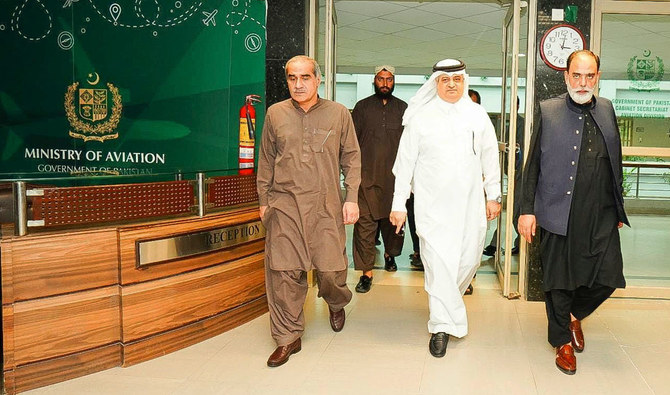
The photo taken on May 26, 2023, shows Pakistan's minister for religious affairs Senator Talha Mehmood (right), with Saudi Arabia’s Ambassador to Pakistan Nawaf bin Saeed Al-Maliki (center), and the Pakistani aviation minister Khawaja Saad Rafiq in Islamabad, Pakistan. (Photo courtesy: religious affairs ministry)
Short Url
Updated 26 May 2023
Follow

Pakistan’s religious affairs minister meets aviation authorities to ensure better Hajj travel facilities

  • Minister holds discussion about difficulties faced by Pakistani pilgrims during air travel to the kingdom
  • Aviation authorities inform about current facilities available to pilgrims, propose enhancements to them

ISLAMABAD: Pakistan’s religious affairs minister Senator Talha Mehmood on Friday held a meeting with the country’s aviation minister to discuss the provision of better facilities for Pakistani pilgrims traveling to Saudi Arabia for Hajj this year, said an official statement.

This kingdom reinstated Pakistan’s pre-pandemic Hajj quota of 179,210 pilgrims and scrapped the upper age limit of 65 in January. About 80,000 Pakistanis are expected to perform the pilgrimage under the government scheme this year while the rest will be facilitated by private tour operators.

The first batch of Pakistani pilgrims arrived in the holy city of Madinah on May 22, while the last flight would depart from Pakistan on June 20. According to the religious affairs ministry, these pilgrims will depart for Makkah after spending about eight days in Madinah.

“Federal Minister for Religious Affairs Senator Talha Mehmood, along with Saudi Arabia’s Ambassador to Pakistan Nawaf bin Saeed Al-Maliki, held a meeting with the Federal Aviation Minister Khawaja Saad Rafiq on Friday,” said the statement issued by the religious affairs ministry.

“Consultations were held regarding the difficulties faced by Pakistani pilgrims during their air travel to Saudi Arabia, while a discussion on [ways] to provide better facilities to the pilgrims was also held.”

According to the state-owned Associated Press of Pakistan (APP) news agency, the Pakistani aviation minister informed about the current facilities available to pilgrims while proposing enhancements to further improve their experience.

“He highlighted the importance of coordination between the two countries to ensure the successful implementation of these improvements,” the APP added.

Meanwhile, a private company that helps the kingdom’s mission in Pakistan by providing visa management facility on its behalf announced on Friday it had extended its operations to facilitate Hajj applicants with biometrics.

“Gerry’s Saudi Visa extends operations this weekend, on May 27th and 28th, from 9:00 am to 5:00 pm, to facilitate the completion of [pilgrims’] biometric applications,” it said in a notification.

Hajj is an obligatory religious ritual for adult Muslims who are physically and financially capable of carrying it out. It involves visiting the holy cities of Makkah and Madinah at least once in a lifetime and takes place during the last month of the lunar Islamic calendar called Dhu Al-Hijjah.



Three Afghan migrants die crossing into Iran as UN warns of new displacement toward Pakistan

Updated 9 sec ago
Follow

Three Afghan migrants die crossing into Iran as UN warns of new displacement toward Pakistan

  • UNHCR says 1.8 million Afghans were forced to return from Iran this year, straining Afghanistan’s resources
  • Rights groups warn forced refugee returns risk harm as Afghanistan faces food shortages and climate shocks

KABUL: Three Afghans died from exposure in freezing temperatures in the western province of Herat while trying to illegally enter Iran, a local army official said on Saturday.

“Three people who wanted to illegally cross the Iran-Afghanistan border have died because of the cold weather,” the Afghan army official told AFP on condition of anonymity.

He added that a shepherd was also found dead in the mountainous area of Kohsan from the cold.

The migrants were part of a group that attempted to cross into Iran on Wednesday and was stopped by Afghan border forces.

“Searches took place on Wednesday night, but the bodies were only found on Thursday,” the army official said.

More than 1.8 million Afghans were forced to return to Afghanistan by the Iranian authorities between January and the end of November 2025, according to the latest figures from the United Nations refugee agency (UNHCR), which said that the majority were “forced and coerced returns.”

“These mass returns in adverse circumstances have strained Afghanistan’s already overstretched resources and services” which leads to “risks of onward and new displacement, including return movements back into Pakistan and Iran and onward,” UNHCR posted on its site dedicated to Afghanistan’s situation.

This week, Amnesty International called on countries to stop forcibly returning people to Afghanistan, citing a “real risk of serious harm for returnees.”

Hit by two major earthquakes in recent months and highly vulnerable to climate change, Afghanistan faces multiple challenges.

It is subject to international sanctions particularly due to the exclusion of women from many jobs and public places, described by the UN as “gender apartheid.”

More than 17 million people in the country are facing acute food insecurity, the UN World Food Program said Tuesday.