Over 400 delegates from 60 countries visit Pakistan for international textile exhibition

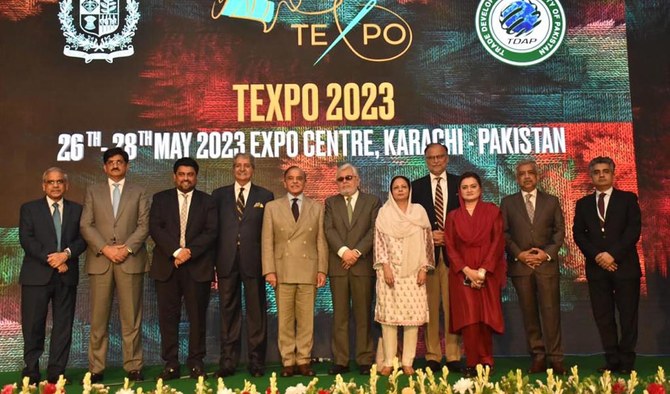
Pakistan Prime Minister Shehbaz Sharif, 5th left, in a group photo with federal Ministers, governor and chief minister Sindh and organizers of Textile Expo (TEXPO) 2023 in Karachi on May 26, 2023. (PID)
Short Url
Updated 26 May 2023
Follow

Over 400 delegates from 60 countries visit Pakistan for international textile exhibition

  • PM Sharif asks exporters to come up with innovative and unique ideas to enhance Pakistan’s commercial potential
  • Pakistan was among the top 10 global textile exporters until 2021, but the sector witnessed slowdown more recently

ISLAMABAD: Prime Minister Shehbaz Sharif on Friday welcomed more than 400 delegates from 60 countries who are currently visiting the country’s southern port city of Karachi to attend the 4th International Textile Exhibition (TEXPO), a statement from the Prime Minister’s Office said.
Pakistan’s textile and clothing industry plays a vital role in sustaining its economy since it accounts for more than 60 percent of the country’s total exports. According to Statista, a market and consumer data platform, the South Asian country was among the top 10 global textile exporters in 2021 with a value of about $9 billion.
Owing to an ongoing economic turmoil amid energy shortages and a major balance of payments crisis, however, the country has witnessed a gradual decline in its textile exports since last October, according to the Pakistan Textile Mills Association (APTMA).
The government has arranged several international exhibitions in this context to once again boost the textile exports, including TEXPO 2023, which is taking place in southern Karachi port city from May 26 to May 28.
Pakistan also hosted the Textile Asia Exhibition in March, which witnessed the participation of eight countries.
“Prime Minister Shehbaz Sharif on Friday stressed the country’s exporters to come up with innovative and unique ideas to boost exports which would ultimately help the country earn valuable foreign exchanges,” said the PM Office in the statement.
“Welcoming the foreign delegates, the PM said he was happy to learn that over 400 foreign delegates from 60 countries were visiting on the occasion, [showing that] Pakistan was a valuable destination for foreign guests, buyers, and traders.”
Addressing a ceremony at the TEXPO, the premier pointed out that despite financial challenges and other difficulties, the government was committed to providing genuine support to all the export sectors, including textile, leather and sports, to help increase the country’s commercial potential.
“I have no doubt in mind that we can still recover from these setbacks and … excel in our exports,” he said.
The PM also appreciated local industrialists, exporters and experts, saying they had contributed immensely to promoting Pakistan’s textile and leather exports.


Pakistan says defense pact with Saudi Arabia elevated brotherly ties to ‘new heights’

Updated 25 February 2026
Follow

Pakistan says defense pact with Saudi Arabia elevated brotherly ties to ‘new heights’

  • Pakistan, Saudi Arabia signed strategic defense pact last year pledging aggression against one will be treated as attack on both
  • Deputy PM Ishaq Dar says enduring bonds with Islamic and Arab nations form vital pillar of Pakistan’s foreign policy 

ISLAMABAD: Deputy Prime Minister Ishaq Dar said on Wednesday that Pakistan’s defense pact with Saudi Arabia elevated its brotherly ties with the Kingdom to “new heights,” stressing that close ties with Arab and Islamic nations form a key pillar of Islamabad’s foreign policy. 

Pakistan and Saudi Arabia signed a Strategic Mutual Defense Agreement on Sept. 17 last year, pledging that aggression against one country would be treated as an attack on both, enhancing joint deterrence and formalizing decades of military and security cooperation.

Both nations agreed in October 2025 to launch an economic cooperation framework to strengthen trade and investment ties. 

“In the Middle East, our landmark Strategic Mutual Defense Agreement with Saudi Arabia has elevated our brotherly ties to new heights,” Dar said while speaking at the Pakistan Governance Forum 2026 event in Islamabad. 

The Pakistani deputy prime minister was speaking on the topic “Navigating International Relations Amidst Changing Geo-Politics.”

Dar noted that Pakistan has reinforced partnerships with other Middle Eastern nations such as the UAE, Qatar, Jordan, Oman, Egypt and Bahrain. He said these partnerships have yielded “concrete agreements” in investment, agriculture, infrastructure, and energy sectors. 

“Our enduring bonds with Islamic and Arab nations form a vital pillar of our foreign policy, and we will continue to expand our partnerships across Asia, Latin America, and Africa,” he said. 

Dar pointed out that the presidents of Kazakhstan, Uzbekistan and Kyrgyzstan have undertaken visits to Pakistan in recent months, reflecting Central Asian nations’ desire to boost cooperation with Islamabad.

On South Asia, the Pakistani deputy PM said Pakistan has successfully transformed its fraternal ties with Bangladesh into “a substantive partnership.”

“Similarly, the trilateral mechanism involving China, Pakistan, and Bangladesh has been launched with a view to expanding and deepening regional cooperation and synergy,” the Pakistani minister said. 

He said Islamabad has strengthened its “all-weather” partnership with China via the second phase of the multi-billion-dollar China-Pakistan Economic Corridor agreement and “unwavering support” from both sides for each other’s core interests. 

Dar said Pakistan had also reinvigorated its partnership with the US, advancing cooperation in trade, technology, investment, and regional stability. 

“This calibrated approach has enhanced our ability to navigate complexity with skill and confidence, ensuring that our national interests are served without compromising our core foreign policy principles,” he said.