

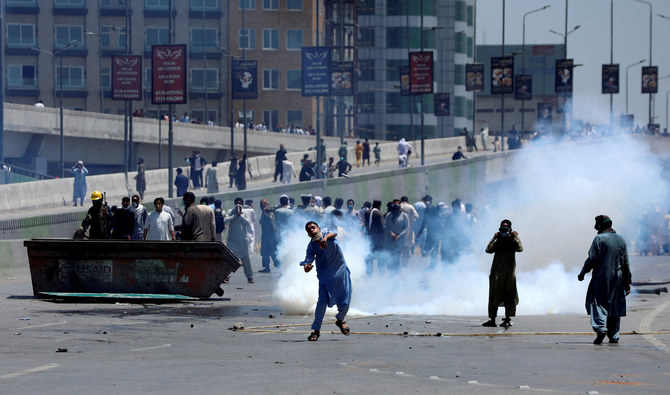

ISLAMABAD: Interior Minister Rana Sanaullah said on Friday 33 suspects arrested for attacks on army installations during violent protests in support of former prime minister Imran Khan earlier this month had been handed to military authorities for trials.
Following demonstrations by Khan supporters that broke out on May 9 after he was arrested in a land fraud case, the army announced that rioters who had attacked military properties would face trial under the Pakistan Army Act and Official Secrets Act.
Protesters stormed military installations, including the house of a top general in Lahore, which was set ablaze to protest Khan’s detention. While he was subsequently released on bail on numerous charges, including graft, thousands of his supporters have been arrested since.
“The accused who are being handed over to the military are those who trespassed and entered very sensitive defense installations,” Sanaullah told reporters in Islamabad on Friday. “Only 19 [protesters] from Punjab and 14 from KP have been handed to military authorities.”
On Thursday, a Pakistani court in the eastern city of Lahore handed 16 civilians over to the military for trial over their suspected involvement in violent protests following Khan’s arrest. It was unclear if they were among the 33 suspects the interior minister mentioned.
“A total of 499 FIRs (first information reports) have been registered against violent protesters, out of which only six, two from Punjab and four from Khyber Pakhtunkhwa, are being processed, and these cases will likely face a trial in a military court,” Sanaullah added, referring to the first police report registered after a crime is committed.
“No innocent person would be punished and the identities of those handed to the military will be verified using three or four methods,” he said, explaining that in Pakistani law, trespassing into prohibited military areas was an offense under the Pakistan Army Act.
“This is not the prime minister’s prerogative or the discretion of the army chief, this is the obligation of the state. If someone has entered prohibited areas, only the Army Act can be used to try them, it’s not a choice, it’s an obligation,” the interior minister said.
The Pakistan Army Act of 1952 established military courts primarily to try members of the military or enemies of the state. Civilians accused of offenses such as waging war against the armed forces or law enforcement agencies, or attacking military installations or inciting mutiny, can be tried by military courts under a federal government order.
Military courts operate under a separate system from the civilian legal system and are run by military officers. The judges are also military personnel and cases are tried at military installations. Trials are closed to outsiders, and no media presence is allowed.
The courts have faced widespread criticism from within Pakistan and rights organizations globally because of their secretive nature and their existence alongside a functioning civilian legal system.


