


KARACHI: Pakistan plans on signing a “comprehensive” energy security agreement with Central Asian states and Russia by the end of this year, petroleum minister Musadik Malik said on Thursday, and would create an energy corridor with Gulf Cooperation Council (GCC) countries.
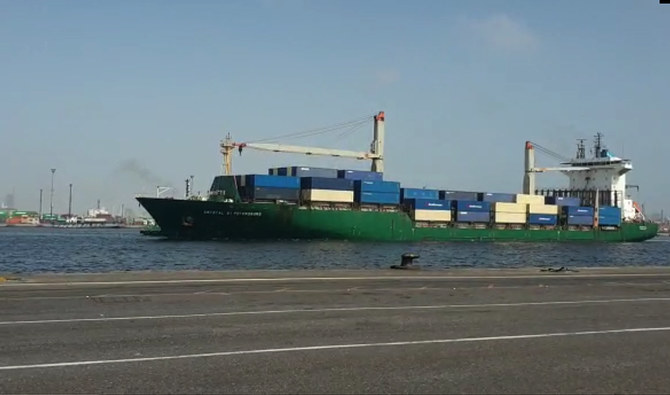
The petroleum minister was speaking at an event held to mark the arrival of Russian container vessel ‘Crystal St. Petersburg’ at Pakistan’s southern port city of Karachi, marking the beginning of a direct shipping line service between the two countries.
Burdened with rapidly depleting foreign exchange reserves that have sunk to a little over $4 billion and struggling to contain an economic crisis, Pakistan has been engaged in talks with Russia to secure oil at cheaper rates and bolster trade relations with the country.
Speaking about Pakistan’s energy agreement with Russia and the Central Asian states, he said it would outline the various sources of oil, LNG, and details about pipeline infrastructure.
“The comprehensive energy security agreement will be presented to the public by the end of this year,” Malik said, adding that agreement would lay out from where Pakistan’s oil, crude, and gas would be secured and which pipeline would be used to transport it.
“And if that will come in form of LNG then [agreement would clarify] what will its source be, from where the LNG will start and where LNG terminals will be set up, where it will be re-gasified and how it would be distributed in the country,” he added.
Malik said that while Central Asian countries would play a central role in the agreement, he said Pakistan would strengthen its ties with Gulf Cooperation Council (GCC) countries at the same time.
“We also want to utilize our historic ties with the GCC countries be it Oman, Saudi Arabia, Qatar and UAE and reshape them into trade,” the minister said.
“We want to meet our energy needs, which include LNG and petroleum products, from these countries.”
He said Pakistan wanted to create an energy corridor with the Central Asian states and another with the GCC countries.
“Our love relation with GCC countries is more than the trade relation and we want to create some balance with trade,” Malik said. “And transform it into our energy security.”
Pakistan plans to blend crude oil from Russia with crude sourced from Gulf countries and refine it at local refineries.
“We expect that Russian oil will reach Pakistan in the first week of June,” Malik said in response to a question. Refusing to share details of Pakistan’s commercial deal with Russia, he said it would provide “significant benefit” to the public, adding that the first shipment of Russian oil due next month consists of 100,000 tons.
Malik said Pakistan’s petroleum policy, which he said would attract investment of up to $10 billion in its refinery sector, would be announced ‘soon’ by the prime minister.
Pakistan’s power minister, Khurram Dastagir Khan, also spoke at the event, saying that the country’s trade complementarity index — used to measure a country’s export pattern with another’s import pattern — suggests the South Asian country is well-positioned to export to the Russian market.
Separately, Minister for Maritime Affairs, Syed Faisal Sabzwari, and Russia’s Consul General Andrey Viktorovich Fedorov received Crystal St. Petersburg when it arrived in Karachi, at a separate event.
Pakistan;s move to start a direct shipping line with Russia would help the country pay for imports in the Chinese currency, especially at a time when its forex reserves are rapidly declining.
Sabzwari termed the vessel’s arrival a “landmark achievement” saying that the Pakistani community now has direct access to Russian markets.
Abdullah Farrukh, CEO of the shipping agency Pak Shaheen Private Limited, told Arab News the start of the direct shipping service has received an overwhelming response from Pakistani exporters.
“Exporters are extremely happy and excited about the service, we are receiving calls from all over Pakistan especially from Punjab, Sialkot, Gujranwala, Multan, Lahore,” he said.
“And these cities are Pakistan’s backbone.”


