

Indian women embark on first Hajj without male guardians 

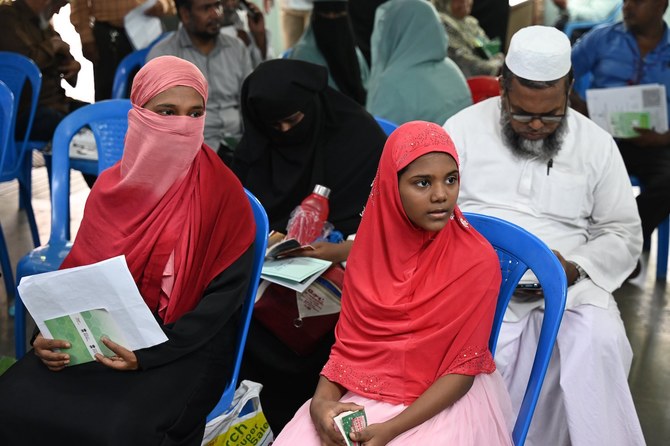
Indian Muslims arrive to get vaccinated against seasonal diseases ahead of the Hajj pilgrimage, at the Tamil Nadu Haj Service Society in Chennai on May 17, 2023. (AFP)
Short Url
Updated 25 May 2023
Follow

Indian women embark on first Hajj without male guardians 

  • 4,300 women registered for Hajj in the Ladies Without Mahram category 
  • Special flights for pilgrims from India started earlier this week  

NEW DELHI: As she prepares to fly to Saudi Arabia, Gulzar Begum will soon see her dream of two decades come true: She will embark on the spiritual journey she has been saving for by teaching the Qur’an. 

The 74-year-old from the Dakshinpuri area of South Delhi will be among thousands of Indian female pilgrims who next month will perform the Hajj on their own, without a mahram, or male guardian. 

“I cannot express my feelings and joy,” Begum told Arab News. “For a long time, I have been saving money for the Hajj. I am not a rich woman. I don’t have a husband, and my two sons are not rich enough to go with me.” 

She and other women pilgrims traveling to Saudi Arabia alone can do so now, after the Kingdom’s decision last year to lift a rule that required women to be accompanied by a mahram. Those who had no such companion could only travel in large groups of other women. 

Following the new rule, India has tweaked its Hajj policy and over 4,300 pilgrims in the Ladies Without Mahram category will, according to the Ministry of Minority Affairs, mark the country’s “largest-ever contingent of women proceeding on Hajj alone without a male (family) member.” 

Last year, the figure was 2,000. With over 200 million Indians professing Islam, Hindu-majority India has the world’s largest Muslim-minority population. Under the 2023 Hajj quota, 175,000 of them are traveling to Saudi Arabia for the pilgrimage, which is one of the five pillars of Islam. 

Special flights for pilgrims started earlier this week. 

Munawari Begum, the vice president of the Haj Committee of India, just returned from the Kingdom after making all the necessary arrangements for female pilgrims. 

“Hajj this year is special,” she told Arab News. “We have made special arrangements for the stay of women in Saudi Arabia…Their attendants will also be women.”  

Many Muslim women have welcomed changes in India’s Hajj policy since its announcement in February. Kausar Jahan, chairwoman of the Delhi Haj Committee, told Arab News it was an “attempt to empower women.”  

She said: “It is inducing not only economic independence of women but also self-reliance. 

“There were many women who earlier wanted to go for Hajj alone, but the rule was strict, and they could not go. Now, women have their own independence.” 


UN’s top court opens Myanmar Rohingya genocide case

Updated 12 January 2026
Follow

UN’s top court opens Myanmar Rohingya genocide case

  • The Gambia filed a case against Myanmar at the UN’s top court in 2019
  • Verdict expected to impact Israel’s genocide case over war on Gaza

DHAKA: The International Court of Justice on Monday opened a landmark case accusing Myanmar of genocide against its mostly Muslim Rohingya minority.

The Gambia filed a case against Myanmar at the UN’s top court in 2019, two years after a military offensive forced hundreds of thousands of Rohingya from their homes into neighboring Bangladesh.

The hearings will last three weeks and conclude on Jan. 29.

“The ICJ must secure justice for the persecuted Rohingya. This process should not take much longer, as we all know that justice delayed is justice denied,” said Asma Begum, who has been living in the Kutupalong refugee camp in Bangladesh’s Cox’s Bazar district since 2017.

A mostly Muslim ethnic minority, the Rohingya have lived for centuries in Myanmar’s western Rakhine state but were stripped of their citizenship in the 1980s and have faced systemic persecution ever since.

In 2017 alone, some 750,000 of them fled military atrocities and crossed to Bangladesh, in what the UN has called a textbook case of ethnic cleansing by Myanmar.

Today, about 1.3 million Rohingya shelter in 33 camps in Cox’s Bazar, turning the coastal district into the world’s largest refugee settlement.

“We experienced horrific acts such as arson, killings and rape in 2017, and fled to Bangladesh,” Begum told Arab News.

“I believe the ICJ verdict will pave the way for our repatriation to our homeland. The world should not forget us.”

A UN fact-finding mission has concluded that the Myanmar 2017 offensive included “genocidal acts” — an accusation rejected by Myanmar, which said it was a “clearance operation” against militants.

Now, there is hope for justice and a new future for those who have been displaced for years.

“We also have the right to live with dignity. I want to return to my homeland and live the rest of my life in my ancestral land. My children will reconnect with their roots and be able to build their own future,” said Syed Ahmed, who fled Myanmar in 2017 and has since been raising his four children in the Kutupalong camp.

“Despite the delay, I am optimistic that the perpetrators will be held accountable through the ICJ verdict. It will set a strong precedent for the world.”

The Myanmar trial is the first genocide case in more than a decade to be taken up by the ICJ. The outcome will also impact the genocide case that Israel is facing over its war on Gaza.

“The momentum of this case at the ICJ will send a strong message to all those (places) around the world where crimes against humanity have been committed,” Nur Khan, a Bangladeshi lawyer and human rights activist, told Arab News.

“The ICJ will play a significant role in ensuring justice regarding accusations of genocide in other parts of the world, such as the genocide and crimes against humanity committed by Israel against the people of Gaza.”