

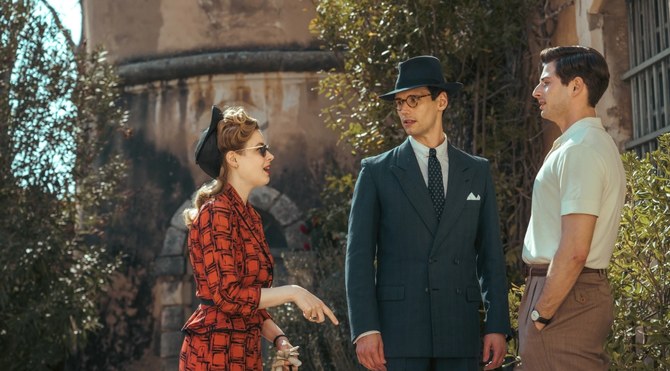
‘Transatlantic’ on Netflix is a fascinating WWII drama

The show is now streaming on Netflix. (Netflix)
Short Url
Updated 25 May 2023
Follow

‘Transatlantic’ on Netflix is a fascinating WWII drama

CHENNAI: Anna Winger's frightening Word War II adventure “Transatlantic,” now on Netflix, was adapted from Julie Orringer's novel “The Flight Portfolio.” 

“Transatlantic” will grip viewers with its exciting narrative of how famous painters and writers — many of them Jewish and the others critics of Hitler — were moved from Marseille in unoccupied France under the Vichy regime to Portugal and the US.


Some of them trudged through treacherous paths on mountains to reach Spain.

Some were lucky to get visas to fly to the US. Literary journalist Varian Fry (Cory Michael Smith) and American heiress Mary Jayne Gold(Gillian Jacobs) were responsible for helping many flee France as the German forces closed in on Marseilles. 

The first few of the seven episodes — all around 50 minutes — are somewhat dull. It is only in the last couple of segments that the pace picks up and the series gets exhilarating.

The visually captivating “Transatlantic” opens in 1940 in the port city of Marseille at a time when the US had not joined the war. US Consul Graham Patterson is essayed by Carey Stoll as a heartless human being. 

Fry and Gold decide to take things in their own hands and form the Emergency Rescue Committee (later known as International Rescue Committee).

At first, Gold has enough resources arriving from her wealthy father back home in America, but he is not happy with his young daughter living in a hostile environment and cuts off the resources. 

Fry and Gold then spend their meagre money in accommodating refugees in Hotel Splendide and later Villa Air-Bel using false documents to get as many men and women out of France.

Among them are writer Walter Mehring (Jonas Nay), artist Max Ernst (Alexander Fehling) and philosopher Walter Benjamin (Moritz Bleibtreu). However, many things work against their mission, and in the final run in with the French police, there is tension and turmoil.  

An international cast speaking English, German and French give real pep to the limited series. With people shacked up on beaches while others sip coffee in cafes discussing racism and antisemitism, there is always something new to provoke thought in every episode. 

However, “Transatlantic” has one flaw — instead of focussing on Fry and Gold’s work, the series veers into covert love affairs. But even then, the underlying levity lifts “Transatlantic” to near glorious heights. 


Lebanese filmmaker turns archival footage into a love letter to Beirut

Updated 28 February 2026
Follow

Lebanese filmmaker turns archival footage into a love letter to Beirut

LONDON: Lebanese filmmaker Lana Daher’s debut feature “Do You Love Me” is a love letter of sorts to Beirut, composed entirely of archival material spanning seven decades across film, television, home videos and photography.

The film premiered at the 82nd Venice International Film Festival in September and has since traveled to several regional and international festivals.

Pink Smoke (2020) by Ben Hubbard. (Supplied)

With minimal dialogue, the film relies heavily on image and sound to reconstruct Lebanon’s fragmented history.

“By resisting voiceover and autobiography, I feel like I had to trust the image and the shared emotional landscape of these archives to carry the meaning,” Daher said.

A Suspended Life (Ghazal el-Banat) (1985) by Jocelyne Saab. (Supplied)

She explained that in a city like Beirut “where trauma is rarely private,” the socio-political context becomes the atmosphere of the film, with personal memory expanding into a collective experience — “a shared terrain of emotional history.”

Daher said: “By using the accumulated visual representations of Beirut, I was, in a way, rewriting my own representation of home through images that already existed."

Whispers (1980) by Maroun Bagdadi. (Supplied)

Daher, with editor Qutaiba Barhamji, steered clear of long sequences, preferring individual shots that allowed them to “reassemble meaning” while maintaining the integrity of their own work and respecting the original material, she explained.

The film does not feature a voice-over, an intentional decision that influenced the use of sound, music, and silence.

The Boombox (1995) by Fouad Elkoury. (Supplied)

“By resisting the urge to fill every space with dialogue or score, we created room for discomfort,” Daher said, adding that silence allows the audience to sit with the image and enter its emotional space rather than being guided too explicitly.

 The film was a labor of love, challenging Daher personally and professionally.

“When you draw from personal memory, you’re not just directing scenes, you’re revisiting parts of yourself and your childhood,” she said. “There’s vulnerability in that.”