Pakistan, Saudi Arabia forge healthcare partnership to boost vaccine research, epidemic response

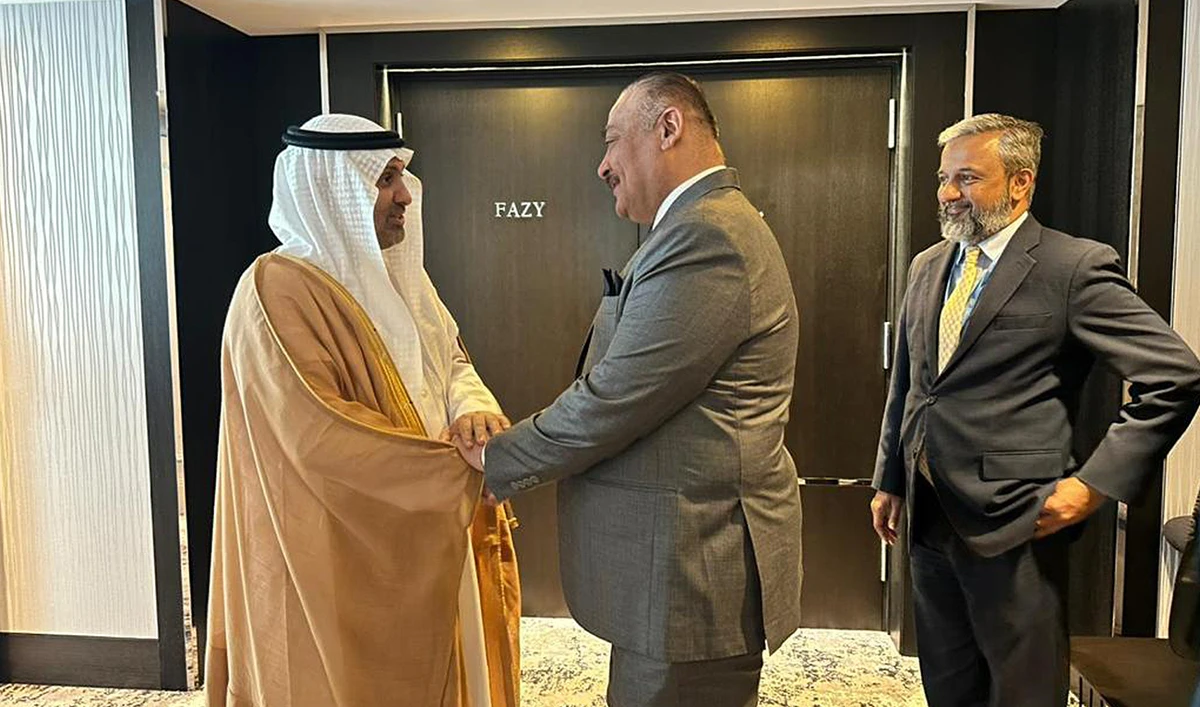
Pakistan’s health minister, Abdul Qadir Patel (right), meets his Saudi counterpart, Fahad Al-Jalajel, on the sidelines of the 76th session of the World Health Assembly at the UN headquarters in Geneva, on May 24, 2023. (Photo courtesy: Ministry of Health)
Short Url
Updated 25 May 2023
Follow

Pakistan, Saudi Arabia forge healthcare partnership to boost vaccine research, epidemic response

  • The two sides took the decision in a meeting between their health ministers on the sidelines of a Geneva conference
  • The Saudi minister also agreed to provide more opportunities to Pakistani medical professionals in the kingdom

ISLAMABAD: Pakistan and Saudi Arabia have agreed to enhance bilateral collaboration in the field of health care, an official statement issued in Islamabad said on Thursday, adding the two countries would join forces to carry out research on vaccine development.

The decision to work together in the medical field was reached after Pakistan’s health minister, Abdul Qadir Patel, met his Saudi counterpart, Fahad Al-Jalajel, on the sidelines of the 76th session of the World Health Assembly at the UN headquarters in Geneva.

Pakistan and Saudi Arabia have always enjoyed close defense and diplomatic ties, and in recent years, they have sought to further broaden and deepen their cooperation to add more strategic value to their relationship.

“The Saudi health minister has agreed to work together with Pakistan while dealing with epidemics and health security,” Patel was quoted as saying by Pakistan’s health ministry in a statement issued after the meeting. “The two countries will jointly conduct research on vaccine development for COVID-19 and other epidemics.”

The meeting marked the second time Patel met with the Saudi minister in the last eight months.

He highlighted the work done by Pakistan’s border health services, saying they were determined to effectively deal with epidemics.

The Pakistani minister also noted Al-Jalajel agreed to provide more opportunities to doctors, nurses, and medical technicians from his country in the kingdom.

It is worth mentioning that a large number of medical professionals from Pakistan are already employed by several hospitals in Saudi Arabia. The services of Pakistani doctors during the COVID-19 pandemic were recognized by the Saudi authorities.

The statement added that Pakistani health minister emphasized the importance of establishing a health security network in Islamic countries with the cooperation of Saudi Arabia.


Pakistan offers Kyrgyzstan Arabian Sea access as two states sign 15 cooperation accords

Updated 05 December 2025
Follow

Pakistan offers Kyrgyzstan Arabian Sea access as two states sign 15 cooperation accords

  • Pakistan and Kyrgyzstan sign MOUs spanning trade, energy, agriculture, ports, education, security cooperation
  • Kyrgyz president is on first visit to Pakistan in 20 years as both sides push connectivity and CASA-1000 power links

ISLAMABAD: Pakistan on Thursday offered Kyrgyzstan the shortest and most economical route to the Arabian Sea as the two countries signed 15 agreements and memoranda of understanding aimed at boosting cooperation across trade, energy, agriculture, education, customs data-sharing and port logistics.

The accords were signed during a visit to Islamabad by President Sadyr Zhaparov, the first by a Kyrgyz head of state to Pakistan in two decades, and part of Islamabad’s renewed push to link South Asia with landlocked Central Asian economies through ports, power corridors and transport routes.

For Pakistan, Kyrgyzstan offers access to hydropower through CASA-1000, a $1.2 billion regional electricity transmission project designed to carry surplus summer electricity from Kyrgyzstan and Tajikistan through Afghanistan into Pakistan. For Bishkek, Pakistan provides overland access to warm-water ports on the Arabian Sea, creating a shorter commercial route to global markets.

“President Asif Ali Zardari has reiterated Pakistan’s readiness to offer Kyrgyzstan the shortest and most economical route to the Arabian Sea,” Radio Pakistan reported after Zhaparov met the Pakistani president. 

The two leaders also discussed expanding direct flights to deepen business, tourism and people-to-people ties.

Zardari welcomed Kyrgyzstan’s completion of its segment of the CASA-1000 project and “reaffirmed Pakistan’s commitment to completing its part of the project, which is now at an advanced stage,” the state broadcaster said. 

Zhaparov thanked Islamabad for supporting Bishkek’s candidacy for a non-permanent UN Security Council seat and invited Zardari to visit Kyrgyzstan at a time of his convenience. Both sides expressed satisfaction with progress under the Quadrilateral Traffic in Transit Agreement, designed to facilitate road movement between Pakistan, Kyrgyzstan, Kazakhstan and China.

Earlier, both governments exchanged 15 sectoral cooperation documents covering commerce, mining, geosciences, power, agriculture, youth programs, the exchange of convicted persons, customs electronic data systems and a sister-city linkage between Islamabad and Bishkek.

According to APP, the MOUs were signed by ministers representing foreign affairs, commerce, economy, energy, power, railways, interior, culture, health and tourism. Agreements also covered cooperation between Pakistan’s Foreign Service Academy and the Diplomatic Academy of Kyrgyzstan, as well as collaboration between universities, youth ministries and cultural institutions.

“Our present mutual trade, comprising of about $15–16 million will be enhanced to $200 million in the next two years,” Prime Minister Shehbaz Sharif said after the agreements were signed, calling them “a framework for structured, result-oriented engagement and closer institutional linkages.”

Sharif said Pakistan was ready to serve as a maritime outlet for the landlocked Central Asian republic, offering access to Karachi, Port Qasim and Gwadar to help Kyrgyz goods reach regional and global markets.