

Pakistani startup, with mainly local and Middle East users, makes it to Silicon Valley Elite 200

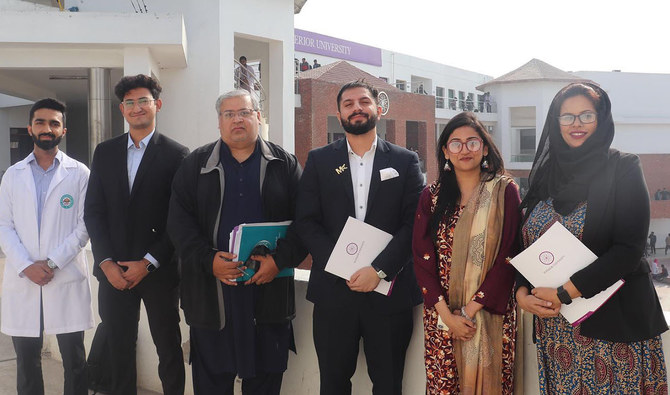
The photo posted on May 16, 2022, shows the founder of MedAngle Dr. Dr. Muhammad Azib (center) with his team at Azra Naheed Medical College in Lahore, Pakistan. (Photo courtesy: MedAngle/Facebook)
Short Url
Updated 25 May 2023
Follow

Pakistani startup, with mainly local and Middle East users, makes it to Silicon Valley Elite 200

  • Dr. Muhammad Azib launched MedAngle, an innovative edtech firm in the field of medical sciences, in 2017
  • Over 62,000 medical students have been using the platform, most of them based in Pakistan and the Middle East

ISLAMABAD: The top official of a Pakistani startup, which found itself among the 2023 Global Silicon Valley (GSV) Elite 200 EdTech Companies this month, said on Wednesday he was planning to introduce a dedicated operating system to encourage technology-based education for aspiring medical professionals.

Launched in 2017, MedAngle is a digital platform for students of medical sciences and aims to help them explore, learn, practice, retain and review a wide range of concepts in their field through multiple-choice and verbal questions, along with detailed clinical studies. It was included among the prestigious GSV list which recognizes the contributions of top technology firms from across the world.

The founder of the startup, Dr. Muhammad Azib, a 29-year-old graduate of Dow University of Health Sciences in Karachi, said he wanted to assist aspiring medical professionals through innovative use of technology. Azib himself has participated in the Transcend Fellowship in Silicon Valley and the MIT-Harvard Medical School Global Healthcare Innovation and Stanford Graduate School of Business Seed Spark programs in recent years.

“After the success of our platform, we are now building an operating system for health education,” he told Arab News in an exclusive phone interview from Chicago. “No matter which medical or dental school a student is attending, our software will help everyone in any country or any medical school.”

Azib said his company wanted the operating system to assist students and medical professionals at all stages of their education and practice.

“Our platform is for everyone, whether they are students of medical, dental, veterinary, physiotherapy, or any other related field,” he added.

The MedAngle official said Pakistan was among the top five countries in the world in terms of the number of doctors it produced every year, but there was no personalized online medical education platform, not only in Pakistan but also in other developing countries.

“So, we got this idea to start a platform for future doctors, not only in Pakistan but also in other emerging economies,” he added.

Azib said MedAngle was the first Pakistani startup to be named in the top edtech companies in the world. He pointed out the GSV was the biggest international platform, representing the number one technology-based education services.

“GSV contacted us last year, and then we were shortlisted in January this year,” he said. “They announced our listing in April at an event in the United States.”

Azib said over 62,000 students were already using MedAngle service.

“Its subscription is currently by invitation only because we are trying to personalize it for every student according to their institution,” he said, adding the platform users had answered built-in questions over 50 million times.

“Out of these 62,000 members, around 10 percent belong to Middle Eastern countries,” he added. “We have a diverse team of 150 medical professionals globally, mostly from Pakistan and the United Arab Emirates.”

Speaking about the subscription cost, Azib said his company wanted to keep it low so every medical student could easily afford it.

“We tried to keep our platform affordable to all students, and the subscription charges are just Rs199 per month, which is less than a dollar,” he said.


Islamabad says surge in aircraft orders after India standoff could end IMF reliance

Updated 22 min 17 sec ago
Follow

Islamabad says surge in aircraft orders after India standoff could end IMF reliance

  • Pakistani jets came into the limelight after Islamabad claimed to have shot down six Indian aircraft during a standoff in May last year
  • Many countries have since stepped up engagement with Pakistan, while others have proposed learning from PAF’s multi-domain capabilities

ISLAMABAD: Defense Minister Khawaja Asif on Tuesday said Pakistan has witnessed a surge in aircraft orders after a four-day military standoff with India last year and, if materialized, they could end the country’s reliance on the International Monetary Fund (IMF).

The statement came hours after a high-level Bangladeshi defense delegation met Pakistan’s Air Chief Marshal Zaheer Ahmed Baber Sidhu to discuss a potential sale of JF-17 Thunder aircraft, a multi-role fighter jointly developed by China and Pakistan that has become the backbone of the Pakistan Air Force (PAF) over the past decade.

Fighter jets used by Pakistan came into the limelight after Islamabad claimed to have shot down six Indian aircraft, including French-made Rafale jets, during the military conflict with India in May last year. India acknowledged losses in the aerial combat but did not specify a number.

Many countries have since stepped up defense engagement with Pakistan, while delegations from multiple other nations have proposed learning from Pakistan Air Force’s multi-domain air warfare capabilities that successfully advanced Chinese military technology performs against Western hardware.

“Right now, the number of orders we are receiving after reaching this point is significant because our aircraft have been tested,” Defense Minister Asif told a Pakistan’s Geo News channel.

“We are receiving those orders, and it is possible that after six months we may not even need the IMF.”

Pakistan markets the Chinese co-developed JF-17 as a lower-cost multi-role fighter and has positioned itself as a supplier able to offer aircraft, training and maintenance outside Western supply chains.

“I am saying this to you with full confidence,” Asif continued. “If, after six months, all these orders materialize, we will not need the IMF.”

Pakistan has repeatedly turned to the IMF for financial assistance to stabilize its economy. These loans come with strict conditions including fiscal reforms, subsidy cuts and measures to increase revenue that Pakistan must implement to secure disbursements.

In Sept. 2024, the IMF approved a $7 billion bailout for Pakistan under its Extended Fund Facility (EFF) program and a separate $1.4 billion loan under its climate resilience fund in May 2025, aimed at strengthening the country’s economic and climate resilience.

Pakistan has long been striving to expand defense exports by leveraging its decades of counter-insurgency experience and a domestic industry that produces aircraft, armored vehicles, munitions and other equipment.

The South Asian country reached a deal worth over $4 billion to sell military equipment to the Libyan National Army, Reuters report last month, citing Pakistani officials. The deal, one of Pakistan’s largest-ever weapons sales, included the sale of 16 JF-17 fighter jets and 12 Super Mushak trainer aircraft for basic pilot training.